

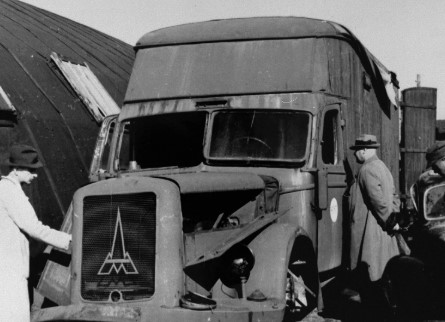
It isn’t widely known that long before the Third Reich allegedly created gas vans in circa 1940 – this is in truth a myth that has been exposed as false by revisionists – (1) but what isn’t widely known – largely because it doesn’t feature in most books on the Stalinist purges in the 1930s such as Robert Conquest’s renowned ‘The Great Terror’ – is that Stalin’s NVKD had created and operated gas vans (better known as ‘Dushegubka’ [lit. ‘Soul Killers’]) in the late 1930s which were used to murder his real or imagined opponents.
As Robert Gellately baldly summarizes it:
‘The Soviets sometimes used a gas van (dushegubka), as in Moscow during the 1930s.’ (2)
While Catherine Merridale is far more explicit when she writes how:
‘When it came to formal executions (as opposed to the slower deaths that took place in the camps), the preferred technique was usually a bullet in the back of the neck. About half a million people are thought to have died this way during the 1930s. It was industrial killing – quick, relatively bloodless, relatively clean – and the killer did not need to meet his victim’s eyes. Other methods were also used on an experimental basis. One policeman, Isai D. Berg, gassed some of his prisoners to death in batches in the back of a specially adapted airtight van. He then had them buried in the mass graves at Butovo, often in the trenches that other victims had already dug, where they already lay. It was a night’s work, a trip out from the city centre.
Burial sites, like execution methods, were secret yet not secret, hidden yet known. For Moscow’s police, the most secure were Butovo and Kommunarka, both several miles outside the city to the south.’ (3)
Now you probably immediately noticed that the NKVD officers associated with the creation and use of the Soviet gas vans was named Isai Berg, who was a jewish senior NKVD officer in the Moscow region and was the head of the ‘Administrative Economic Department’ of Moscow’s NKVD from mid-1937 (4) and who was put in command of the Butovo firing range in October 1937. (5)
We have testimony from Berg’s NKVD subordinates in 1937/1938 from 1956 – which was part of de-Stalinization process initiated by Khrushchev which including going through and cataloguing what had actually gone under Stalin’s rule – Nikolai Kharitonov and Fjodor Tschesnokov concerning these murders of Soviet dissidents and innocents to the effect that gas vans were very much Berg’s idea and that he both created them and actively supervised their operation. (6)
Essentially how it worked in practice was that the prisoners to be executed were loaded into the gas van(s) at the relevant NKVD and/or prison facility – being stripped naked, tied up, gagged and thrown in the back of the gas van – in the Moscow area then while the gas van was travelling to Butovo – which remember operated as one of the most secure body disposal sites in the entire Soviet Union – (7) the prisoners were gassed via the partially redirected exhaust. (8)
Now you might suggest this is problematic given what we know about the problems with using gas vans – and these could have been either petrol or diesel vans as we don’t know which was used – but the fact that they appear to have been not altogether that effective at murdering their human cargo tallies with Friedrich Berg’s studies on the subject. (9)
We know this because in 2005 Alexander Lipkov published the testimony of two different former NKVD officers from the period who testified to much the same thing as Kharitonov and Tschesnokov had in 1956.
To wit:
‘Mikhail Kirillin: The details of everything that happened here, we restored by talking with one person. There were no other survivors who would directly work in the zone. And now he is gone. This is the former commandant of the Moscow administration, who told all the details.
Lydia Golovkova: He told the following: cars loaded with people moved through the forest, up to 50 people were stuffed into a truck. Muscovites have long called these cars “dushegubka [soul killers].” In the case of Berg, who took part in the executions, of which there is his signature, he was accused as the inventor of these gas vans.
Alexander Mikhailov: According to the driver of such a truck, the gas was used to prevent the possibility of riot in the truck. Naturally, the people who swallowed carbon monoxide have been suppressed, and many of them accepted death as deliverance from the torment.
Lydia Golovkova: The exhaust pipe turned inside the van, and people came already half-conscious. Buses with half-dead people drove up from the side of the forest. There was a tower with a searchlight above the trees, the territory was surrounded by barbed wire, and there was a long wooden hut, where everyone was supposedly brought in for sanitation.’ (10)
For context Mikhail Kirillin and Alexander Mikhailov – presumably now dead – are the former NKVD officers while Lydia Golovkova is the historian interviewing them.
What they testify to – and Golovkova’s comments are also telling – is that ‘the former commandant of the Moscow administration’ (i.e., Isai Berg) told them that he had created the gas vans to ‘prevent the possibility of a riot’ during transport, but this is transparently false given that – as we have already seen – the prisoners were stripped naked, tied up and gagged in the back and given that there were fifty or so of them in each gas van at each time. Then the idea of there being some kind of ‘riot during transparent’ is just an obvious non-starter.
However, as Mikhailov remarks; the carbon monoxide – which suggests (although it doesn’t prove) Berg’s gas vans were using a petrol not a diesel engine given petrol engines produce far more carbon monoxide than diesel engines do (much of their exhaust is particulate rendering it particularly difficult as a method for mass execution) – (11) pumped back into the cargo compartment of the gas van killed most of those inside, while some were simply – to use Golovkova’s words – ‘half-dead’ by the time they arrived at Butovo where they were appropriately finished off by Berg’s subordinates. (12)
This is entirely inline with what has been suggested by revisionists in that gas vans are simply not a very good way of murdering people – especially if using a diesel rather than a petrol engine – and that re-directing only part of the engine’s exhaust back into the cargo compartment (or only for a limited time) as Berg’s gas vans were apparently designed to do would result in only partial success, because unless you know roughly how long it would take to kill your human cargo then there is a good possibility that some will still be alive when you arrive at your destination.
The rationale for why Berg created the gas vans for the NKVD is obvious when we note – as Kurt Schlogel does – that:
‘There was a regular competition to see who could deal with the most cases and at greater speed.’ (13)
He goes on to explain specifically that:
‘I. Berg, who was responsible for the implementation of the death sentences in Butovo has described the process.
All criminal cases (dela) were passed on by Semenov without comment, 400 to 450 trials in the troika, i.e. two trials every minute. It has to be said that Semenov competed with Jakubovich to see who was the faster… After a sitting, Semenov always went over to Jakubovich’s room and boasted that he had dispatched fifty cases more than him at the same time, and they were both delighted to have been able to pass sentence so quickly without even having glanced at the dossiers.
Those sentenced in this way were taken to the gaols in Moscow, where they were photographed from the side and from the front. The files were brought up to date and sent on to Butovo. The road to Butovo began for the condemned men and women with the signature of the Moscow NKVD commissar Stanislav Redens. M. Semenov and I. Berg were in charge of organization and logistics – transport from the gaols, execution and disposal of the bodies. They not only confirmed that the sentence had been carried with their signatures but also took part in the executions.’ (14)
Essentially Berg was engaged in ‘socialist competition’ (i.e., trying to one up and outshine your rivals as much as possible by sheer productivity) with his rivals in the Moscow NKVD: M. Semenov and Grigory Yakubovich (‘Jakubovich’) and one way to achieve that and outshine Semenov and Yakubovich to his boss Moscow NKVD chief Stanislas Redens was to come up with new faster and more efficient methods of murdering Soviet dissidents and innocents, which then resulted in Berg hitting on the idea of the gas vans and then creating and operating at least one during his tenure at Butovo.
It is also worth pointing out at this juncture that as far as I can work out Yakubovich was – like Berg – jewish, while Semenov was not and Redens was Polish although occasionally mistakenly claimed as having been jewish.
Additionally, we should note that Berg oversaw the executions at Butovo for roughly nine to ten months between October 1937 and 4th August 1938 as he had been arrested the day before (3rd August) by the NKVD. (15) Berg was subsequently shot by them on 3rd March 1939. (16)
The irony is – as Schlogel remarks – that:
‘After his arrest in 1938, I. Berg, the former head of the administration of the Moscow NKVD, was accused of having invented the dushegubki – i.e., the gas trucks – and he was sentenced for that.’ (17)
In essence Isai Berg was executed by the NKVD on the excuse that he invented and used gas vans to murder Stalin’s enemies which was someone a problem now, but that this paper-thin excuse to get rid of Berg as yet another NKVD official who ‘knew too much’ is patently obvious considering how frequently extremely senior figures in the NKVD visited Butovo under Berg’s command (18) and would have almost certainly known about (and approved of) his gas van(s) as they didn’t either complain about it or immediately rip Berg from his command as they could have done had they disapproved of his methods.
The only element left to discuss is how many people were gassed by Berg and his subordinates between Moscow and Butovo?
This is almost impossible to say and – as Gellately suggests – requires further research (19) but we know from limited archaeological excavations at Butovo in 1997 that there was at least one van load of victims since 55 of the 59 bodies found roughly dated to Berg’s time in charge of Butovo and don’t have the standard bullet wound to the back of the head/neck that is the hallmark of NKVD executions of this period (20) and thus are almost certainly victims of Berg’s gas van(s). (21)
The numbers are hard to estimate but if we assume for the sake of argument that Berg only managed to operate one gas van for one month gassing one load of fifty NKVD prisoners a day five days a week then that is 1,000 gassed men and women, while far more likely is that Berg was operating at least one gas van – possibly doing multiple loads – seven days a week for several months giving the total number of men and women gassed by Berg and his subordinates as something like 5,000 to 10,000.
This purely a guestimate on my part but never-the-less we can quickly see that the numbers add up quickly and the fact remains – as Schlogel implies – (22) that Berg had more than one gas van and it would make perfect sense if he did, but we have no direct evidence that as of yet he had – or operated – more than one.
Thus, we can see that Stalin had gas vans, had people murdered in said gas vans and also that said gas vans were the creation of a jewish NKVD officer who then oversaw the murder of potentially thousands of men and women for real and imagined political crimes.
We can therefore label Isai Berg as exactly what he was: Stalin’s Willing Executioner.
References
(1) On this see: https://web.archive.org/web/20230217010907/http://inconvenienthistory.com/5/1/3203
(2) Robert Gellately, 2007, ‘Lenin, Stalin, and Hitler: The Age of Social Catastrophe’, 1st Edition, Jonathan Cape: London, p. 460
(3) Catherine Merridale, 2000, ‘Night of Stone: Death and Memory in Twentieth Century Russia’, 1st Edition, Penguin: New York, p. 200
(4) Alexander Vatlin, 2016, ‘Agents of Terror: Ordinary Men and Extraordinary Violence in Stalin’s Secret Police’, 1st Edition, University of Wisconsin Press: Madison, p. 11
(5) Tomasz Kizny, 2013, ‘La grande terreur en URSS 1937–1938’, 1st Edition, Les Editions Noir sur Blanc: Paris, p. 236
(6) Idem.
(7) Merridale, Op. Cit., p. 200
(8) Kizny, Op. Cit., p. 236
(9) Cf. Friedrich Berg, 2015, ‘Nazi Gassings: Thoughts on Life & Death’, 1st Edition, CreateSpace: Internet
(10) Alexander Lipkov, 2005, ’I Will Grow You Like Grass…’, Continent, Vol. 123 (available at: https://magazines.gorky.media/continent/2005/123/ya-k-vam-travoyu-prorastu.html)
(11) Cf. Berg, Op. Cit.
(12) Kizny, Op. Cit., p. 236
(13) Kurt Schlogel, 2012, ‘Moscow, 1937’, 1st Edition, Polity: Cambridge, p. 481
(14) Ibid., pp. 481-482
(15) Kizny, Op. Cit., p. 236; Valtin, Op. Cit., p. 67 also see https://www.sciencespo.fr/mass-violence-war-massacre-resistance/fr/document/butovo-shooting-range.html
(16) Kizny, Op. Cit., p. 236
(17) Schlogel, Op. Cit., p. 482
(18) Idem.
(19) Gellately, Op. Cit., p. 460
(20) Merridale, Op. Cit., p. 200
(21) Kizny, Op. Cit., p. 236
(22) Schlogel, Op. Cit., p. 482
Karl’s SubstackRead More



 R1
R1
 T1
T1


