
A controversial plan to release genetically modified mosquitoes in Queensland is on hold after a huge backlash driven by concerns about potential health and ecological impacts.
Oxitec Australia, a joint venture between the Commonwealth Science and Industrial Research Organisation (CSIRO) and UK-based biotechnology firm Oxitec, which is funded by Bill Gates, has now withdrawn its licence application, saying more local research was needed.
A CSIRO spokesperson said the decision was not related to concerns about the technology, but about the “necessary financial requirements of holding a licence”, saying a second application may be submitted following further research, ABC News reported.
The venture aimed to curb dengue fever by using Oxitec’s commercialised genetically engineered male mosquitoes, which carry a self-limiting gene that ensures only non-biting males survive are released into the wild, reducing pest females and overall mosquito numbers.
The trademarked lab-made mosquitoes also contain a fluorescent gene that makes them able to be easily identified.

 Aedes aegypti mosquito technology (CSIRO)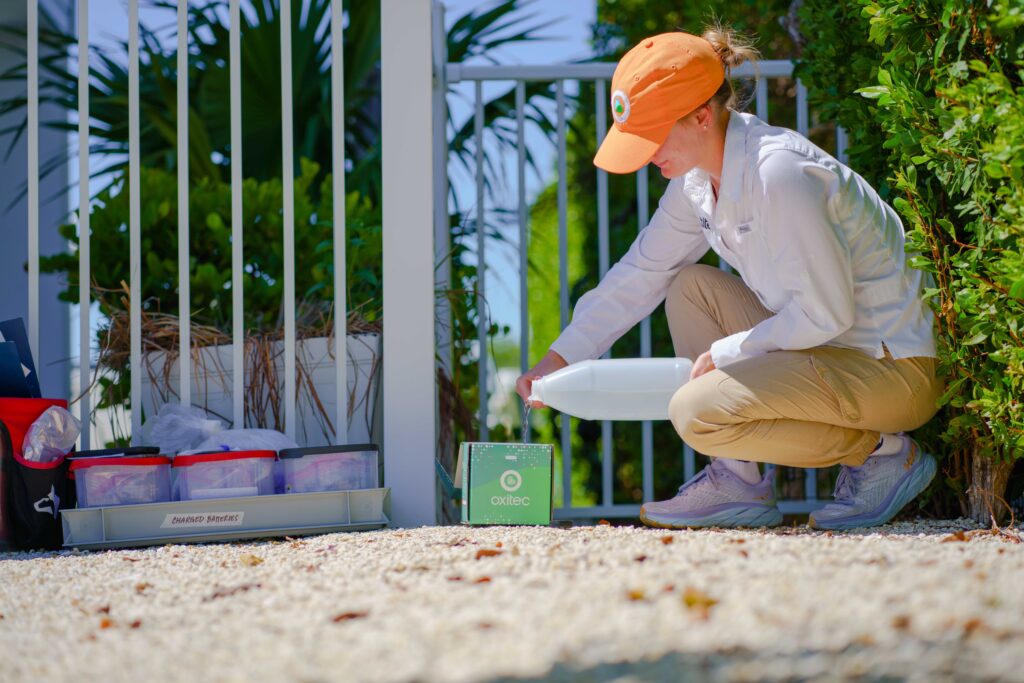
But the plan sparked concerns due to the involvement of former Chief Health Officer of Victoria, Brett Sutton, and the One Health Special Interest Group within the Public Health Association of Australia (PHAA) also warned GM mosquitoes could create “wide-ranging unintended consequences”.
Professor Sutton, who led the state’s bungled response to the Covid pandemic and used emergency powers to impose the world’s longest lockdown on Melbourne along with draconian human rights-violating restrictions, is now Director of Health & Biosecurity at CSIRO and a key figure in Oxitec Australia.
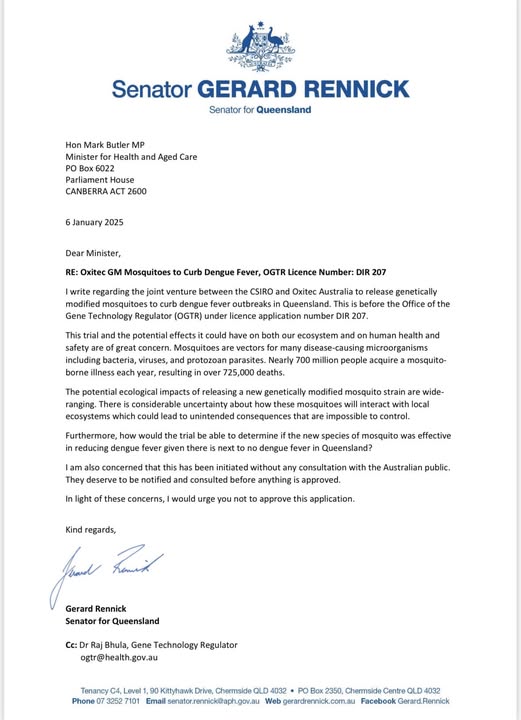
Then-senator Gerard Rennick wrote to Health Minister Mark Butler in January, and pointed out that dengue fever was almost non-existent in Queensland, and that there had been no public consultation.
PHAA co-convener Andrea Britton said Queensland already had a successful mosquito control system, and her association was worried the GM plan could disrupt it, and raised concerns about how the mosquitoes would affect the ecosystem when their eggs entered the food chain.
University of Melbourne mosquito biologist Perran Ross also welcomed the withdrawal of the application saying, saying he thought there was “a few issues” with importing a mosquito strain from Mexico into Australia without testing in the local environment.
In January Professor Sutton told ABC News the technology had been used successfully in Brazil, and that the process involved placing factory-made mosquito eggs into a box with water and allowing them to hatch and interbreed with existing mosquito populations.
He said the “product” that targeted Aedes aegypti, an invasive African mosquito that can spread dengue and is already established in northern and central Queensland, was “ready to go”, but needed government approval before it could be released.
“It needs to get through our Office of Gene Technology regulator before it can be rolled out,” he said.
“It’s a bit like the TGA [Therapeutic Goods Administration] for our medicines, but it’s looking at genetically modified products, and it needs to go through the same type of rigorous process.”
In 2021 the TGA approved the Oxford–AstraZeneca Covid vaccine, but it was later withdrawn for people under 60 due to the risk of blood-clotting and is no longer being produced.
Just two months before the federal government raised the age limit for the AstraZeneca jab, Professor Sutton declared that flying to Europe was riskier for clotting while urging Victorians to get injected with the product.
Dengue deaths are extremely rare in Australia.
Oxitec received a $1,415,894 grant from the Bill & Melinda Gates Foundation in 2020, and has carried out genetically engineered mosquito field trials in Brazil, Malaysia, Panama, and the United States.
Header image: Left, An Oxitec worker holding a box of genetically engineered mosquito eggs. Right, an Asian Tiger mosquito on skin. (CSIRO)
The post Plan to release genetically modified mosquitoes paused after huge backlash first appeared on The Noticer.
The NoticerRead More



 R1
R1
 T1
T1


