
Futures Rise For 10th Day In Past 11 With Fed Rate Cut Looming
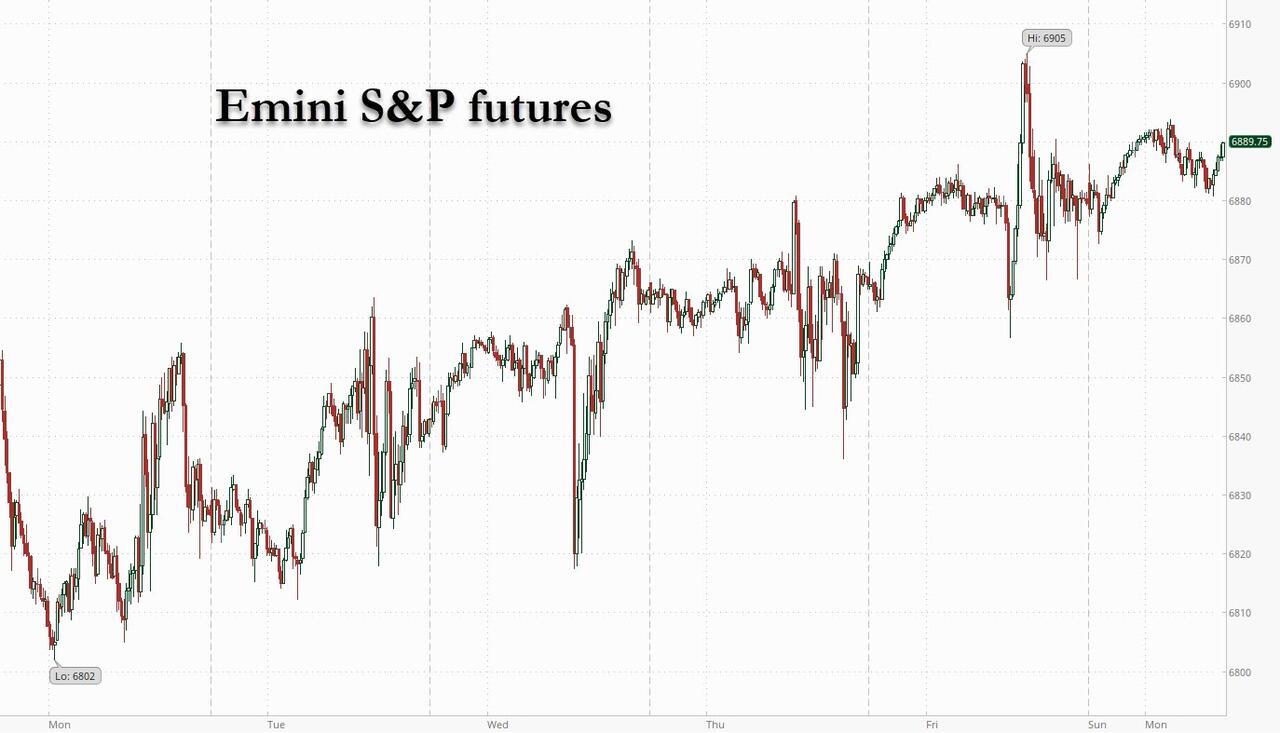
With just 17 trading sessions left in 2025, stock futures edge higher again and are on pace for 10 gains in the past 11 days. S&P 500 futures were up 0.2% as of 5:32 a.m. in New York, with Nasdaq 100 contracts +0.3%. Pre-market, Mag 7 are mostly unchanged except for a -1.3% decline in TSLA on a downgrade from Morgan Stanley. Most Asian markets clock firm start to the week, while European markets are mixed. Bond yields are 1-2bp higher and the USD is flat after reversing an earlier drop. Commodities are mixed: oil and most base metals are down small, while precious metals are higher. Over the weekend, there were several corporate headlines: (i) MSFT is considering shift custom chip business to Broadcom from Marvell (The Information). (ii) Trump warned the Netflix-Warner deal may post antitrust problem (BBG); (iii) IBM close to buy Confluent. A Fed cut on Wednesday looks like a done deal, but the trajectory after that is less clear. JPMorgan’s Mislav Matejka warned that the recent stock rally could stall after the decision. The Fed is also expected to restart “Reserve Management Purchases” ($45BN per month), which according to BofA’s Mark Cabana is not priced in; we also get earnings from Oracle and Broadcom, which may provide an end-of-year test for the AI narrative.
In premarket trading, Mag 7 stocks are mixed, with Tesla an outlier to the downside following a downgrade by Morgan Stanley from OW to EW (Amazon +0.3%, Nvidia +0.2%, Alphabet -0.1%, Microsoft +0.07%, Meta -0.1%, Apple -0.3%, Tesla -1.3%)
- Agios Pharmaceuticals (AGIO) falls 3% after saying that the FDA has not yet issued a regulatory decision on the supplemental new drug application for mitapivat in thalassemia.
- Carvana (CVNA) rises 9%, CRH (CRH) gains 7% and Comfort Systems USA (FIX) climbs 1% after S&P Dow Jones Indices said they will join the S&P 500 Index before trading opens Dec. 22.
- Confluent (CFLT) is up 28% after the the Wall Street Journal reported International Business Machines Corp. is in advanced negotiations to acquire the data infrastructure firm.
- CoreWeave (CRWV) drops 5% after announcing a $2 billion convertible senior notes offering.
- Fluence Energy (FLNC) falls 4% after Mizuho Securities analyst Maheep Mandloi cut the recommendation to underperform, saying data-center opportunities are still early-stage.
- ITT (ITT) slips 3% after plans to sell 7 million shares to help fund a portion of its SPX Flow deal.
- Kymera Therapeutics (KYMR) rises 29% after the drug developer announced positive results from a Phase 1b clinical trial of KT-621.
- Tesla (TSLA) shares fall 1.4% in premarket trading as Morgan Stanley downgrades the electric-car maker to equal-weight from overweight, saying non-auto catalysts priced into the stock.
In corporate news, Trump raised potential antitrust concerns around Netflix’s planned $72 billion acquisition of Warner Bros. Discovery. IBM is in advanced negotiations to acquire data infrastructure firm Confluent for around $11 billion, the WSJ reported. Robinhood is set to enter the Indonesian market after signing deals to acquire two local brokerages. Unilever spinoff The Magnum Ice Cream Co. will start trading in New York today as part of a three-location listing.
US stocks have rebounded in recent weeks after some Fed officials – and especially vice chair John Williams – signaled they intend to cut rates for a third straight time on Wednesday. Still, the advance has been jittery as uncertainty over the pace of easing in 2026 and wariness about the sustainability of an AI-driven rally temper sentiment.
Investors are now looking ahead to 2026. Over three-quarters of asset managers polled in an informal Bloomberg survey are positioning for a risk-on environment through 2026. Among strategists, Oppenheimer AM’s John Stoltzfus is calling for an 18% rally in the S&P 500 next year, becoming the most optimistic forecaster among those tracked by Bloomberg for a third year running. Still, there are some nuances. Investors are rotating out of the tech behemoths that drove virtually all of this year’s rally in the S&P 500 and are snapping up shares of risky small companies and old-economy transportation names. Yardeni Research now recommends effectively going underweight the Mag 7 versus the rest of the S&P 500, expecting a shift in earnings growth ahead.
For stocks, interviews with 39 investment managers across the US, Asia and Europe showed that a vast majority of allocators were still positioning for a risk-on environment through next year. The thrust of the bet is that resilient global growth, further developments in artificial intelligence, accommodative policy and fiscal stimulus will deliver outsize returns.
Fabien Benchetrit, head of target allocation for France and southern Europe at BNP Paribas Asset Management, said he remains bullish on 2026 but isn’t planning to increase his stock exposure before year-end. “Like other market participants, we’ve had a good year and it doesn’t make much sense to do it when liquidity typically dries up in the last two weeks of December,” he said. “In terms of AI, 2025 was all about capex, but 2026 will be about these investments delivering revenues, profits and productivity gains.”
Unease that inflation remains too high has also caused divisions among Fed officials, in a rift that’s been exacerbated by the lack of fresh data during the shutdown. After this week’s likely cut, money markets are leaning toward two more moves by the end of 2026, down from three signaled barely a week ago.
While a resilient economy, seasonal support and catch-up positioning are supporting stocks, key risks still loom for investors, said Daniel Murray, deputy chief investment officer and global head of research at EFG Asset Management. Those include “that the Fed is less dovish than investors currently assume,” Murray said, along with “a delayed tariff impact that sees inflation higher for longer and cracks starting to widen in the labor market.”
“The tone of Chair Powell’s press conference and accompanying statement will be critical,” wrote Deutsche Bank AG strategist Jim Reid. “We expect Powell to emphasize that the hurdle for further cuts in early 2026 is high, signaling a near-term pause. This guidance will be key to maintaining credibility.”
The Stoxx 600 is little changed as gains in industrial and insurance shares are offset by losses in consumer products and chemicals. Here are some of the biggest movers on Monday:
- Kloeckner shares climb as much as 27% in Frankfurt, the most since 2008, after the firm said Worthington Steel was conducting due diligence with a view to a potential takeover of the German metals company.
- Galderma shares rise as much as 4.5%, touching a record high, after L’Oreal announced plans to double its stake in the Swiss dermatology firm to 20%.
- FlatexDEGIRO shares rise as much as 5.9% after Berenberg raised its price target on the online brokerage firm.
- AUTO1 shares rally as much as 5.4% after Jefferies initiated coverage of the digital platform for buying and selling used cars with a buy recommendation.
- Absa shares rise as much as 4.8% in Johannesburg, to their highest intraday level on record after the bank said it expects mid-single digit revenue growth in 2025, with stronger growth in non-interest income than net interest income.
- GEA Group shares sink as much as 5%, to their lowest level since April, after Morgan Stanley downgraded the equipment supplier for the food processing industry to underweight.
- Ferrari shares fall as much as 3% after Morgan Stanley downgraded the Italian luxury car maker to equal-weight on account of its decision to strictly limit volume growth until 2030.
- Embracer falls as much as 33% as shares in the Swedish game company traded without rights to the upcoming spinoff of its Coffee Stain Group subsidiary.
- Schott Pharma shares drop as much as 6.8% to the lowest level on record after analysts at Barclays and Deutsche Bank downgraded their ratings on the stock, saying the 2026 fiscal year will be a “transition year” for the German pharma packaging company.
Earlier in the session, Chinese indexes rally after local media reports leverage limit hike for brokerages, and the Politburo pledges more proactive macroeconomic policies. The ChiNext soars more than 3% and the CSI 300 gains about 1.2%. Topix, Taiex and Kospi are also in the green. Hang Seng slides almost 1%.
In FX, the Bloomberg Dollar Spot Index is flat. EUR/USD rose to session highs after ECB’s Schnabel said she is comfortable with investor bets that the next interest-rate move will be an increase. The yen eases back to around 155.50/USD. Offshore yuan stays marginally stronger after a strong trade report.
In rates, treasuries outperform their European counterparts but are still in the red. US 10-year borrowing costs climb 2 bps to 4.15%. Europe led declines in global bond markets after the European Central Bank’s Isabel Schnabel became the first senior official to suggest with any certainty that European rates have reached a floor, and she is comfortable with investor bets that the next interest-rate move will be an increase. German 10-year yields rise 4 bps to 2.84%. Gilts also drop, pushing UK 10-year yields up 4 bps to 4.52%. Japanese bond yields rose across the curve after data showed that the economy shrank in the three months through September, giving some justification for Prime Minister Sanae Takaichi’s stimulus package announced last month. The figures add an element of complexity to the Bank of Japan’s policy decision next week, but likely won’t derail it from its gradual hiking path. Aussie bonds remain heavy as 10-year yield hits a two-year high ahead of Tuesday’s RBA decision. JGB futures are tightly rangebound following lackluster GDP report.
In commodities, WTI crude futures fall 1% to near $59.50 a barrel. Brent crude futures pause around $63.90 and gold rises back above $4,210 an ounce. Spot gold adds $10 while Bitcoin rises 1.9% to around $92,000.
Today’s economic calendar includes November NY Fed 1-year inflation expectations at 11am
Market Snapshot
- S&P 500 mini +0.1%
- Nasdaq 100 mini +0.2%
- Russell 2000 mini +0.4%
- Stoxx Europe 600 little changed
- DAX +0.2%
- CAC 40 little changed
- 10-year Treasury yield +1 basis point at 4.15%
- VIX +0.8 points at 16.22
- Bloomberg Dollar Index little changed at 1211.98
- euro little changed at $1.1652
- WTI crude -0.9% at $59.54/barrel
Top Overnight News
- Donald Trump said Netflix’s planned $72 billion acquisition of Warner Bros. Discovery may pose antitrust concerns, warning that the combined entity’s market share “could be a problem.” He confirmed he met with Netflix co-CEO Ted Sarandos recently. BBG
- Trump plans to unveil a $12 billion farm aid package today, including one-time payments for crop farmers hit by low prices amid slow Chinese purchases. Advisers are also weighing measures to curb soaring beef prices, including reopening the border to Mexican cattle. WSJ
- Trump signed a Presidential Memorandum directing the HHS to fast-track a comprehensive evaluation of the vaccine schedules from other countries around the world, and better align the US vaccine schedule.
- White House said it will establish food supply chain security task forces to protect competition.
- US Treasury Secretary Bessent said the US will finish the year with 3% GDP growth.
- China’s trade surplus in goods this year topped $1 trillion for the first time, a milestone that underscores the dominance that the country has attained. For the first 11 months of the year, China’s exports increased 5.4% from the year-earlier period to $3.4 trillion, while the country’s imports declined 0.6% over that same stretch to $2.3 trillion. WSJ
- China’s annual car sales dropped 8.5% in November in a second straight monthly decline, for their biggest fall in 10 months, data showed on Monday, amid a waning scramble to buy vehicles before government subsidies dwindle at year-end. RTRS
- Japan’s real wages shrank for the 10th consecutive month in October, with an uptick in nominal pay falling short of taming relentless consumer inflation, government data showed on Monday.
- Thailand has launched air strikes on Cambodia after border clashes that killed on Thai soldier, marking the collapse of a Trump brokered peace deal between the south east Asian neighbors. FT
- Industrial production in Europe’s largest economy continued to accelerate in October, with the sector showing further signs of stabilization as it awaits large-scale government investment. October came in at +1.8% M/M (vs. the Street +0.3%). WSJ
- Sen. Bill Cassidy (R-La.) said he planned to present Republican leadership with his health care plan as soon as Sunday night, predicting that the divisive proposal to put money directly in Americans’ health savings accounts could clear the 60-vote threshold needed to pass in the Senate. Politico
- IBM is in advanced talks to acquire data-infrastructure company Confluent (CFLT) for around $11 billion, according to people familiar with the matter. A deal could be announced as soon as today. WSJ
- Following an 11% drawdown this fall, Consumer Discretionary stocks have rebounded by 7% during the past two weeks. The combination of hawkish Fed commentary, weak labor market data, declining consumer sentiment, and downbeat corporate commentary contributed to a sell-off in Consumer Discretionary stocks between early September and mid-November. During the past two weeks, however, consumer stocks have rebounded, with the equal-weight S&P 500 Consumer Discretionary sector outperforming the equal-weight S&P 500 by 2%: Goldman
Trade/Tariffs
- US President Trump said we’ll work it out, when asked if he would restart trade talks with Canada, while it was separately reported that the Canadian PM’s office said PM Carney agreed with US President Trump and Mexican President Sheinbaum to keep working together on the trade deal.
- USTR said China’s trade commitments are going in the right direction and that they are seen to be in compliance so far.
- French President Macron warned that the EU could hit China with tariffs if nothing is done to reduce its widening trade deficit with the EU, according to Les Echos.
- EU is to expand the carbon border tax to garden tools and washing machines, as it seeks to close loopholes in the law to prevent carbon-intensive imports, according to FT.
- US Embassy in India said US Under Secretary of State for Political Affairs Allison Hooker will visit New Delhi and Bengaluru, India, on December 7th-11th.
- German Foreign Minister said a lot of work is still needed to persuade China to issue general export licenses for rare earths.
- China’s Vice Commerce Minister said he welcomes EU automakers to continue to invest in China. Urges Germany and the EU auto association to push the EU Commission to resolve the EV anti-subsidy case. On Nexperia, he said the root cause of chaos in the global semiconductor supply chains lies in the Netherlands.
A more detailed look at global markets courtesy of Newsquawk
APAC stocks were mixed following a lack of major macro drivers over the weekend and with markets tentative ahead of this week’s risk events, while participants also digested data, including the latest Chinese trade figures. ASX 200 was subdued amid somewhat mixed trade data from Australia’s largest trading partner and as the RBA kick-started its 2-day policy meeting. Nikkei 225 traded indecisively following a slew of mixed data from Japan, including firmer-than-expected Labour Cash Earnings and disappointing revisions to Q3 GDP, while sentiment was also clouded by geopolitical tensions after Japan accused Chinese fighter jets of aiming military radar at Japan’s Self-Defence Force jets. Hang Seng and Shanghai Comp were mixed with the Hong Kong benchmark underperforming as gains in tech were overshadowed by losses in the big banks, while participants also digested the latest Chinese trade data, which showed a stronger-than-expected recovery in Exports but Imports disappointed.
Top Asian News
- China’s Politburo held a meeting on the economy and reiterated its stance that monetary policy is to be moderately loose, with fiscal policy being more proactive, while it stated that the economic operation is generally stable and it will implement more active macro policies. Furthermore, it will continue to prevent and resolve risks in key areas, as well as stabilise employment, markets, and enterprises’ expectations.
- Hong Kong held its legislative election on Sunday to elect 90 Legislative Council members from the 161 government-vetted candidates.
- Australia Treasurer Chalmers said they will not extend electricity rebates and that the mid-year review will not be a mini budget, while he added that the review will include savings.
- BoJ Governor Ueda to attend Japan’s lower house budget committee from 05:35-06:05 GMT on Tuesday, according to a parliamentary source cited by Reuters.
- Chinese President Xi held a meeting with non-party members on the economy, according to Xinhua, and said China to stabilise jobs and markets. said 2025 has been unusual and will smoothly meet the main targets. To reinforce economic growth momentum. Economic goals will be achieved this year. To drive reasonable economic growth.
- China’s auto industry body CPCA said China sold 2.24mln passenger cars in November, down 8.5% Y/Y; Tesla (TSLA) exported 13,555 China-made vehicles (prev. 35,491 in October).
- Indonesian Finance Minister said the nation is to impose a coal export tax near year between 1% and 5%.
European bourses (STOXX 600 +0.1%) began the morning mixed, with a slight negative bias. Since the open, indices have held an upward bias with some climbing marginally into the green. European sectors are mostly lower. Industrials and Tech hold towards the top of the pile, whilst Real Estate and Media lags a touch. In terms of a key story, BNP Paribas (+0.7%) is to sell its stake in AG insurance to Ageas (+2.2%) for EUR 1.9bln.
Top European News
- UK PM Starmer said former Deputy PM Angela Rayner will return to the cabinet after resigning in September, while he described her as “hugely talented”.
- Tony Blair is reportedly exploring alternative Labour leadership options amid frustration with UK PM Starmer’s direction, according to The Times.
- ECB’s Schnabel said she is ‘comfortable’ on bets that next move will be a hike. Later on, she also said she would be ready to succeed President Lagarde if she were asked to, via Bloomberg. She said the euro economy is on course to grow above potential despite the headwinds, and the economic outlook has brightened and the downside risks to growth have been reduced significantly, and uncertainty has come down quite quickly, which should further support future economic activity. The global economy and global trade have proven to be more resilient. On inflation, she said it’s in a good place. It’s currently around 2%, and we also project medium-term inflation to be around 2%. Volatile energy prices and related base effects may push headline inflation temporarily below our target. Services inflation has been much stickier than expected. The downward pressure on goods inflation due to a stronger euro, lower energy prices and potential trade diversion from China has been weaker than expected. On policy, she said interest rates are in a good place. Rather comfortable with those expectations of the next move being a rate hike. A first rate hike in June 2026 remains very uncertain.
- ECB’s Rehn said the ECB is concerned about central bank independence in the US, via Econostream. Adds that Fed independence is an important issue for “all of us globally”. On an insurance cut, said “we are not in the insurance business, not in December, March or June”. Inflation expectations have remained quite well anchored around the 2% target. German spending to have a “formidable positive impact” on Germany and the Euro area.
- ECB’s Rehn said they must be aware of upside and downside inflation risks, while he added that inflation risk is slightly tilted to the downside in the medium-term. Furthermore, he said they should not impose unnecessary bars or floors on policy, and that the position on interest rates is not fixed.
- French President Emmanuel Macron called for a change in the ECB’s approach to monetary policy to boost the single market and protect it from the risks of a financial crisis, while he commented that reasserting the value of the European internal market means it can’t let inflation be its sole objective, but also growth and employment.
- European Commission may announce a package to support the auto industry on December 16th, according to industry sources.
- German Chancellor Merz and French President Macron are set to discuss the fate of the Franco-German fighter jet project FCAS in the week of December 15th, according to an industry source.
- Germany’s auto industry body VDA said it expects 2026 registrations to rise 2% to 2.9mln. Electric car sales in Germany to jump 17% to 979k in 2026. Expects the nation to remain the world’s second-largest EV producer in 2026.
- French Socialist Party (PS) leader Faure said the party will vote for the French budget’s social security programme.
FX
- DXY has now returned to flat territory after being dragged lower, but EUR strength as ECB hawk Schnabel said she is ‘comfortable’ on bets that the next move will be a hike, albeit not any time soon, according to Bloomberg. Little notable reaction was seen in ECB marking pricing throughout 2026, which remains unchanged for rates throughout the horizon, although the EUR strengthened and EZ yields rose.
- The Single Currency was also supported by surprisingly upbeat German Industrial Output data. EUR/USD hit a 1.1672 peak, matching Friday’s high, before waning back towards 1.1650 levels. Subsequently, DXY fell to a 98.79 trough before trimming losses back towards near-99.00.
- GBP is subdued by the EUR/GBP cross, which briefly eclipsed its 50 DMA (0.8751) from a 0.8726 low on the back of the aforementioned ECB commentary and data. GBP/USD meanwhile closed around its 200 DMA on Friday and traded below the level (1.3331) throughout most of today’s session. In terms of weekend UK newsflow, Tony Blair is reportedly exploring alternative Labour leadership options amid frustration with UK PM Starmer’s direction, according to The Times.
- Other G10s are largely flat with Antipodeans mixed following the Chinese Trade Balance data, which showed a stronger-than-expected recovery in Exports but Imports disappointed. Thus, AUD is subdued ahead of the RBA decision tomorrow, whilst NZD is among the better performers as AUD/NZD falls back after meeting resistance at 1.1500.
Fixed Income
- USTs are trading lower by a couple of ticks, having held a negative bias throughout the European morning. Nothing really much driving things for US paper this morning, and action appears to be following peers and in a continuation of Friday’s losses. Traders await the FOMC meeting mid-week, where a 25bps cut is widely expected – but likely to be subject to dissent from several board members. Back to price action, USTs are trading within a narrow 112-14 to 112-19 range, with today’s trough a tick below that made on Friday. Further pressure could see a retest of the trough made on 20th November at 112-10+.
- Bunds are also pressured, and to a larger magnitude than USTs (but less so than UK paper). The benchmark followed US paper overnight, and held a negative bias, before taking a leg lower on comments via Schnabel. The arch-hawk, speaking on Bloomberg, said that she is ‘comfortable’ on bets that the next move will be a hike, albeit not any time soon. In an immediate reaction, Bund Mar’26 fell from 127.98 to 127.80 over the course of around 5 minutes, before then extending to a trough of 127.74; from a yield perspective, the 10-year rose 3bps to 2.83%, levels not seen since March. Elsewhere, other ECB members have not impacted assets quite so much, with Rehn suggesting that “inflation expectations have remained quite well anchored around the 2% target.”, via Econostream. And finally on the data front, German Industrial Output M/M rose more than expected; ING’s Brzeski said “there are at least tentative signs of a bottoming out” in the German economy.
- Gilts underperform vs peers, and are currently down by around 40 ticks. Price action has been fairly muted this morning, gapped lower at the open and has resided at the bottom end of a 90.90 to 91.11 range. Pressure today in tandem with US/German paper, but with underperformance perhaps explained by ongoing domestic political updates. Focus has been on reports that Tony Blair is reportedly exploring alternative Labour leadership options amid frustration with UK PM Starmer’s direction, according to The Times. Moreover, perhaps some focus on political instability within the Labour Party as PM Starmer floats the return of Angela Rayner. Elsewhere, a KPMG/REC survey showed the UK labour market weakened further in November.
Commodities
- WTI and Brent oscillated in a tight USD 59.98-60.27/bbl and USD 63.63-63.94/bbl, respectively, throughout the APAC session. As the European session got underway, benchmarks failed to extend the highs of the APAC session and reversed lower to dip below USD 60/bbl and USD 63.50/bbl, despite a lack of crude-specific newsflow. Currently, benchmarks are extending on session lows as progress on a potential peace deal between Ukraine and Russia remains in focus.
- Spot XAU edged higher throughout the APAC session amid a weaker dollar ahead of Wednesday’s FOMC rate decision, in which the Fed is expected to cut rates by 25bps at its meeting on Wednesday. XAU hit a low of USD 4191/oz as the APAC session commenced and gradually traded higher to a peak of USD 4219/oz as the European session got underway. Data over the weekend showed that the PBoC increased its gold reserves for a 13th consecutive month.
- 3M LME Copper extended to a new ATH of USD 11.75k/t as China’s Politburo reiterated its stance that monetary policy is to be moderately loose, setting domestic growth as its top economic priority. This comes amid new demand, fuelled by AI infrastructure build and EVs, coming up against a tight global supply. China’s exports also rose in November to 5.9%, compared to the expected 3.8% and the October figure of -1.1%.
- UAE Energy Minister said overall demand for energy will increase, fossil fuels will be “a percentage of it”. Adds that natural gas is important and they intend to not only satisfy their local demand but also grow exports of their LNG. Agrees that natural gas demand is more than the projects they are seeing.
- Russia’s Kremlin said India buys energy where it is profitable to; as far as Russia understands, India will “continue to do that”.
- EU to delay proposals on carbon border tariff and proposals for automotive sector, including Co2 emissions to December 16th, according to a document seen by Reuters.
Geopolitics: Middle East
- Israeli PM Netanyahu said he will meet with US President Trump this month, while he said they believe there is a path to a workable peace with their Palestinian neighbours and that the sovereign power of security from the Jordan River to the Mediterranean will always remain in Israel’s hands. Furthermore, he said political annexation of the West Bank remains a subject of discussion, and the status quo in the West Bank will remain for the foreseeable future, as well as noted that they are close to the second phase of Trump’s Gaza plan.
- Palestinian PM Mustafa said Israel is stepping up the ‘creeping annexation’ of the West Bank and is intensifying efforts to make the West Bank unliveable and drive people out of the occupied territory, according to FT.
- Turkey’s Foreign Minister said Hamas is ready to hand over the Gaza administration to the Palestinian committee to advance the Gaza ceasefire deal. He also commented that Hamas disarmament in the first phase of the Gaza deal may not be a realistic and doable objective, while other steps are needed first.
- US, Israel and Qatar were reportedly holding a trilateral meeting in New York on Sunday to rebuild relations, according to Axios.
- A US official said the US is pushing Ukraine to agree “faster” to the peace plan, according to AFP.
Geopolitics: Ukraine
- Ukraine’s President Zelensky says no accord so far on Ukraine’s Donbas in US talks, via Bloomberg.
- Ukrainian President Zelensky said he had a substantive call with US envoy Steve Witkoff and Jared Kushner, while he stated they agreed on the next steps and format for talks with America, as well as noted that Ukraine is determined to continue working honestly with the US side in order to bring real peace. Zelensky separately commented that talks with US representatives on a peace plan were constructive but not easy.
- Ukrainian military conducted a strike on Russia’s Ryazan oil refinery.
- Russian Defence Ministry said Russian forces captured Kucherivka in Ukraine’s Kharkiv region and completed the capture of Rivne in Ukraine’s Donetsk region, while they carried out a group strike on Ukraine’s transport infrastructure facilities, fuel and energy complexes, and long-range drone complexes.
- Russia and China held their third joint anti-missile drills on Russian territory.
- Japanese Chief Cabinet Secretary Kihara said China’s claims about the Japan Self-Defence Force’s dangerous flight are inaccurate, while he added it is very important to gain an understanding of other countries, including the US, regarding Japan’s stance.
- Japan is reportedly frustrated at the Trump administration’s silence over the row with China and urged the US to give PM Takaichi more public support, according to FT.
- Australia’s Defence Minister Marles said they are deeply concerned about the actions of China following the air incident near Japan, while Marles discussed with Japanese Defence Minister Koizumi common serious concerns about the situation in the South China Sea and East China Sea. Furthermore, they discussed how to work together to maintain a free and open Indo-Pacific, while Marles also commented that they want the most productive relationship they can achieve with China.
- Pakistan and Afghanistan exchanged heavy fire in a border region on Friday.
- Thai Army spokesman said their military launched airstrikes in the disputed border area with Cambodia.
- The Chinese Foreign Ministry said China believes both countries can win from cooperation on the new US defence strategy. Also said it stands ready to work with the US to improve ties and that China will firmly defend its sovereignty.
- Rapid Support Forces confirms control of Heglig oil field, the largest oil field in Sudan, according to Sky News Arabia.
- Russia’s Kremlin said it welcomed the removal of Russia from the list of US direct threats in the new national security strategy.
Geopolitics: Other
- Japanese Defence Minister Koizumi said Chinese military planes directed radar at Japan’s self-defence forces twice. It was separately reported that Japanese PM Takaichi said the incident involving Chinese fighter jets directing radar at Japanese planes is extremely regrettable, while she said they will respond calmly and resolutely to the development.
US Event Calendar
- November NY Fed 1-year inflation expectations at 11am
DB’s JIm Reid concludes the overnight wrap
All roads this week will point to Wednesday’s FOMC. Markets and DB expect the Fed to deliver a final and third 25bps rate cut for 2025, making it 6 cuts and 175bps in this easing cycle since September 2024. The decision is unlikely to be unanimous, with dissent anticipated from both hawkish and dovish members. Should four or more officials break ranks, it would mark the largest split since 1992. Beyond the headline move, the tone of Chair Powell’s press conference and the accompanying statement will be critical. We expect Powell to emphasise that the hurdle for further cuts in early 2026 is high, signalling a near-term pause. This guidance will be key to maintaining credibility ahead of likely softer labour market data due later in December.
Beyond the Fed, the global calendar features several other central bank decisions and important data releases. Maybe tech earnings from Oracle (Wednesday) and Broadcom (Thursday) will be the most interesting, with the two names diverging considerably over the last couple of months. The former is down -34% over this period with the latter only -3% off its all-time-high seen a couple of weeks ago. In terms of central banks, the Reserve Bank of Australia meets tomorrow, where policymakers are expected to hold rates steady, but with a hawkish tilt likely after recent inflation increases. The January 7th inflation data could encourage markets to price in a hike as soon as February. The Bank of Canada follows on Wednesday, with the Swiss National Bank on Thursday with both expected to stay on hold. Canada saw a +16bps rise in 2yr yields on Friday after another strong labour market release with traders now suddenly, and fully, pricing in a hike by October next year. Meanwhile, the SNB are trying to avoid negative rates next year with rates now around zero.
Elsewhere, UK monthly GDP for October will be released on Friday, alongside German industrial production today and trade figures on Tuesday. China inflation is released on Wednesday where our economists expect CPI inflation to rise by 0.5ppt to 0.7% YoY and PPI to improve by 0.2ppt to -1.9% YoY. Nordic inflation prints are also due midweek, with Denmark and Norway publishing November CPI reports. Also watch out for the BoJ Ueda who speaks in London tomorrow ahead of a fascinating BoJ meeting next Friday just as the market winds down for Xmas.
Expanding further on the FOMC now, according to our economist’s preview here, the updated Summary of Economic Projections (SEP) should show only modest revisions. Growth forecasts for 2025 and 2026 are likely to be nudged higher, consistent with the October staff update, while inflation projections should be trimmed for this year and next. The unemployment path is expected to remain broadly unchanged. The dot plot should continue to point to one cut per year over the next two years, reinforcing the message that policy is approaching the neutral range (3.5–3.75%). Our economist’s baseline remains that the Fed stays on hold through the first half of 2026, with risks skewed towards another cut in Q1 if labour market weakness persists. Under new leadership later in the year, they anticipate a September cut as disinflation resumes, taking the trough in the fed funds rate to around 3.3%.
While the Fed dominates, a handful of other releases could provide additional nuance. Tomorrow brings combined September–October JOLTS data, offering a backward-looking snapshot of hiring and quits trends. Recent figures have underscored a “low hiring/low firing” dynamic, with private hiring at multi-year lows and quits subdued. Wednesday’s Employment Cost Index for Q3 is forecast at DB to hold steady at +0.9%, keeping annual growth around 3.6%. Thursday rounds out the docket with September trade numbers (-$69.6bn expected vs. -$59.6bn prior) and initial jobless claims (225k vs. 191k), the latter likely to increase after holiday distortions.
Asian equities are relatively quiet ahead of an important week. As I check my screens, the Nikkei is flat, impacted by Japan’s revised Q3 GDP data (details below). In other markets, Chinese stocks are diverging with the Hang Seng (-1.05%) lower, while the CSI (+1.05%) and the Shanghai Composite (+0.67%) are higher, buoyed by better-than-expected China exports and a larger trade surplus compared to the previous month. Additionally, the KOSPI (+0.77%) is also rising. S&P 500 (+0.18%) and NASDAQ 100 (+0.25%) futures are both trading higher.
Returning to China, outbound shipments increased by +5.9% year-on-year in November, surpassing market expectations for +4.0% growth, marking a recovery from an unexpected -1.1% decline in October — the first contraction since March 2024. Imports rose by +1.9% last month, falling short of the anticipated +3.0% increase, as a prolonged housing downturn and rising job insecurity continued to hinder domestic consumption. This growth was an improvement compared to the 1% recorded in October. Elsewhere, in Japan, the revised annualised Q3 growth contraction was reported at -2.3%, compared to an earlier estimate of -1.8% and a market forecast of a -2.0% decline.
On a quarter-on-quarter basis, GDP decreased by -0.6%, which is steeper than the initial -0.4% contraction and exceeded the forecast of a -0.5% decline. Separately, real wages fell by -0.7% in October compared to the previous year, a slower decline than the revised -1.3% drop in September, but it extended a losing streak that began in January. Meanwhile, average nominal wages, or total cash earnings, rose by +2.6% year-on-year in October, marking a three-month high that followed a +2.1% increase in the previous month.
In bond markets, yields on the 10-year Australian government bonds are +2.2bps, reaching 4.71%, marking the highest level in two years in anticipation of the RBA meeting tomorrow. New Zealand’s 10-year government bond are +8.8bps. 10 and 30yr JGBs are +2bps and +3bps higher respectively.
Recapping last week now and markets continued to grind higher, with the S&P 500 (+0.31%; +0.19% Friday), NASDAQ (+0.91%; +0.31% Friday), and the STOXX 600 (+0.41%; -0.01% Friday) all edging higher. The Mag-7 (+1.40%; +0.35% Friday) was boosted by strong performances from Tesla (+5.77%; +0.10% Friday) and Meta (+3.93%; +1.80% Friday), the latter on a Bloomberg report of budget cuts up to 30% for its metaverse division. In contrast, Microsoft fell -1.80% (+0.48% Friday) amid a press report of lowered AI sales quotas, which the company subsequently denied. The overall risk-tone saw the VIX volatility index (-0.55pts) fall to a two-month low of 15.41, and credit spreads tighten, with both US IG (-3bps) and HY (-5bps) rallying.
On the data front, we saw mixed US labour market releases, as the ADP report showed US private payrolls falling by 32k in November (vs. +10k expected) driven by highest job losses for small businesses since the pandemic (-120k) but weekly initial jobless claims (191k vs. 220k expected) painted a more robust picture, although Thanksgiving distortion likely dominated. In terms of survey releases, ISM services was slightly stronger than anticipated at 52.6 (vs. 52.0 expected), while its prices paid component fell to a seven-month low of 65.4 (vs. 68.0 expected). And on Friday, the University of Michigan consumer sentiment (53.3 VS 51.0 expected) rebounded from its November slump as 5-10 year inflation expectations (3.2% vs 3.4% expected) fell to their lowest since January.
While a December Fed rate cut is more than 95% priced, the conflicting data drove a hawkish adjustment further out with the amount of cuts priced by end-26 declining by -9.3bps (-3.4bps Friday). This led to a rise in Treasury yields, with the 2yr yield up +7.0bps to 3.56%, while the 10yr saw its biggest weekly sell-off since April (+12.1bps to 4.14%, +3.7bps Friday). Higher yields were also driven by developments in Japan, as comments from BoJ Governor Ueda led investors to anticipate a December rate hike. 10-year JGB yields rose by +13.5bps to a post-2008 high of 1.94% and 30-year yields by +1.5bps to 3.35%, its highest since the tenor was introduced in the late-1990s.
In Europe, 10yr bunds (+10.9bps), OATs (+11.4bps), and BTPs (+8.5bps) joined the global bond sell-off. That came as the Euro Area flash CPI for November was higher than expected at +2.2% (vs. +2.1% expected), while the composite PMI was revised up to 52.8, its highest in two-and-a-half years. The data supported modest equity gains, with the DAX +0.80% higher though the CAC 40 (-0.10%) was marginally lower. European credit spreads were also tighter for both IG (-6bps) and HY (-8bps).
In commodities, Brent crude saw a modest rally of +2.20% to $63.75/bbl, as no concrete plans for a ceasefire in Ukraine emerged. Cryptocurrencies experienced a volatile week. Bitcoin ended the week down -1.88%, but that included a -5.19% move on Monday and +5.97% on Tuesday. Gold was down -0.98% to $4,198/oz following an almost 5% rally the previous week.
Tyler Durden
Mon, 12/08/2025 – 08:42ZeroHedge NewsRead More


 R1
R1
 T1
T1


