
Futures Flat With Fed/Oracle Event Bonanza On Deck
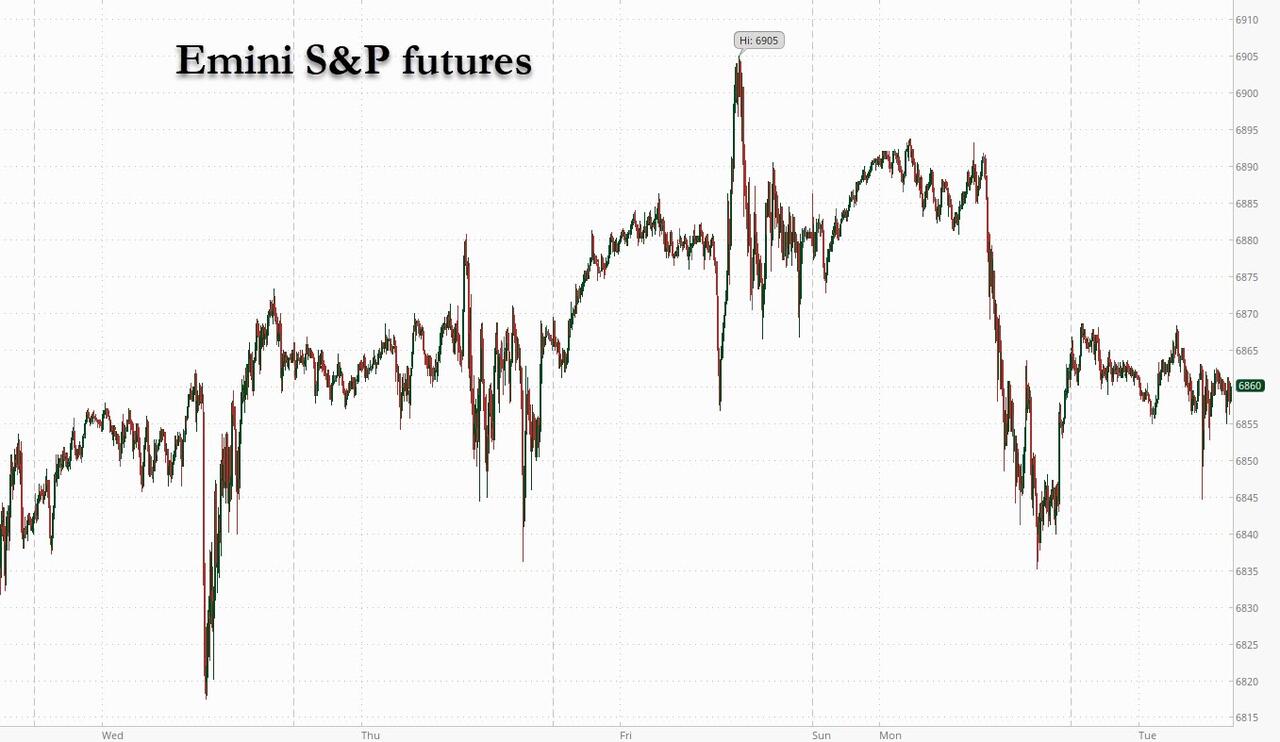
US futures are unchanged, with traders looking forward to two market-moving events on Wednesday: the Fed meeting (where 22bps of easing is priced in) and Oracle results. As of 8:00am ET, S&P 500 futures and Nasdaq 100 contracts are little changed. Pre-market, Mag 7 are mostly lower except for a 0.5% gain in NVDA: TSLA -0.9%, META -0.5%, GOOGL -0.3%. Since yesterday’s close, incremental macro headlines were largely muted. Headlines on NVDA’s likely H200 shipment approval drove gains in stocks both during Monday trading session and pre-market today. In addition, there was an article on China is set to limit access to NVDA’s H200 chips this morning. Bond yields are fractionally lower, while the USD reverses earlier losses and is flat. Commodities are mixed: oil and previous metals are higher, while base metals and Ags are lower. Key focus today are Small Business Optimism and JOLTS.
In premarket trading, Mag 7 stocks are mostly lower: Nvidia up 0.1%, paring earlier gains, after the FT reported that China’s regulators are discussing ways to limit permits for access to its H200 semiconductors (Amazon +0.1%, Microsoft +0.1%, Apple -0.1%, Alphabet -0.2%, Meta -0.6%, Tesla -0.9%).
- Almonty Industries (ALM) is down 14% to $6.79 after the company priced 18 million shares at $6.25 each for $112.5 million in gross proceeds.
- Ares Management (ARES) rises 8.1% after S&P Dow Jones Indices said the stock will replace Kellanova in the S&P 500, effective Dec. 11.
- Toll Brothers Inc. (TOL) falls 4.6% after the luxury builder beat analysts’ estimates for quarterly orders, while providing full-year guidance for 2026 that fell below expectations.
- Viking Holdings (VIK) rises 2.3% after Goldman Sachs upgraded the cruise operator to buy from neutral. Meanwhile, peer Norwegian Cruise Line Holdings (NCLH) falls 2.5% as the bank downgraded the stock to neutral from buy.
US stocks may be more volatile after tomorrow’s Fed meeting than after other recent decisions because of diverging views among Fed officials, with Bloomberg options data showing an implied move of 0.7% in either direction. Globally, central banks are starting to tilt more hawkish, upending yields. Meanwhile, while buyside investors have said they’re feeling risk-on into 2026, a poll of Goldman Sachs clients shows their bullish views about AI and US stocks are moderating.
Elsewhere, a recent jump in Treasury yields has curbed risk appetite as traders grow cautious about the pace of monetary easing beyond Wednesday’s meeting. Money markets now see two cuts in 2026 after a likely 25bps hawkish cut tomorrow, a retreat from more optimistic forecasts in recent weeks.
“Given all the tension in global bond markets at the moment, the meeting of the Fed could potentially add fuel to the fire,” said Vincent Juvyns, chief investment strategist at ING in Brussels. “Investors will also be watching very closely the results of Oracle and Broadcom. There’s a lot at stake this week.”
Stoxx 600 little changed, with outperformance for German and Italian stocks, offset by weakness in France. The defense sector is rallying as Germany prepares to authorize a record amount of orders for military gear and services. Other sectors are muted amid concerns about the path of monetary policy at global central banks. Here are some of the biggest movers on Tuesday:
- Orsted shares jump as much as 4.4% to their highest level in four months after a US federal judge ruled President Donald Trump’s executive order banning new wind projects is illegal.
- Rusta gains as much as 13%, the most since June, after the Swedish discount retailer reported second-quarter earnings that DNB Carnegie described as “much stronger than expected,” with sales growth accelerating.
- Man Group shares gain as much as 5.2%, touching their highest level since February, after JPMorgan says there are “reasons to be cheerful” about the European diversified financials sector heading into 2026, with a brighter economic outlook offering a supportive backdrop for equity markets.
- Thungela shares rally as much as 6.7% after the coal miner said in a statement that it expects its export saleable production from its South African operations for 2025 to exceed its guidance range.
- BAT shares decline as much as 5.4% after the company said it expects revenue growth in 2026 at the lower end of its mid-term guidance.
- Thyssenkrupp shares slide as much as 13%, paring this year’s huge gains, after the German industrial firm’s 2026 guidance missed estimates. Morgan Stanley said the weak outlook outweighed a full-year results beat.
- Air France-KLM shares fall as much as 11%, the most intraday in a month, after CMA CGM offered about €325m senior unsecured bonds due 2028 exchangeable for shares of the airline operator.
- EssilorLuxottica shares fall as much as 5%, the most since May, on competition concerns after Alphabet’s Google said it’s working to create two different categories of artificial intelligence-powered smart glasses.
- OCI shares slump as much as 18%, reaching a record low, after the Dutch chemical maker announced a merger with Orascom Construction, an engineering and construction contractor based in Abu Dhabi.
- Gerresheimer shares drop as much as 8.9% after Morpheus Research published a report on the German company and said it’s short the stock.
Earlier in the session, Hang Seng Tech Index drops more than 1.5% and mainland China indexes are better offered. The ChiNext stands out with a modest gain. Kospi, Taiex and ASX 200 indexes are nursing small losses, while Japanese stocks are broadly unchanged.
In FX, the Bloomberg Dollar Spot Index marginally weaker. Aussie dollar among the strongest major currencies after the RBA said it was done with rate cuts in this cycle, which sent Aussie bond yields soaring.
In rates, bonds are recovering slightly from the selloff in the prior session in Europe, with outperformance in longer maturities. Ten-year bund yields down two basis points. Treasuries mixed, with yields lower at the long end, unchanged at the short. 10-year TSY yields, little changed around 4.165%, trails bunds and gilts in the sector by 1.5bp and 0.5bp. Treasury curve spreads are mostly within a basis point of Monday’s closing levels, with 5s30s near 105bp holding Monday’s sharp flattening move. Rangebound price action precedes 10-year note auction at 1pm New York time, following October JOLTS job openings data during US morning. Treasury coupon auctions cycle continues with $39 billion 10-year reopening, a day earlier than normal to avoid coinciding with FOMC communications. Cycle concludes Thursday with $22 billion 30-year bond reopening. WI 10-year yield near 4.165% is ~9bp cheaper than the November sale, which tailed by 0.6bp
In commodities, gold prices higher, up by around $12 to $4,202/oz. Oil prices fluctuating, with Brent futures trading up to around $62.60/barrel.
Looking ahead, the US economic calendar includes September Leading index and October JOLTS job openings (10am)
Market Snapshot
- S&P 500 mini little changed
- Nasdaq 100 mini little changed
- Russell 2000 mini little changed
- Stoxx Europe 600 little changed
- DAX +0.4%
- CAC 40 -0.4%
- 10-year Treasury yield -1 basis point at 4.16%
- VIX +0.1 points at 16.77
- Bloomberg Dollar Index little changed at 1213.31
- euro little changed at $1.1648
- WTI crude +0.4% at $59.1/barrel
Top Overnight News
- Trump Says U.S. Will Allow Nvidia H200 Chip Sales to China, Get 25% Cut: BBG
- China set to limit access to Nvidia’s H200 chips despite Trump export approval: FT
- China’s top leaders are signaling they are on alert for a potential flareup of tensions in global commerce as they draw up economic plans for next year, after amassing a record trade surplus despite the tariff war with the US: BBG
- President Donald Trump signaled he could impose fresh tariffs on agricultural products, including Canadian fertilizer and Indian rice, the latest sign that protracted negotiations with two US trading partners could drag on: BBG
- US farmers said the Trump administration’s $12bln aid package brings temporary relief, but is unlikely to kickstart a lasting recovery for the American farm economy, according to Bloomberg.
- Oil market faces ‘super glut’ as supply surge hits prices, Trafigura warns: FT
- China’s Manufacturing Is Booming Despite Trump’s Tariffs: WSJ
- Foreign investors are storming into Japan’s once-placid government bond market, exposing the world’s second-largest pool of sovereign debt to bouts of volatility sparked by traders thousands of miles away: BBG
- German lawmakers are set to approve 29 military procurement contracts worth a record €52 billion ($61 billion) next week, part of the government’s push to transform the Bundeswehr into Europe’s strongest conventional army: BBG
- South Korea’s National Pension Service has recently started selling dollars to bolster the won, according to a person familiar with the matter, reviving earlier efforts to support the currency: BBG
- Investors increase bets on ECB rate rise in threat to dollar: FT
- Chinese stocks slumped in Hong Kong as investors reacted to a lack of stimulus signals from a meeting of top Communist Party leaders and turned cautious ahead of the Federal Reserve’s policy decision: BBG
- Lithuania declares state of emergency over smuggler balloons from Belarus: FT
- Trump Rails Against Europe, Threatens Expanded Anti-Drug Strikes: BBG
- Boaz Weinstein’s $2bn flagship hedge fund sinks amid buoyant markets: FT
- Warner Bros. Rival Bids Put Spotlight on Flagging Cable Networks: BBG
Trade/Tariffs
- US President Trump said he spoke with Chinese President Xi very recently and thinks that China will buy even more soybeans than promised. Trump separately announced that he informed Chinese President Xi that the US will allow NVIDIA (NVDA) to ship its H200 products to approved customers in China and other countries, while Trump added that President Xi responded positively, and that 25% will be paid to the US. Furthermore, Trump said the Department of Commerce is finalising the details, and that the same approach will apply to AMD (AMD), Intel (INTC) and other great US companies.
- China is set to limit access of NVIDIA’s (NVDA) H200 chips despite export approval from US President Trump, via FT citing sources; no decision has been made on the matter
- US President Trump posted that ”Mexico continues to violate our comprehensive Water Treaty, and this violation is seriously hurting our BEAUTIFUL TEXAS CROPS AND LIVESTOCK. Mexico still owes the U.S over 800,000 acre-feet of water for failing to comply with our Treaty over the past five years.” Trump added that the “U.S needs Mexico to release 200,000 acre-feet of water before December 31st, and the rest must come soon after. As of now, Mexico is not responding, and it is very unfair to our U.S. Farmers who deserve this much needed water. That is why I have authorized documentation to impose a 5% Tariff on Mexico if this water isn’t released, IMMEDIATELY.”
- US lawmakers urged US President Trump to ease Japan tariffs amid Chinese economic coercion, according to Nikkei.
- US Treasury Secretary Bessent said they are working on an India trade deal.
- Chinese Premier Li said at the ‘1 + 10’ dialogue with the heads of major international economic organisations that the global economy in 2025 is marked by turbulence and twists, creating urgent demand for reforming and improving global economic governance, while he added that tariffs have dominated global discussions on the economy this year and that mutually destructive consequences of tariffs becoming increasingly evident. Li said calls for free trade are growing louder and that AI is also becoming central to global trade discussions.
A more detailed look at global markets courtesy of Newsquawk
APAC stocks were subdued following the lacklustre lead from Wall Street with markets cautious ahead of the FOMC policy announcement on Wednesday, while downside was stemmed in the region amid a further warming of US-China trade relations after US President Trump confirmed that the US will permit NVIDIA (NVDA) to sell its H200 chips to China. ASX 200 was pressured following the RBA rate decision where the central bank unsurprisingly kept the Cash Rate unchanged at 3.60%, although comments from RBA Governor Bullock at the press conference leaned hawkish as she stated that it looks like more rate cuts are not needed and she doesn’t see rate cuts in the foreseeable future, while she added that the outlook is for an extended pause or hikes, but would not put a probability on it. Nikkei 225 lacked conviction and swung between gains and losses within a narrow range following recent currency weakness and anticipation that the BoJ will hike rates next week. Hang Seng and Shanghai Comp were subdued after the readout from yesterday’s Politburo meeting underwhelmed, as some were hoping for more forceful measures, while chipmakers in China were pressured in early trade after US President Trump’s announcement to allow NVIDIA to sell chips to approved customers in China.
Top Asian News
- RBA kept the Cash Rate unchanged at 3.60%, as expected, with the decision unanimous and noted that recent data suggests the risk to inflation have tilted to the upside, but it will take a little longer to assess persistence of inflationary pressures, while it added that private demand is recovering, and labour market conditions still appear a little tight, though modest easing is expected. RBA said the board judged it appropriate to remain cautious and update its outlook as the data evolves, with the board to be attentive to the data and evolving assessment of the outlook and risks to guide its decisions. Furthermore, the board judged that some of the recent increase in underlying inflation was due to temporary factors, while it is focused on its mandate to deliver price stability and full employment, and will do what it considers necessary to achieve that.
- RBA Governor Bullock said at the post-meeting press conference that inflation and jobs data will be important for the board meeting in February, while she added that it looks like more rate cuts are not needed. Bullock stated they did not consider a rate cut and did not explicitly consider the case for a rate hike at this meeting, but discussed the circumstances in which tightening might be required. Bullock said if inflation looks persistent, it will raise questions for policy, while she would not put timing on any future move and will proceed meeting by meeting. Furthermore, she doesn’t see rate cuts in the foreseeable future and noted the outlook is for an extended pause or hikes, but would not put a probability on it.
- China’s Premier said “we are confident in completing economic goals this year”, according to Xinhua.
- BoJ Governor Ueda said he believes that the economy will go back to positive growth in Q4 and beyond that. “Because we are foreseeing convergence to 2% of the underlying component, we have been adjusting the degree of easing slowly”. As Japanese automakers have chosen to lower export prices without passing them to US consumers, this has stabilised the volume of auto exports, not creating negative effects on employment and production in Japan. Strong enough momentum in domestic price and wage dynamics to prevent negative shocks from having a large impact on inflation. At the moment, not seeing a very high risk of inflation, especially underlying inflation accelerating in the wake of fiscal stimulus. Watching the possibility of food inflation and JPY weakness altering inflation expectations. It is the government’s job to deliver on medium to long-term fiscal sustainability. Keep an eye on bank exposure to non-bank financial institutions abroad. Exchange rates should follow fundamentals. How exchange rates will affect our inflation outlook is a “very important question for us.”
- BoJ Governor Ueda said he won’t comment on specifics on interest rates but noted that long-term interest rates are rising rather rapidly recently, adding that it will increase JGB purchases if long-term rates make abrupt moves.
European bourses (STOXX 600 U/C) opened with mild gains, then clambered higher soon after the cash open – a move which ultimately proved fleeting, with indices now broadly in the red. European sectors opened without bias and continue to fare this way. Financials, Insurance and Banks lead the charge, helped by the continued constructive yield environment, while Basic Resources underperforms as the metals rally loses steam.
Top European News
- European Parliament said parliament and member state negotiators reached a provisional deal to update EU rules on sustainability reporting and due diligence requirements for companies. Furthermore, it stated that companies with more than 1,000 employees and annual turnover over EUR 450mln are to report on their sustainability, while large corporations with more than 5,000 employees and annual turnover of more than EUR 1.5bln are to carry out due diligence on their adverse impacts.
- Germany is to approve EUR 52bln in military orders, via Bloomberg.
- NBP’s Duda said it is necessary to wait before cutting rates to assess the impact of reductions already made on the economy.
FX
- DXY resides within a narrow 98.97-99.14 range with the index testing 99.00 to the downside shortly after the European cash equity open, with newsflow on the quieter side as trades look ahead to tomorrow’s FOMC with eyes on the dot plots. The index remains well within yesterday’s 98.79-99.22 parameter. Trade headlines have been more conciliatory between the US and China, after US President Trump announced that he informed Chinese President Xi that the US will allow NVIDIA (NVDA) to ship its H200 products to approved customers in China and other countries. On the docket ahead, the US data slate features weekly ADP jobs data, as well as JOLTs data for September (7.199mln expected vs a prior 7.227mln; in August, the vacancy rate was unchanged at 4.3%, while the quits rate eased by 0.1ppts to 1.9%).
- AUD is the outperformer this morning after the RBA maintained its Cash Rate at 3.60%, as unanimously forecast, while support was seen during the post-meeting press conference where RBA Governor Bullock noted that it looks like more rate cuts are not needed. AUD/USD tested levels near 0.6650 from a 0.6610 base.
- JPY lags following yesterday’s weakness on the 7.6 magnitude earthquake, which did later see all advisories eventually lifted. USD/JPY saw a dip lower on hawkish commentary from BoJ Governor Ueda after he noted, “How exchange rates will affect our inflation outlook is “very important question for us.” USD/JPY resides in a 155.74-156.43 range after tipping yesterday’s 155.98 peak, with the next upside level the 28th Nov peak at 156.58.
- GBP and EUR trade with modest gains in quiet newsflow, with GBP/USD on either side of 1.3350 and EUR/USD printing on either end of 1.1650. Strength in the GBP in the early part of this morning’s session lacked a clear catalyst.
Fixed Income
- USTs were initially slightly this morning, but then caught a slight bid. Currently trading at the upper end of a 112-05+ to 112-12+ range. The upside seen in the morning came alongside FX-related commentary by BoJ Governor Ueda, which sparked some demand in the Yen, which led to a broader pick-up across havens (bonds/gold). On the trade front, President Trump said he would allow NVIDIA H200 chip shipments to China, which has seemingly lifted sentiment a touch in Europe/US equity futures. Elsewhere, Trump threatened Mexico with an extra 5% tariff amidst a water dispute. Ahead, markets await the Weekly US ADP Prelim Average, JOLTS data and a 10-year auction.
- Bunds started the European session with modest strength, attempting to scale back some of its recent losses; currently trading within a 127.26 to 127.66 range; the low for the day is a couple of ticks below Monday’s trough. Though soon after the cash open, Bunds moved a touch lower amidst a pick-up in European equities – a move which ultimately proved fleeting, with Bunds now back in the green by roughly 15 ticks. Earlier, German Exports rose 0.1% (exp. -0.5%), whilst Imports disappointed – overall, ING suggests the data shows that Germany is unlikely to be pulled out of stagnation by its exports. Most recently, in line with peers, the benchmark has picked up to trade near highs.
- OATs are higher, but underperforming vs European peers, as traders count down their clocks to a key National Assembly Vote on the 2026 social security budget; if passed, PM Lecornu would have successfully resolved issues which have led to failure for the prior two PMs. In brief, recent pension/healthcare spending concessions have earned Lecornu support from the Socialists, who are expected to vote in favour of the bill, whilst support from the right has waned – Politico writes that “it’s not looking great”. Overall, the outcome could heighten political turbulence and uncertainty over France’s plans to address gaps in its public finances.
- Gilts trade higher alongside peers; currently at the upper end of a 90.63 to 91.22 range. Focus ahead will be on the BoE TSC hearing, with the likes of Ramsden (Dove), Lombardelli (Neutral), Mann (Hawk) and Dhingra (Dove) all set to appear.
Commodities
- WTI and Brent have seemed to have stabilised following Monday’s risk-off selloff. Benchmarks extended below Monday’s trough of USD 58.62/bbl and USD 62.34/bbl, respectively, to a low of USD 58.59/bbl and USD 62.24/bbl as the APAC session came to an end. Thus far, benchmarks trade muted in a c. USD 0.40/bbl range with the EIA to release its STEO later today.
- Spot XAU failed to extend beyond the key support level at USD 4176/oz, troughing at USD 4170/oz, before reversing higher as the dollar continued to weaken ahead of the FOMC meeting on Wednesday. XAU gradually rose c. USD 35/oz higher to a session high of USD 4209/oz as the European session gets underway, aided by hawkish comments by BoJ’s Ueda, which pressured USD/JPY and in turn, weakened DXY.
- 3M LME Copper continued to pull back from its ATH formed in Monday’s session, set at USD 11.75k/t, following a disappointing readout from the Politburo and a cautious risk tone ahead of the FOMC meeting. The red metal gradually fell from a session high of USD 11.66k/t to a trough of USD 11.43k/t throughout the APAC session. Currently, losses have been slightly pared back as the European session gets underway, with 3M LME Copper trading back above USD 11.5k/t
- Iraq sets January Basrah medium crude official selling price to Asia at -USD 1.05/bbl to Oman/Dubai average.
- Ukraine’s Naftogaz says Russian drones attacked its gas infrastructure
Geopolitics
- Israeli military announced it struck infrastructure belonging to Hezbollah in several areas in southern Lebanon.
- EU Commission President von der Leyen said as peace talks are ongoing, the EU remains ironclad in its support for Ukraine, while she added that the goal is a strong Ukraine, on the battlefield and at the negotiating table. Furthermore, she said Ukraine’s sovereignty must be respected, and Ukraine’s security must be guaranteed in the long term as a first line of defence for our union.
- Russia’s Kremlin said European claims that Russian President Putin plans to attack NATO are “complete nonsense”.
US Event Calendar
- 6:00 am: Nov NFIB Small Business Optimism, est. 98.3, prior 98.2
- 10:00 am: Sep Leading Index, est. -0.31%
- 10:00 am: Oct JOLTS Job Openings, est. 7117k
DB’s Jim reid concludes the overnight wrap
Morning from Zurich after a day in sunny Geneva yesterday as the 2026 World Outlook roadshow moves on to audiences that don’t quite rival the recent Oasis tour but are decent nonetheless. Tickets are undoubtedly cheaper. Bonds continue to cheapen up as well as the recent sell-off has showed no signs of letting up over the last 24 hours, with global yields moving higher as investors reacted to several headlines, including hawkish comments from multiple officials. So by the close, 10yr bund yields (+6.4bps) had posted their biggest daily jump since August to reach 2.86%, which is their highest level since March after the fiscal stimulus announcements. Meanwhile in the US, 10yr Treasury yields (+2.9bps) closed at 4.17%, their highest since September. Remember that’s building on the +12bps increase last week, which was already the biggest weekly jump since the Liberation Day turmoil in April. This follows big recent rises in yields in places like Japan, Australia, Canada and New Zealand in recent weeks. For yesterday the yield rise meant that the S&P 500 (-0.35%) fell back after four consecutive gains.
The initial catalyst for yesterday’s additional sell-off was a Bloomberg interview with the ECB’s Isabel Schnabel. That came out before the European open, with her suggesting that “I’m rather comfortable” with expectations that the next move would be a hike. Moreover, she made other hawkish comments, saying that “risks to inflation are tilted to the upside”, and that she believed that the equilibrium or neutral interest rate that neither restricts nor stimulates economic activity (r*) could rise because of AI and public investment. So collectively, that served as the initial trigger for the selloff, and euro overnight index swaps for December 2026 moved +8.0bps higher on the day.
Unsurprisingly, this hawkish repricing led to a huge reaction among European government bond yields, particularly at the front end. For instance, yields on 2yr German (+6.4bps) and French (+5.8ps) debt moved up to their highest level since March, right after the German government had announced their plans to reform the constitutional debt brake to permit extra borrowing. And notably, the 30yr German yield (+3.1bps) moved up to 3.46%, its highest level since summer 2011 as the Euro crisis escalated. So there was a real sense yesterday that markets were pricing back in a pre-GFC normal of higher long-term rates, particularly given the background concerns over the current fiscal trajectory.
Putting all the yield moves in perspective, over the last month 10yr Australian (+36bps), Japanese (+26bps) New Zealand (+39bps), Canadian (+25ps) and German (+19bps) lead the way. The likes of the UK (+7bps) and the US (+6bps) have actually held in better, even if they are up more from their lows, but yesterday saw US yields rise as we heard from Kevin Hassett, who’s now considered the strong favourite (77% on Polymarket) to become the next Fed Chair. He was asked yesterday how many rate cuts there should be in 2026, but he struck a cautious tone, saying “what you need to do is watch the data.” So given his previous calls for more rate cuts, that was interpreted in a more hawkish light.
Those comments and the global backdrop meant investors meaningfully dialled back their expectations for Fed rate cuts next year. For instance, the amount of further cuts priced in by December 2026 came down -3.9bps on the day to 78bps. And in turn, that meant US Treasury yields moved higher across the curve. So the 2yr yield (+1.5bps) moved up to 3.58%, while the 10yr yield (+2.9bps to 4.17%) and the 30yr yield (+1.0bps to 4.80%) both reached their highest levels since September. Remember that the two-day FOMC meeting begins today ahead of tomorrow’s decision, and the last dot plot in September only signalled one further cut in 2026 after the December cut expected tomorrow. So the dot plot already has a more hawkish profile than futures are pricing, and there was also a wide dispersion around that, with 8 out of the 19 officials above the median, so it would only take two more to push that higher. So there’s heightened uncertainty among investors going into that.
All this proved a tougher backdrop for risk assets, with the S&P 500 (-0.35%) falling back after a run of 4 consecutive gains. To be fair, the move kept the index less than 1% beneath its record high from late-October, but there was a clear loss of momentum as yields moved higher. The decline was broad-based, with 10 of the 11 S&P 500 sector groups down on the day, led by communication services (-1.77%) and materials (-1.66%). The Magnificent 7 (-0.91%) posted its worst day in over two weeks even as semiconductor stocks outperformed, led by a +1.72% gain for Nvidia. Meanwhile in Europe, the equity losses were more muted, but the STOXX 600 (-0.07%) also fell back.
Overnight Mr Trump has granted permission for Nvidia to sell its H200 AI chip to China in exchange for a 25% surcharge for the government. Nvidia gained an extra 2% in after-hours trading.
Asian equity markets are predominantly weaker this morning with the Hang Seng (-1.10%) the largest underperformer in the region, with the CSI (-0.44%) and the Shanghai Composite (-0.24%) also lower alongside the KOSPI (-0.41%) and the S&P/ASX 200 (-0.45%). The Nikkei is flat alongside US equity futures.
Overnight, the RBA has maintained its cash rate target at 3.60% in a unanimous decision, marking the third consecutive meeting in which rates have been held steady, following 75bps of cuts in 2025. The press conference was hawkish and emphasised that they are considering a hike and suggested February was under consideration. Following this, the Australian dollar is +0.33% higher against the US dollar, while yields on the policy-sensitive 3-year Australian government bonds have surged by +10.2bps to reach 4.14%. Meanwhile, 10-year yields have increased by +5.4bps, trading at 4.76% as we go to print. So the sell-off in G10 rates continues and Kiwi bond yields are up a similar amount this morning. However, 10-year JGBs are pausing for breath with 10yr yields down by -0.8bps overnight after closing +2.8bps higher yesterday, reaching another post-2007 high of 1.96%.
Finally on Ukraine, there was no new progress on the peace talks, with President Zelenskiy saying there were still disagreements on territory, and that he wanted answers on security guarantees for Ukraine. After a meeting with UK’s Starmer, France’s Macron and Germany’s Merz in London, Zelenskiy added that Ukraine would share its revised plan with the US today. Oil prices did fall back yesterday, although that reflected the global sell-off rather than geopolitical developments, with Brent crude down -1.98% to $62.49/bbl.
To the day ahead now, and US data releases include the JOLTS report of job openings for September and October, and the NFIB’s small business optimism index for November. Otherwise, central bank speakers include the ECB’s Nagel, whilst the BoE’s Lombardelli, Ramsden, Mann and Dhingra will be appearing before the House of Commons’ Treasury Committee.
Tyler Durden
Tue, 12/09/2025 – 08:34ZeroHedge NewsRead More



 R1
R1
 T1
T1


