
A bombshell report from the Center for Immigration Studies exposes Minnesota’s Somali refugee community as one of the heaviest welfare-dependent populations in America, with reliance rates that dwarf those of native-born residents.
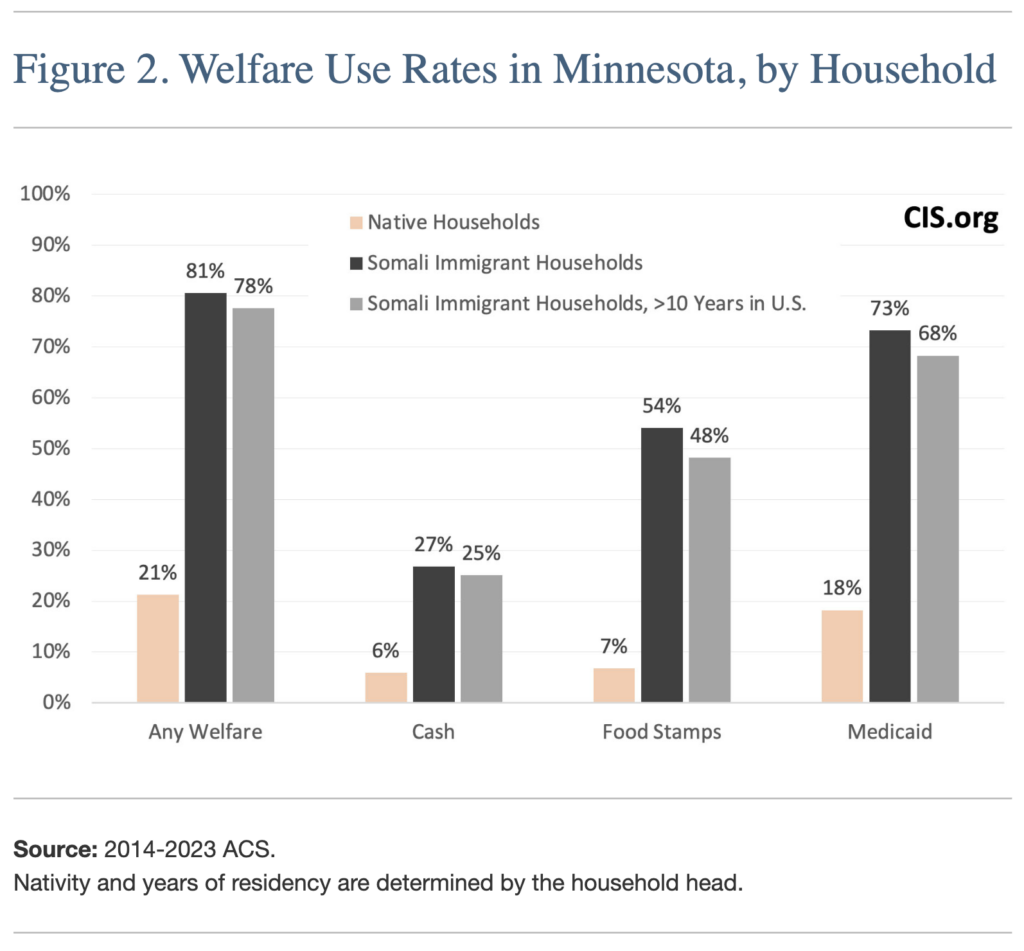
Data compiled from a decade of U.S. Census Bureau surveys shows a whopping 81 percent of Somali-headed households in Minnesota use at least one major welfare program.
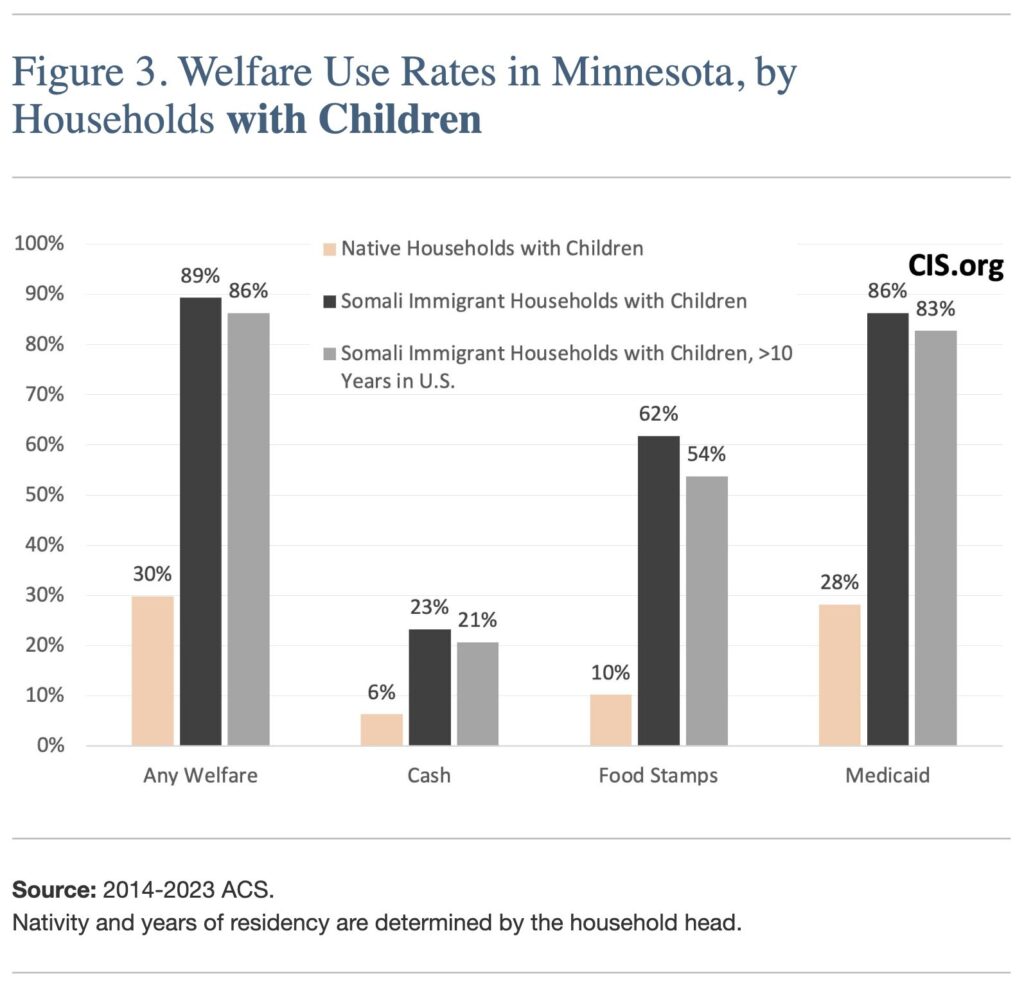
That figure climbs to 89 percent among Somali households with children.
“Nearly every Somali household with children … receives some form of welfare,” CIS researcher Jason Richwine reports.
Specific breakdowns reveal 27 percent of Somali households receive cash assistance, 54 percent use food stamps, and 73 percent have at least one member on Medicaid.
Among households with children, Medicaid enrollment hits 86 percent and food stamp use reaches 62 percent. Native-born Minnesota households present a stark contrast.
Only 21 percent access any welfare program, with cash assistance at 6 percent, food stamps at 7 percent, and Medicaid at 18 percent. For native households with children, the overall welfare rate stands at roughly 30 percent.
More than 52 percent of children in Somali immigrant homes live below the poverty line, compared to 7.6 percent in native-headed homes.
One in eight impoverished children in Minnesota now lives in a Somali household.
Educational and language barriers remain severe. Nearly 40 percent of working-age Somalis lack a high school diploma—eight times the native rate—and 58 percent speak English less than “very well,” including half of those resident in the U.S. for over a decade.
Employment offers one relative bright spot, though 21.6 percent of working-age Somali men remain jobless versus 17.6 percent of native men.
The report notes recent large-scale welfare fraud cases involving Somali defendants, including the theft of over $1 billion in child-nutrition funds.
Yet researchers emphasize that sky-high legal welfare use stems primarily from low skills and earning power, not fraud alone.
Richwine argues the most effective solution lies in admission policy.
“The best way to reduce immigrant consumption of welfare is not simply to crack down on fraud, but to reduce the number of new arrivals who have low earning power,” he contends.
What began as a humanitarian resettlement of clan-war refugees in the 1990s has transformed Minnesota, once celebrated for Scandinavian-level equality, into ground zero for America’s most dramatic experiment in rapid, low-skill refugee importation.
Taxpayers now fund a parallel society where welfare has become the rule, not the exception, and integration metrics barely budge after a decade or more.
This article originally appeared on RiftTV and is republished by The Noticer with permission.
Header image: Somalian politicians Ilhan Omar and Omar Fateh (Facebook).
The post Nine in 10 Somali immigrant families with children on welfare in US state first appeared on The Noticer.
The NoticerRead More



 R1
R1
 T1
T1


