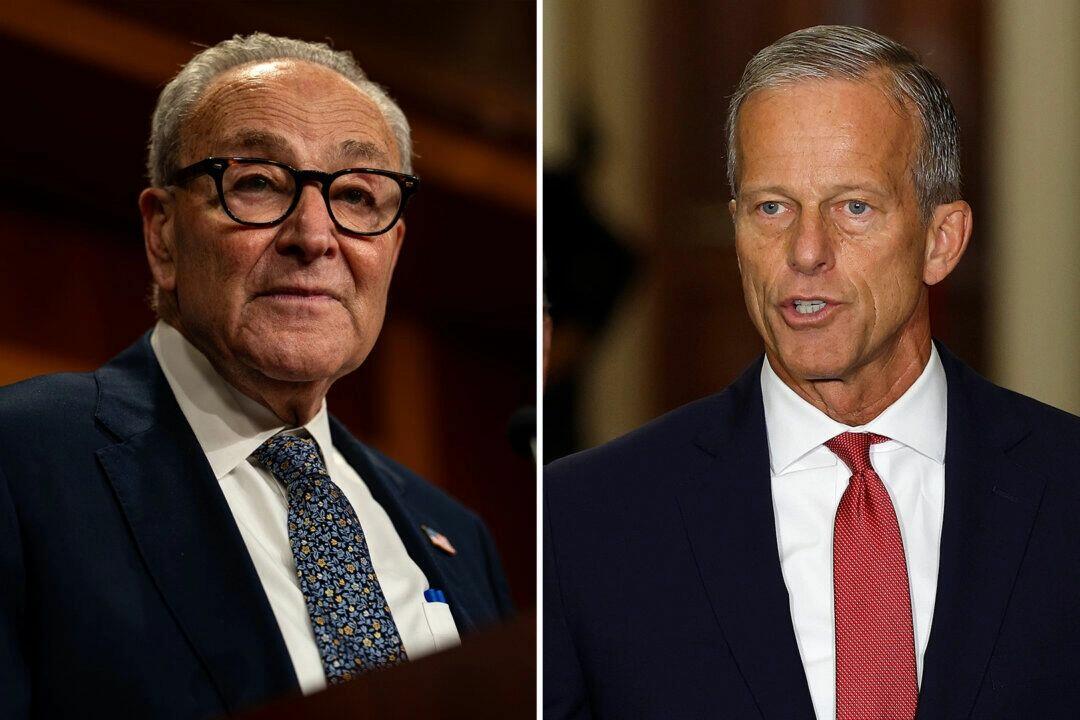
Senate To Vote On Dueling Health Care Bills Tackling Expiring Obamacare Subsidies
Authored by Lawrence Wilson & Nathan Worcester via The Epoch Times (emphasis ours),
The Senate is poised for a Dec. 11 vote on competing measures to resolve the standoff over extending the expiring subsidies for Obamacare.
Both are likely to fall along party lines, and to fail to reach the 60-vote threshold required to advance legislation in the Senate.
The subsidies, officially known as enhanced premium tax credits, were created as a temporary measure in 2021 to blunt the economic impact of the COVID-19 national health emergency.
Originally offered for two years, the enhanced subsidies were further extended for three years and will expire at the end of this month.
Democrats, fearing that allowing the subsidies to expire now would cause financial hardship and cause millions of Americans to drop their health coverage, have proposed another three-year extension.
“Democrats have put forward the cleanest, fastest, most realistic solution, a three-year extension of the current tax credits,” Senate Minority Leader Chuck Schumer (D-N.Y.) said on Dec. 9.
Republicans, saying that the billions spent on these additional subsidies have contributed to rapidly rising insurance premiums and have given rise to opportunities for fraud, oppose an extension that does not address those issues.
“The bill [Democrats] are going to put on the floor will fail,” Senate Majority Leader John Thune (R-S.D.) told reporters on Dec. 9.
Republicans have proposed an alternative plan. It would replace the enhanced subsidies with a cash payment to eligible enrollees, to be placed in a Health Savings Account. The original Obamacare subsidies, distinct from the enhanced subsides, would remain in place.
Schumer on Dec. 9 criticized the proposal as “dead on arrival.”
Enhanced Subsidies
The enhanced subsidies enacted in 2021 expanded eligibility for Obamacare, offering subsidies for wage earners well into the middle class.
The original Obamacare subsidies are open to people making between 100 percent and 400 percent of the federal poverty level. That equates to a household income of between $32,150 and $128,600 for a family of four.
The enhanced subsidies increased the amount of the subsidies, removed the income limit, and capped out-of-pocket premium payments at 8.5 percent of household income. Some low-income enrollees are eligible for plans with no premium payment under the coverage expansion.
Obamacare enrollment more than doubled after the enhanced subsidies were introduced.
Standoff
Democrats pushed for a permanent extension of the enhanced subsidies early in the fall, refusing to authorize continued spending to fund the government until Republicans agreed to negotiate over this and other health-care-related proposals.
Republicans refused to consider the extension during the shutdown.
The government shutdown, which lasted for 43 days, ended when eight Democratic Senators voted with Republicans to approve stopgap funding to reopen the government, but on the condition that their party be given a vote this month on extending the subsidies.
Schumer revealed the Democrats’ proposal for a three-year extension on Dec. 4.
Sens. Mike Crapo (R-Idaho) and Bill Cassidy (R-La.) released their plan on Dec. 8, and Republicans elected to present it for a vote alongside the Schumer plan on Dec. 11.
Other plans have been proposed by Senate Republicans, by bipartisan groups of House members, and by the House New Democrat Alliance.
Compromise Seekers
The latest compromise proposal has been put forward by Rep. Brian Fitzpatrick (R-Pa.), joined by a bipartisan group of House members.
Fitzpatrick introduced a discharge petition that, if successful, could force the House to vote on his proposal. A discharge petition requires support from 218 House members.
The Fitzpatrick plan would extend the enhanced premium tax credits through 2027 to insulate consumers from sudden rate increases. It includes some measures to check fraud by unscrupulous insurance brokers and rein in some practices of pharmacy benefit managers, the middlemen in the prescription drug supply chain.
The measure has the support of several moderate House members, including Reps. Jared Golden (D-Maine), Michael Lawler (R-N.Y.), Don Bacon (R-Neb.), Thomas Suozzi (D-N.Y.), and Robert Bresnahan (R-Pa.).
The subsidies have taken on a sense of urgency as the Jan. 1 premium increases draw nearer. “This is personal to a lot of us because these are our friends and our neighbors that are losing sleep over this,” Fitzpatrick said.
Sen. Thom Tillis (R-N.C.) applauded the effort, saying it seemed similar to a three-year ramp-down of the subsidies that he suggested.
Tillis told The Epoch Times on Dec. 10 that any measure would need roughly equal support from both parties because hardliners on both sides would be likely to reject a compromise.
Sen. Richard Blumenthal (D-Conn.) said, “Compromise should never be a dirty word.”
Sen. Angus King (I-Maine) said: “This should be a bipartisan. Let’s get together and figure this out.”
Sen. Josh Hawley, who has proposed no tax on health care premiums, deductibles, or copays, said lawmakers should explore every option for bringing down the cost of health care.
“I think it should be hard to go home and say to people whose premiums are doubling, ‘You know, we just couldn’t quite get it done,’” he said.
Tyler Durden
Thu, 12/11/2025 – 12:25ZeroHedge NewsRead More



 R1
R1
 T1
T1