
Cover-Up Or Frame-Up? How Democrat’s Epstein Releases Are A Classic Example Of False Light
Many years ago, as a law student, I had the honor of working with the great prosecutor William J. Kunkle Jr., who put away John Wayne Gacy. I was a young intern at the litigation firm of Phelan, Pope & John and loved listening to Bill’s stories about his famous cases. I even had to take a couple of calls from Gacy from prison when Bill was out.
(I was asked to write down everything that he would say in the routine calls. On one call, Gacy told me, “Tell Bill he was wrong. I was not guilty of homicide. I was guilty of running an indoor funeral parlor without a license.”).
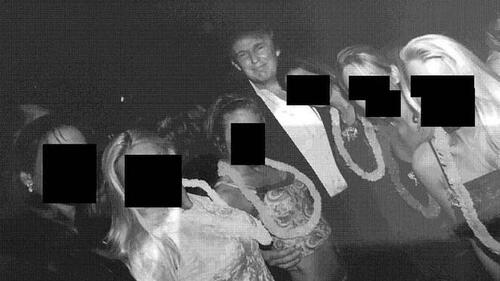
One story of Bill’s came to mind last night when Democrats released their latest tranche of “bombshell” photos from the Epstein files to suggest that Trump is implicated in the scandal.
Bill told me how he would stage the trial room to maximize impact on the jury.
In the Gacy trial, he was allowed to create an exhibit showing the pictures of the victims. He knew that defense counsel would not want the faces staring at the jury throughout the trial. So he made the exhibit so large that it would be difficult to move and waited for the defense to insist that the pictures themselves be removed.
When they did so, they found that each picture was attached to the board by Bill with large red tape. Throughout the trial, the jurors stared at each name with a large red X beneath it.
It was better than the pictures themselves.
Bill’s story came to mind yesterday when the Democrats released the photos from the Epstein files.
The White House accused Democrats on the House Committee on Oversight and Government Reform of spreading a “false narrative” with photos. It is more of an effort to create “false light,” a term from tort law where true photos are presented in a misleading and harmful way.
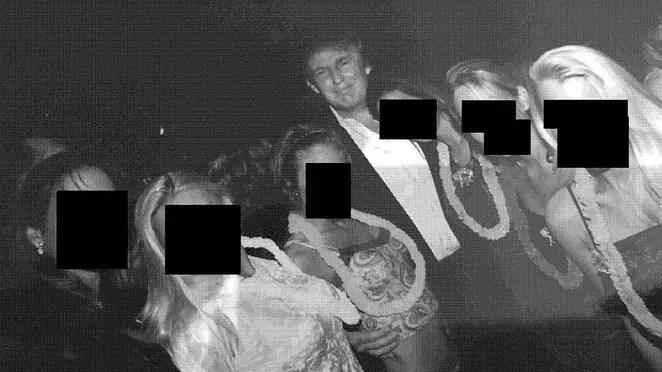
The photos of Trump show women with their faces obscured as “possible” victims of human trafficking with underaged girls.
Even a photo with a single woman on what appears to be a plane is blacked out. There is no context offered, but the blacked-out faces suggest that these women have to be protected as possible victims.
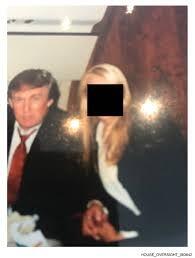
It has the same effect as Kunkle’s Xs.
However, the real question of false light is the inclusion with the other photos selected for release.
The Democrats included pictures of sex toys, novelty condom boxes with Trump’s face (saying “I’m Huuuge”) and even Epstein in a bathtub.


The combination is meant to make the other photos seem more sinister, even though we have no information on where they were taken or who the women are in the images. Just Xs.
Trump is not alone in the framing of such photos. The release included a previously public photo of Harvard Professor Alan Dershowitz simply meeting with Epstein, who is wearing a Harvard sweatshirt. There is no information on when or where it was taken. (Epstein was a major donor to Harvard, and Dershowitz was a Harvard professor as well as someone who served as counsel to Epstein).
The Democrats have long despised Dershowitz, a liberal who broke ranks with the party and represented Trump in his impeachment. Now, he is included with the photos of condoms and Epstein in a bath.
In torts, litigants can bring cases for “false light” when photos may be true images but are presented in a misleading way.
While some states have rejected false light claims in favor of using defamation actions exclusively, other states recognize both claims.
Under a false light claim, a person can sue when a publication or image implies something that is both highly offensive and untrue. Where defamation deals with false statements, false light deals with false implications.
California produced an important case that is particularly illustrative in this circumstance. In Gill v. Curtis Publ’g Co., 239 P.2d 630 (Cal. 1952), the court considered a “Ladies Home Journal” article that was highly critical of couples who claimed to be cases of “love at first sight.” The article suggested that such impulses were more sexual than serious. The magazine included a photo of a couple, with the caption, “[p]ublicized as glamorous, desirable, ‘love at first sight’ is a bad risk.” The couple was unaware that the photo was used and never consented to its inclusion in the magazine. They prevailed in an action for false light given the suggestion that they were one of these sexualized, “wrong” attractions.
The standard California jury instruction asks the jury if “the false light created by the disclosure would be highly offensive to a reasonable person in [name of plaintiff]’s position” and whether “there is clear and convincing evidence that [the defendant] knew the disclosure would create a false impression … or acted with reckless disregard for the truth.”
Likewise, in Solano v. Playgirl, Inc., 292 F.3d 1078 (9th Cir. 2002), the court found false light in the use of an actor’s photo on the cover of Playgirl magazine. In combination with the headlines, the plaintiffs argued that the magazine created the false impression that nude photos of the actor were featured inside the magazine.
Congress is protected from such lawsuits, and even without those protections, it is unlikely that this case would be viable as a tort action. However, the underlying concept is still relevant. The Democrats were suggesting that there was a cover-up of Trump’s (and others’) involvement in these crimes. They have not produced such evidence. They can, however, release images in a way that suggests such untoward or even illegal conduct.
If Dershowitz’s picture were just re-released on its own, it would hardly be notable. However, in the company of condom boxes and bathtub shots, it can feed a news cycle of eagerly awaiting and enabling media.
In the end, the photo dump is unlikely to change any minds or move the needle in polls. Some will see a cover-up and others will see a frame-up.
The difference with the Gacy trial is that most of the jury has already left the room, leaving only the Xs behind.
Tyler Durden
Sat, 12/13/2025 – 19:50ZeroHedge NewsRead More



 R1
R1
 T1
T1


