
Time For An AI-Tech Supply-Chain Channel-Check In Asia. Here Are Key Takeaways…
Channel checks in Asia’s tech supply chain are critical and can be used as early signals or leading indicators when trying to gauge the AI bubble and/or global demand for tech, especially in North America and Europe.
Goldman’s James Schneider told clients on Monday that his team visited two dozen companies deeply embedded in the IT supply chain across Taiwan, Korea, and Japan, the global production capitals for semiconductors, servers, memory, displays, optics, and capital equipment.
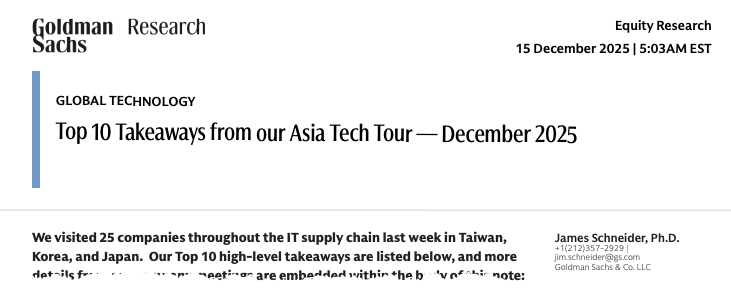
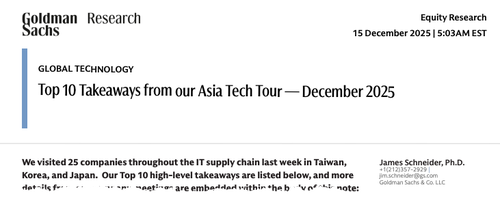
Schneider’s top ten takeaways from his team’s channel checks were that AI server demand remains robust, with no signs of slowing in 2026, while end-market growth for PCs remains mixed.
Here are the top ten takeaways:
-
AI servers: Robust demand is expected to continue in 2026, with no signs of slowing. Although full-rack shipments could more than double, with similar levels of growth in GPU and ASICs, the rate of ASIC shipment growth will likely be faster.
-
AI chip vendors: Nvidia’s Rubin is on track for mid-2026 production and a strong 2H26 volume ramp. Suppliers note very strong traction for Broadcom’s TPU for Google but mixed trends for other suppliers.
-
Optical networking: Demand is extremely strong, driven by significant speed upgrades (transition to 800Gb and eventually 1.6T) and pricing uplift — and Broadcom datapoints are particularly strong.
-
Semi cap equipment: 2026 & 2027 WFE expectations continue to increase, led by DRAM and leading-edge logic. NAND spending remains muted for now, and trailing-edge logic remains under pressure.
-
Semi test: Robust demand continues for AI-driven applications, driven by GPU, ASIC, and HBM. We expect Teradyne’s market share position to improve.
-
Analog and RF: Demand is improving but varies by end market, with strength in datacenter, moderate improvement in industrial, and sluggish trends in automotive.
-
DRAM: Supply growth remains moderate, and demand continues to materially exceed supply. Blended HBM pricing is expected to moderate before increasing again, while conventional DRAM pricing is expected to increase substantially.
-
NAND: Supply/demand conditions have tightened materially and are expected to remain tight in the medium term. SanDisk appears to have won an additional hyperscaler customer for eSSDs in 2026.
-
PCs: Expectations are for very muted unit growth or modest declines in 2026. AMD appears to be gaining some increased level of traction in commercial PCs.
-
Smartphones: High-end unit shipments remain solid, but low-end market volumes are already being significantly pressured by rising input costs.
Schneider also provided 10 critical charts and much more detail on the channel checks, which can be viewed in full by ZeroHedge Pro subscribers in the usual place.
Tyler Durden
Mon, 12/15/2025 – 21:20ZeroHedge NewsRead More



 R1
R1
 T1
T1


