
UBS Upgrades Luxury To “Overweight” For First Time In Three Years
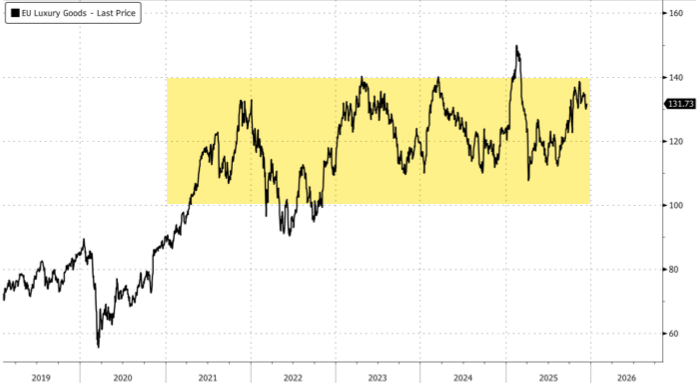
European luxury stocks have been locked in a 4.5-year trading range, oscillating between peaks and troughs rather than the up-and-to-the-right pattern seen with AI stocks.
Global consumer uncertainty has been a persistent overhang for the last few years. Lower-income households remain under pressure from inflation and affordability constraints. By contrast, upper-income consumers have benefited from wealth effects driven by rising equity markets, cryptos, precious metals, and home prices.
UBS analyst Andrew Garthwaite now offers clarity on the next move for luxury stocks, writing in a lengthy 2026 outlook note to clients that his team has, for the first time in three years, upgraded luxury to “overweight.”
Garthwaite cited a combination of improving fundamentals, supportive valuations, and strengthening macro tailwinds entering 2026 as the primary reasons for the upgrade in luxury stocks.
The analyst laid out his case in a section of the note titled, “The major sector changes are to upgrade luxury…”:
We take luxury up to overweight for the first time in over 3 years:
We upgraded to benchmark (from underweight) on July 1st. We raise further because: i) EPS is now back to trend (having been 100% above trend); ii) capex is now below trend (implying that future margins should improve); iii) we are now seeing EPS and revenue expectations being at the low end of range but improving (with UBS forecasting luxury EPS to be 5% above the market compared to consensus on 2% above the market) – we have seen the first signs of margin improvement since 2022; iv) P/E relatives ex Hermes are mid-range (only slightly above its normal 32% P/E premium) – on UBS HOLT, the implied CFROI and growth rate are at the bottom end of their historical range against that of the market at only a 1.3% and 1.5% premium, respectively. A quarter of the luxury cluster is US-related and if just 0.5% on the wealth gain in equities that we predict in 2026 in the US is spent on luxury, then that adds c7% to sales. The rise in gold has generated a wealth gain 3X higher than the losses in bitcoin YTD. The top income decile household stands to benefit by $12K a year (according to the CBO) from the OBBB. A stronger dollar forecast post Q1 26 has statistically speaking been very helpful for a sector with extremely high transactional exposure. High-end luxury tends to avoid the disruption associated in other sectors from Gen AI, GLP-1, governments cutting healthcare budgets or Chinese competition. We forecast outsized growth of the EM middle class, boosting demand for conspicuous status symbols. China is a risk, but Macau casino stocks (a proxy on high-end spending) have modestly outperformed YTD. The team have Buys on LVMH, Richemont and EssilorLuttoxica.
The UBS EU Luxury Goods basket has been rudderless for roughly 4.5 years, trapped in a trading range as investors search for signs of a consumer rebound.
Will a breakout be coming in 2026?
Meanwhile, U.S. Treasury Secretary Scott Bessent pointed to a brighter outlook for low-income consumers in 2026.
ZeroHedge Pro subs can read the full note in the usual place.
Tyler Durden
Tue, 12/16/2025 – 14:25ZeroHedge NewsRead More



 R1
R1
 T1
T1


