
Shell Oil Sued Over “Causing Typhoon” In Philippines In Major Test Case
Authored by Chris Morrison via DailySceptic.org,
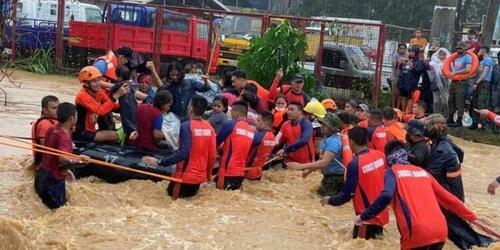
A massive ‘lawfare’ claim backed by Greenpeace and Friends of the Earth has been filed in the UK’s Royal Courts of Justice claiming that Shell Oil played a part in a devastating typhoon in the Philippines in 2021. At the centre of the case is a Green Blob-funded weather ‘attribution’ study that claims Typhoon Rai, also known as Odette, was made significantly worse due to human caused climate change. The study has been recently published and is heavily linked to academic institutions funded by the green billionaire investor Jeremy Grantham.
The action has been filed by a number of survivors of the Philippines storm that caused considerable damage in parts of the Philippines in late 2021. It claims financial compensation as well as “injunctive relief to curb Shell’s destructive activities”.

Typhoons are not unknown in this part of the world, but recent evidence suggests there has been little change in the overall trend over the last 100 years. Numbers and intensity of storms rise and fall over shorter periods but the Intergovernmental Panel on Climate Change (IPCC) has seen little evidence that humans have recently caused the trend to get worse. In fact, a recent paper published in Nature found “robust declining trends in the annual number of tropical cyclones at global and regional scales during the 20th century”. The paper was titled: ‘Declining tropical cyclone frequency under global warming.’
The key attribution paper in the Shell case uses a standard technique measuring the outputs of two computer model simulations. This imagines an atmosphere where humans have emitted carbon dioxide by burning hydrocarbons and one where there is no such contribution. To say the process is controversial would be an understatement. It cannot count as scientific work under the Popperian principle since the results are unable to be tested and are unfalsifiable. The field of weather attribution is dedicated to grabbing media headlines and providing ammunition for lawfare cases.
If the Shell case ever gets to court, it will be interesting to see how weather attribution claims stand up to forensic cross examination. Shell could call on the services of the distinguished science writer Roger Pielke Jr., who has noted that he can think of no other area of research “where the relaxing of rigour and standards has been encouraged by research in order to generate claims more friendly to headlines, political advocacy and even lawsuits”. Pielke suggests that the rise of individual event attribution studies coincides with frustration that the IPCC cannot say that the frequency and intensity of most types of extreme weather have increased in an era where humans are using oil and gas. In his view, they offer “comfort and support” to those focused on climate advocacy.
The Typhoon Rai attribution paper is written by four academics from the University of Sheffield and Imperial College London. Both universities have financial links with Jeremy Grantham. The fourth author Nathan Sparks works at the Grantham Institute at Imperial. The Philippines’ Category 5 Cyclone Rai caused widespread damage across the southern-central part of the country, with compounding effects of extreme rainfall, high winds and storm surges. It is claimed that a “multi-method, multi-model probabilistic event attribution” found that wind speeds of landfalling storms like Rai had become 70% more likely due to humans emitting ‘greenhouse’ gases. Looking of course at you in particular Shell Oil. Lawsuits and lawyers thrive on precise numbers so “multi-method probabilistic” modelling along with “compound event attribution theory” produces the conclusion that human-caused climate change “has likely more than doubled the likelihood of a compound event like Typhoon Rai”.
As noted, it will be interesting to see how all this modelling stands up to examination in a civil law court. The less charitable might note that this probabilistic guff would not last five minutes in a criminal court where hard and conclusive evidence, such as DNA, fingerprints, confessions and observations, is generally considered a basic requirement to secure a conviction.
The Rai civil lawsuit has been filed under Philippines tort law in the London Courts due to the domicile of Shell in the UK. The case is backed by three large activist groups who are thought to be covering the legal and organisational costs. Greenpeace is providing advocacy, research and mobilisation support, while Legal Rights and Natural Resources Centre, the local member of Friends of the Earth International, is said to be handling local legal coordination matters. Also involved is a local grouping under the banner of Philippine Movement for Climate Justice. Shell is accused of being responsible for producing 2% of global fossil fuel emissions that have directly contributed to human-caused atmospheric warming. For good measure, Shell is said to have known about the alleged risks for decades, a common claim made by activists that will no doubt be tested in any future court hearing. The mainstream rules around ‘settled’ climate science, where discussion is effectively banned in the interests of promoting the Net Zero fantasy, are unlikely to apply in the London High Court.
The Shell litigation is an important test case.
Activists have spent years seeking financial support and recognition for their pseudoscientific claims that they can measure a chaotic and non-linear atmosphere. Such is the level of refinement and expertise that they claim, many people believe they are able to pin the blame for individual weather events on humans.
Most mainstream media hype their alchemistic pronouncements without question, but it will be interesting to see how the attribution claims stand up to the attention of m’Learned Friends in a combative court forum.
Tyler Durden
Wed, 12/17/2025 – 13:40ZeroHedge NewsRead More



 R1
R1
 T1
T1


