
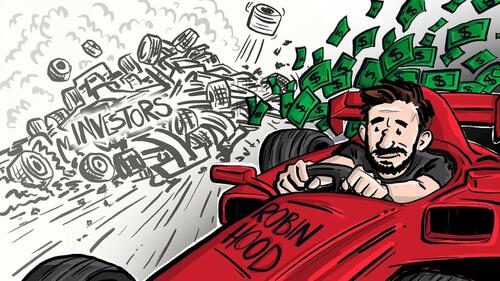
‘Rather Brilliantly Evil’: Life In The Fast Lane With Robinhood Markets
Authored by Eric Salzman via Racket News, (emphasis ours)
By just about any metric it has been a blowout year for the retail brokerage company Robinhood Markets. The company’s stock (HOOD) price is up about 220% in 2025, revenues and account growth have shot higher, and founder Vlad Tenev has become a multi-billionaire.
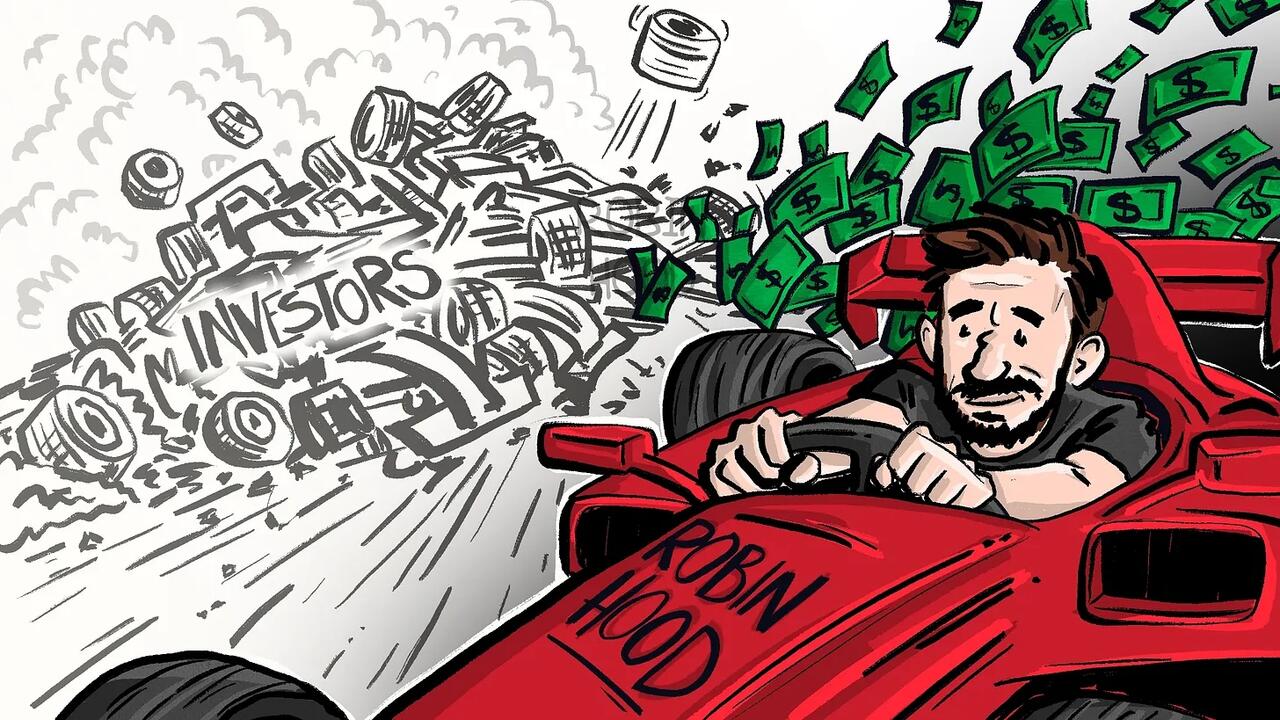
Robinhood was founded in 2013 but really burst onto the scene in 2020, changing the face of the retail brokerage industry. After a near-death experience in 2021 with the infamous GameStop episode, the company has become a phoenix, rising from the ashes, turning itself into a casino that can fit in a young man’s pocket. On the Robinhood app you can buy and sell stocks, options, crypto and bet on Monday Night Football all at the same time!
Robinhood is a pusher in plain sight and dopamine is the drug it peddles. It rounds up retail, non-professional traders and matches them up with the best and fastest traders in the world and gets paid handsomely to do it. Tenev continually claims he’s democratizing investing, but his customers are, in effect, profitable lab rats. Their order flow is sold to professional trading firms and studied. They’re more like marks than investors.
The Wall Street Journal recently reported:
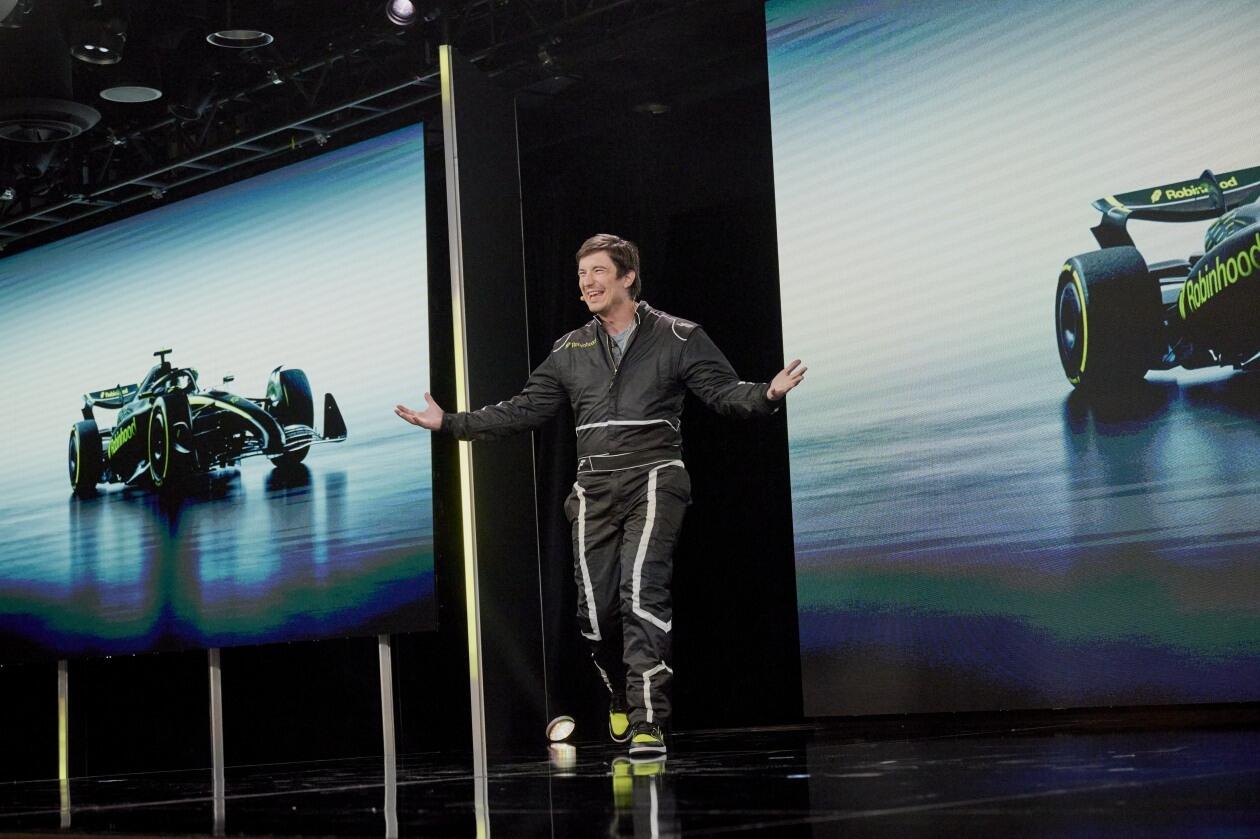
The chief executive of Robinhood took the stage at the online brokerage’s annual summit in Las Vegas this fall decked out in a race-car driver’s jumpsuit and customized Nikes.
Vlad Tenev told the hundreds of cheering traders in the audience that they had chosen “one of the most intense lifestyles out there.” He compared trading to driving a race car. “A finely tuned machine can make all the difference,” he said, “and that’s the role we feel Robinhood plays for our active investors.”
Vlad is right about one thing: trading for a living is definitely intense. I’ve done it professionally until I realized I really wasn’t good at it (most people aren’t) and went back to sales and strategy! A veteran trader, who was actually very good at it, said to me once, “If it were easy, Girl Scouts would be doing it.”
As far as Vlad taking the stage in race-car driver get-up and talking about a finely tuned machine making the difference, the analogy only works if the driver knows how to handle the damn car.
If you put 99.99% of us into a Formula One car, we’re going to run that thing into the first wall we see. Maybe the odds are a little better trading stocks, or options on stocks and the host of other high-octane wagers that Robinhood promotes and offers, but over the long term, not much better.
The Journal’s story includes that of a 35-year-old man who says he gets up at 6:30 a.m. every day to start trading zero-day options.
It’s a hobby he said he never would have picked up if not for how easy it is on Robinhood. “The thrill gets me going. If $500 can get me $50,000 or $60,000, let me just try.”
Good Lord.
I have to admit that I’ve looked at the meteoric growth of Robinhood with fascination and a sick sense of admiration for what Vlad Tenev and Baiju Bhatt built.
I felt the same way when I watched “Narcos Mexico” and saw how Felix Gallardo built the first Mexican marijuana and cocaine cartel.
My admiration comes from the rather brilliantly evil way Tenev and Bhatt took their early experiences with high frequency trading (HFT), identified a new brokerage profit model that could offer a no-fee brokerage combined with a video game-like interface to serve up dopamine hits to a whole new generation of investors that the traditional brokerage houses either overlooked or didn’t know how to reach effectively.
A Ticket to Billions: Payment for Order Flow
Fee-less trading was Robinhood’s main draw when it started in 2013. You might ask yourself how Robinhood could have made money without the traditional fees a retail broker would charge per trade. To this day, most users of Robinhood don’t know the answer to this question.
From their experience with high frequency trading, the Robinhood boys learned that they didn’t have to send your order to the publicly visible New York Stock Exchange, but could sell customer orders to buy and sell stocks and options to the big and secretive HFT market makers, like Citadel, Dash, Wolverine, Susquahanna, Jane Street and Morgan Stanley, who will happily take the other side of your trade and quietly pay Robinhood for the privilege. This is called Payment for Order Flow (PFOF). You may have read or heard about this from Michael Lewis’ book, “Flashboys.” Before all the super geniuses of the planet went into Artificial Intelligence, they went to Wall Street or Chicago to build these super-fast trading algorithms that can transact in about 100 milliseconds, or faster than you can blink your eyes.
Without getting too into the weeds, when a Robinhood customer places an order to buy a stock, Robinhood can go to say, the New York Stock Exchange to fill the customer’s order or can route the order to one of the HFT market makers as long as it’s making the best effort to get the best execution (essentially, price) for the customer. The HFT market makers post where they will buy or sell a particular stock or option. The market maker profits from the difference.
Profit isn’t guaranteed but market makers typically make a penny or two per share on stock trades — and they are potentially making tens of millions of pennies per day. For options, the HFTs can make a much larger spread, anywhere from 10 cents to a few dollars. This is why HFT market makers like options! HFT market makers pay retail brokerages like Robinhood and Charles Schwab a certain amount per share of their retail orders to direct the orders to them, and as long as the retail customer is getting the National Best Bid and Offer (NBBO) at the moment of trade, all good, right? Maybe.
The SEC found that from 2015 to 2018, Robinhood was not disclosing to its retail clients how the company was making money off orders by selling their order flow. from the 2020 SEC press release.
“…Robinhood made misleading statements and omissions in customer communications, including in FAQ pages on its website, about its largest revenue source when describing how it made money – namely, payments from trading firms in exchange for Robinhood sending its customer orders to those firms for execution, also known as “payment for order flow.” As the SEC’s order finds, one of Robinhood’s selling points to customers was that trading was “commission free,” but due in large part to its unusually high payment for order flow rates, Robinhood customers’ orders were executed at prices that were inferior to other brokers’ prices. Despite this, according to the SEC’s order, Robinhood falsely claimed in a website FAQ between October 2018 and June 2019 that its execution quality matched or beat that of its competitors. The order finds that Robinhood provided inferior trade prices that in aggregate deprived customers of $34.1 million even after taking into account the savings from not paying a commission.
After that ethical speed bump, Robinhood really got down to business. The demographic Robinhood was going for suddenly had lots of time on its hands when Covid hit. The Robinhood app provided a fix as people went to work day-trading, especially trading options. When it comes to getting your dopamine on, trading options — especially those expiring in a week or two — can do the trick.
Leverage
Here is a simple example. Back in 2021 when stocks were on a huge bull run, especially the big technology stocks like Google, Robinhood traders used options to get leverage. Leverage means using a smaller amount of your own money to control a much larger position or exposure in the market — essentially amplifying both potential gains and losses.
In this case, one standard stock option contract gives you control over 100 shares of the underlying stock (without having to buy the shares outright). Therefore, the trader could buy 10 call option contracts for $1,200, betting that Google stock will go higher by more than about 5% in the next two weeks. That $1,200 controls exposure to 1,000 shares (10 contracts × 100 shares each), which is the leverage in action.
At the end of two weeks, if Google went up say, 7%, the options could roughly double in value (or more, depending on the details), letting the trader turn that $1,200 into a big profit. However, if Google only goes up 4% (or less than the break-even point), the options the trader paid $1,200 for expire and become worthless, and the entire $1,200 is lost.
From June 1, 2020 to December 31, 2021, (Source Bloomberg) Google went up 102% and the option bets paid off handsomely. Since this was the first time many Robinhood traders invested in options, they felt it was a license to steal! They had never really lost. However, in 2022 Google shares dropped 39% and option bets got creamed as newbie traders learned the downside of leverage. In 2021 Bloomberg News reported on Robinhood’s option activity.
New disclosures show the app’s monthly volume of options executed tripled last year, making the firm the second-most active among peers behind Charles Schwab Corp., a 50-year-old stalwart that just bought TD Ameritrade. Offering options is so lucrative that they accounted for two-thirds of Robinhood’s reported revenue from order flow, a significant source of income. A single contract can generate more money than handling 100 shares.
Using its app, clients can unlock Robinhood’s most advanced level of options strategies in minutes by tapping their details into a smartphone. They can then instantly start placing wagers on some of the most complex U.S. markets available to the investing public. Approval for similar access can take days at competitors such as Schwab and Morgan Stanley’s E*Trade.
Between 2020 and the 3rd Quarter of 2025, Robinhood has been paid billions by HFT firms for their option order flow. For example, in the 3rd quarter of 2025, HFT market makers paid Robinhood approximately $260 million.
Robinhood gets paid more than other retail brokers for its option order flow. Why?
As of September 2025 Robinhood was paid by HFT firms $0.53 per options contract. Their closest option flow competitor Schwab got $0.39 per contract. Why is Robinhood’s flow so much more valuable than Schwab’s? One theory that I subscribe to is that Robinhood’s main client base — young men — is aggressive risk takers and relatively predictable. As we learned in the “Meme Stock” craze of 2020-2021, this client base moves in herds. HFT algorithms study the trading patterns of this demographic and predict what the Robinhood customer is going to do before they do it and I would bet that Vlad and Baiju knew about this when they started the firm more than a decade ago.
The HFT firms are not guaranteed wins every time, and they are taking risk which means they are not necessarily doing anything wrong. Robinhood on the other hand, pushing option trading aggressively because they know their option order flow is the most valuable by a wide margin is, at best, sleazy.
Recently, the Wall Street Journal reported:
(Vlad) Tenev has come to realize that plugged-in, aggressive traders are actually key to his company’s success.
Robinhood offers a host of ordinary financial products, including retirement accounts and credit cards. It is the riskier products tailored to day traders that make the most money for the company. In the most recent quarter, customer trading generated more than half of Robinhood’s revenue, and 78% of that transaction-based revenue came from crypto and options trading.
Tenev said he directed his team to cater more to that group. “These are our most engaged customers that generate the lion’s share of our revenue,” he said in an interview. “We put our best people on active traders.”
This sort of reminds me of “The Wire” druglord Avon Barksdale
Crypto
Robinhood has continued to expand rapidly in crypto. The Block reported last week:
Robinhood wants to attract more advanced, high-volume crypto traders in both the U.S. and EU and is unveiling new features to do so, including lower fees and added leverage for altcoin futures, the company said Monday.
Hoping to woo sophisticated traders away from rival exchanges, the stock and crypto trading platform has in the U.S. expanded the number of available fee tiers from three to seven, “offering rates as low as 0.03% for high-volume traders,” Robinhood said in a statement. In the EU, users who want to trade perpetual futures will now have access to new trading pairs with eligible customers able to trade up to 7X leverage.
7x leverage on altcoins, what could possibly go wrong?
Zero Day Options
Also recently, Robinhood has piled into a fabulous product mentioned earlier, zero-day options. If there was ever a product where probably 99% of Robinhood customers should not be playing in, it is zero-day options or 0DTE (Zero Days to Expiration), especially with Michael Lewis’ “Flash Boys.”
The way the product works is, say the S&P 500 index starts the day at 6,800. The customer can buy an option that pays off if the S&P 500 goes up 1% by the end of the day or down 1% (greater than 6,868 or less than 6,732). This is called “buying volatility.” If the S&P moves more than 1% in either direction by the end of the day, the customer wins; if not customer loses. There are many iterations of this type of trade, the type of trade Flash Boys wrote the book on, and they are the ones Robinhood’s customers are trading against. Who do you think will win that one over time?
Robinhood is getting paid handsomely to serve up its customers to the sharks. I imagine there are lots of guys like the one the Wall Street Journal spoke to who put down a daily bet at the opening bell and stare at their phone or iPad until the 4 pm close instead of actually living a life.
Prediction Markets
Finally, there’s the prediction markets. Prediction markets have been around for a while. The biggest prediction exchange in the U.S. is Kalshi, which started up in 2021. Kalshi is pretty simple.
Take an event like the presidential election. The player thinks Trump will beat Harris and currently 53% of all betters think Trump will win. The player bets $0.53 on Trump, and if Trump wins the player gets $1.00 and has made $0.47. Conversely, the players that bet on Harris put up $0.47. Now you can pretty much bet on the outcome of anything with Kalshi, including most sporting events.
The genius of Kalshi is that it’s able to call its product an “event contract” regulated by the Commodity Futures Trading Commission (CFTC). Kalshi is now considered to be a regulated exchange. Not having its product classified as a wager, but instead a regulated financial product, means that it’s legal to sell to 18-year-olds in all 50 states. Online sports gambling sites like DraftKings at least require customers to be 21 years old.
Brilliant.
Naturally, this August, just in time for football season, Robinhood partnered with Kalshi to put prediction markets for the NFL and college football on Robinhood’s app. Then in late November, Robinhood partnered with Susquahanna (one of the HFT Flash Boys that buys Robinhood’s order flow) and bought an existing CFTC-regulated exchange, acquiring a designated contract market (DCM) and derivatives clearing organization (DCO), MIAXdx. Susquahanna will be the market maker. The whole shebang will be launched in 2026 and the best news is, those highly entertaining but idiotic Same Game Parlay NFL bets will be available.
Starting Tuesday, users are able to trade preset combinations of the outcome, totals and spreads of individual NFL games, and starting in early 2026, users will have the ability to create custom combos of up to 10 outcomes across NFL games. Those will have “a structural look or feel as a parlay,” JB Mackenzie, vice president and general manager of futures and international at Robinhood, told CNBC.
Even more, the company is allowing users to wager on the performances of individual NFL players in real time. For example, they can place prop bets on a certain player scoring a touchdown at any point during a game as well as the passing, receiving and rushing yards for a player.
Awesome, bro.
We have been in a bull market for stocks for three years now. At some point we are going to have a draw down, probably a big one. Unfortunately, these three years have drawn in hundreds of thousands of our kids to the Robinhood pocket-casino. I’d like to think something can be done before the bad event to at least stop Robinhood’s growth, but there’s really nothing that can or will be done. I’d like to see the prediction market on that.
You can also listen to Eric Salzman discuss Robinhood on his podcast, Monkey Business.
Tyler Durden
Mon, 12/22/2025 – 08:05ZeroHedge NewsRead More



 R1
R1
 T1
T1


