

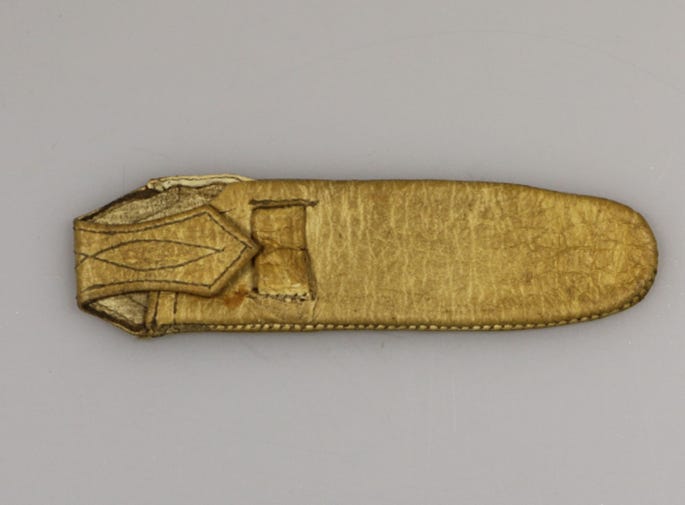
One of the barely known ‘the Nazis made X out of human-skin from dead concentration camp prisoners’ exhibits is called the ‘human-skin penknife case’ (sometimes referred to as a ‘human-skin pocket knife case’) which was not one of the exhibits at the famous ‘Table of Horrors’ at Buchenwald made famous in George Stevens’ 1945 propaganda film ‘Nazi Concentration Camps’.
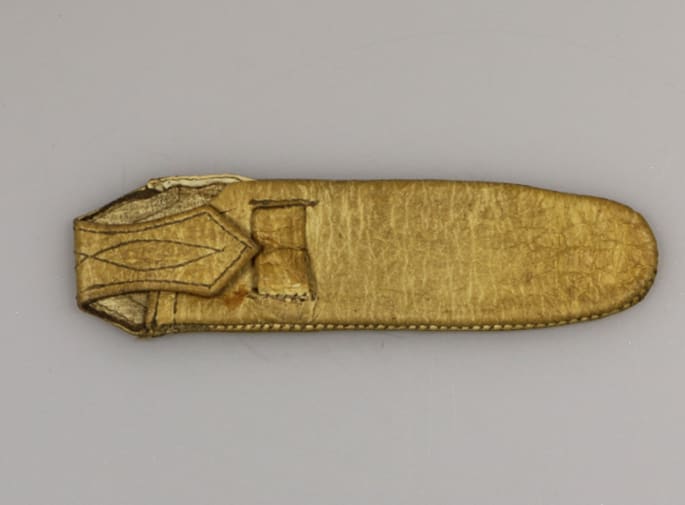
This is the ‘human-skin penknife case’ concerned as shown in the Buchenwald Memorial Museum’s photographic archive: (1)
The history and provenance of this object is given by them as follows:
‘During his visit to the pathology department in April 1945, a British parliamentarian received two artefacts from its deputy prisoner chaplain, Dr. Kurt Sitte (1910-1993). These were a penknife case made from human skin and a small piece of human skin cut from the edge of a piece of tattooed skin.
Immediately after his return, the member of the British House of Commons asked the well-known British pathologist and forensic pathologist Sir Bernard Spilsbury to examine the two artefacts brought back from Buchenwald. After visual and microscopic examination, he came to the conclusion that both artefacts “resemble human skin”.’ (2)
Now any reasonable human being should already see the problem: this object comes from Kurt Sitte not Buchenwald and there is no evidence that it was in Buchenwald at all other than Sitte’s say so.
The next thing that most people would wonder is whether we should trust Sitte; well, the problem is that despite being a major witness for the alleged ‘human skin exhibits’ of Buchenwald. (3) Sitte is an extraordinarily problematic source for anything given that he was arrested by the Germans in March 1939 as a known (and vocal) communist (4) and while his new wife Khedra Kraus was jewish: (5) Sitte was not. (6)
Further Sitte was likely already working for Soviet intelligence at this point (7) and continued actively working for them until 1960 when he arrested for (and convicted of) spying on Israel for the Soviet Union by Israeli authorities. (8)
So Sitte is not a neutral witness in any way, shape or form: he was a Soviet agent who the Germans had captured in Czechoslovakia in March 1939, put in Buchenwald concentration camp with his jewish wife that same month and kept there till April 1945 when he was ‘liberated’ by the US 6th Army. Therefore, his testimony is suspect and anything he claims is likely to be in-line with the propaganda claims/objectives of his Soviet handlers with whom he’d presumably been recently reunited.
Then out of nowhere Sitte visits in April 1945 England carrying a ‘human-skin penknife case’ that he claims he found at Buchenwald and which no one has ever found any record of which he then inexplicably gives to an unnamed British member of parliament who keeps it in his collection and until 2023 when Myfanwy Lloyd orchestrates the item being donated to the Buchenwald Memorial Museum who then – as with the alleged ‘human-skin lampshade panel’ she found – (9) was immediately sent away ‘for testing’ in February 2024 but which – rather suspiciously – hasn’t been actioned yet (as stated before these tests take days, weeks and months not years) suggesting that the Buchenwald Memorial Museum already know what I strongly suspect is true: it isn’t ‘human-skin’ at all.
Indeed, I am a bit flummoxed about how anyone thought Sitte’s claim that it was made of ‘tattooed human-skin’ was true in the first place given I can see no tattoo markings on the item in any of the several photos I have found of it! (10)
However, evidence for the idea that is possibly real is found in Franz Blaha’s testimony on this at the Nuremberg Trials (11) which states that:
‘It was common practice to remove the skin from dead prisoners. I was commanded to do this on many occasions. Dr. Rascher and Dr. Wolter in particular asked for ‘this human skin from human backs and chests. It was chemically treated and placed in the sun to dry. After that it was cut into various sizes for use as saddles, riding breeches, gloves, house slippers, and ladies’ handbags. Tattooed skin was especially valued by SS men. Russians, Poles, and other inmates were used in this way, but it was forbidden to cut out the skin of a German. This skin had to be from healthy prisoners and free from defects. Sometimes we did not have enough bodies with good skin and Rascher would say, ‘All right, you will get the bodies.’ The next day we would receive 20 or 30 bodies of young people. They would have been shot in the neck or struck on the head so that the skin would be uninjured.’ (12)
We should note that Blaha – like Sitte – was also a communist but who had been interned at Dachau where similar such claims were made, but have subsequently been quietly dropped by nearly all mainstream ‘Holocaust’ historians but his testimony does indicate that – while it is extremely unlikely to be true – there is some concordance with Sitte’s claim to have found this ‘human-skin penknife case’ in Buchenwald since while he doesn’t mention the Germans making these things specifically. The examples he uses in his testimony at Nuremberg are consonant with Sitte’s claim however unlikely it is to be true.
Moving on to the claim made that Sir Bernard Spilsbury analysed it and claimed it ‘resembled human skin’ is also dubious. In so far as that while Spilsbury was probably the most famous British criminal pathologist of his day – having made his name in the famous Crippen case in 1910 – his wording is quite specific. He stated that it ‘resembles human-skin’ which is not the same as ‘is human-skin’ and which suggests Spilsbury had some inkling that he was being sold a reputational timebomb to certify as ‘true’ that was likely complete nonsense, and which would impact his future credibility if it is exploded in his lifetime and his legacy if it exploded after he had died. So, he seemingly ‘certified it is as true’ – so to speak – while actually not saying that it was true.
The fact that Spilsbury also certified the ‘human-skin lampshade’ panel Lloyd located in the collection of the same ‘unnamed British member of parliament’ as ‘resembling human-skin’ is also telling since one – or several – of these ‘human-skin lampshade’ panel(s) was/were also analysed by the US authorities between 1945-1948 and found to be goatskin not ‘human-skin’. (13) This necessarily suggests that Spilsbury – working in 1945 – was hedging his bets with his non-committal position since it would be reasonable to have expected Spilsbury and his American opposite numbers to come to the same (or at least similar) conclusions rather than almost diametrically opposing conclusions when examining the same material around the same time.
This per force suggests that either there was substantial scientific disagreement – which is frankly unlikely since they would have both used similar techniques – or the factor in the different conclusions was whether Spilsbury performed his ‘analysis’ in the immediate aftermath of – or just before – Nuremberg and thus was under pressure to conform to/sign off on the absurd atrocity propaganda that dominated Nuremberg Trials, but then his American opposite numbers when freed from this constraint just a year or two later stated what Spilsbury had likely known at the time: it wasn’t ‘human-skin’ at all.
Since the ‘human-skin lampshade’ panel and the ‘human-skin penknife case’ both come from the same source (Sitte) and were examined at the same time as well as given a joint conclusion by Spilsbury. We can quickly see that Spilsbury’s analysis of the ‘human-skin penknife case’ has to be discarded as driven by the propaganda needs of the victorious Western Allies not by dispassionate science.
Now that we can see that Spilsbury’s analysis is a non-starter and that the ‘human-skin penknife case’ has no actual provenance linking it to Buchenwald at all other than the claims of Kurt Sitte, who was a known communist espionage agent at the time.
It therefore follows that we can dismiss the ‘human-skin penknife case’ claim as just another piece of ‘Remarkable Holocaust Nonsense’.
References
(1) https://www.buchenwald.de/en/geschichte/themen/dossiers/menschliche-ueberreste/taschenmesser-etui
(2) Idem.
(3) On these please see my article: https://karlradl14.substack.com/p/remarkable-holocaust-nonsense-74
(4) Olival Freire Junior, 2015, ‘The Quantum Dissidents: Rebuilding the Foundations of Quantum Mechanics (1950–1990)’, 1st Edition, Springer Verlag: Heidelberg, p. 179, n. 15; on his activities see: Detlef Brandes, 2008, ‘Die Sudetendeutschen im Krisenjahr 1938’, 1st Edition, R. Oldenbourg Verlag: Munich, p. 285
(5) https://i-hls.com/archives/21469
(6) Junior, Op. Cit., p. 179, n. 15
(7) Implied by Brandes, Op. Cit., p. 285
(8) https://i-hls.com/archives/21469
(9) On this please see my article: https://karlradl14.substack.com/p/remarkable-holocaust-nonsense-76
(10) For an alternative photograph see for example: https://home.benecke.com/publications/biologische-spuren-kl-buchenwald-/-biological-stains-kz-buchenwald
(11) On Blaha’s ‘testimony’ please see my article: https://karlradl14.substack.com/p/remarkable-holocaust-nonsense-31
(12) Trial of the Major War Criminals Before the International Military Tribunal, Nuremberg, 14 November 1945 – 1 October 1946, Vol. 5, p. 170
(13) Jean Edward Smith, 1990, ‘Lucius D. Clay: An American Life’, 1st Editon, Henry Holt: New York, p. 301
Karl’s SubstackRead More



 R1
R1
 T1
T1


