

Subscribe to future audio versions of AmRen articles here.
Last year, New York Magazine published the results of a poll of chief executives, who were asked to choose the best American cities in which to locate a business. At the head of the list were Seattle, Sacramento, and Portland. At the bottom were Miami, Philadelphia, and Detroit.
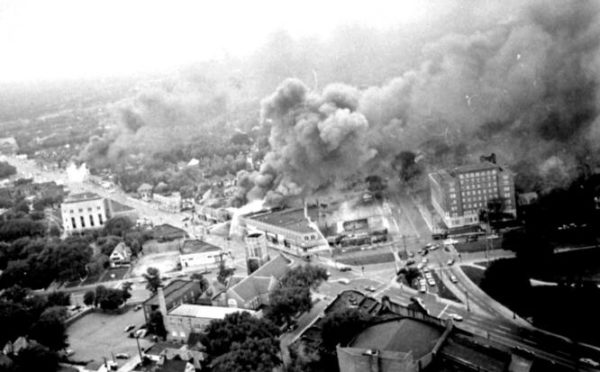
Smoke rising from Detroit during one of its many race riots.
As it happens, the winners were cities that still have large white majorities, while the losers were substantially non-white. The city of Miami now has a white population of only 10 percent. Detroit is 70 percent black. Philadelphia, hovering on the brink of bankruptcy, has a minority white population.
Obviously, there are many factors that go into making a city a good place to locate a company. Nevertheless, if someone had done nothing more than arrange the 20 cities mentioned in the New York Magazine poll by number of whites in the population, he would have gotten roughly the same ranking that the executives came up with.
Race and ‘Urban’ Problems
Today, Americans talk about their “decaying” cities, and rightly so. Crime, drugs, poverty and squalor are primarily city problems. What commentators prefer to ignore is that these are also primarily non-white problems. In any urban area, as the number of blacks or Hispanics increases, so does the incidence of “city” problems.
“Inner-city” long ago became a euphemism for black or Hispanic. “Inner-city youths” are, somehow, never white. What many Americans do not realize is that increasingly, to talk about American cities at all is to talk about non-whites. There are very few cities left in this country with a white majority, and many are now overwhelmingly non-white. This has a profound impact not only on the texture of life in American cities but in the very role they play in our society and our economy.
Although whites are still just over 70 percent of the nation’s population, Seattle is one of the few major American cities that is still over 70 percent white. Of the 42 cities in the country with populations of 300,000 or more, only 13 have white majorities.
Of the 7 cities with populations over one million, not one has a white majority. The seven, with their white percentages in parentheses, are New York (28), Los Angeles (13), Chicago (26), Philadelphia (48), Houston (25), Dallas (34), San Diego (47), and Detroit (25).
Of the smaller cities, Washington (DC) is 24 percent white, Atlanta is 29 percent, and New Orleans is 31 percent white. Boston, at 52 percent, Phoenix at 61 percent, and Pittsburgh and Indianapolis at over 70 percent, are some of the few metropolises that still have white majorities.
American cities were originally built and peopled by whites. Only, a few decades ago, most were overwhelmingly white. They were transformed by migrations of rural blacks looking for jobs and by a huge influx of non-white immigrants. Today, the very presence of large immigrant populations makes them attractive to yet more immigrants, and urban welfare systems attract the indigent, who are disproportionately non-white.
In some cases, the ethnic transformation has been astonishingly rapid. Miami, for example, with its ten percent white population is now essentially part of Latin America. As recently as 1960, it was 90 percent white.
Cities like Miami did not change color simply because non-whites arrived in large numbers. Whites left in equally large numbers, and government — especially the Supreme Court — greatly speeded their flight. Many white neighborhoods had been kept that way not only by custom but by law; restrictive covenants prohibited resale of homes to non-whites. The 1948 Supreme Court case of Shelley v. Kraemer found these covenants unconstitutional.
Likewise, in the 1954 case of Brown v. Board of Education the court ruled that segregated schools were unconstitutional, and many school districts were forcibly integrated through mandatory busing. For many whites, this was the last straw. Even if they had managed to stay in a mostly white neighborhood, their children were now being bused across town to black schools. The brand new, Interstate Highway System made it all the more convenient to escape to the still white suburbs and commute to work. Urban public schools were integrated but they soon became a national disgrace.
Most of our cities have decayed gradually and steadily, but sometimes there are watershed events that clearly mark the turning point. For Detroit, it was the riots of 1967 that left 43 people dead. They touched off a white exodus. A city that was prosperous and 70 percent white in 1960 is now 70 percent black and a wasteland. Fully a third of its residents are on welfare. In 1987, the city counted 12,000 abandoned buildings and issued only two construction permits for single family homes.
Most milestones of a city’s decay are more subtle. Oakland’s symphony orchestra, once of national stature, goes broke and disappears. Public library hours are shortened in Brooklyn. New York City closes down public restrooms because so many people are mugged in them. All across America, bus drivers stop making change. Ugly graffiti begin to appear.
Once a city begins to go down hill; it is hard to bring it back. Whites continue to flee to the suburbs, where civility still reigns, and businesses follow them. The city tax base shrinks. As more non-whites arrive, crime and welfare increase, and both are costly. Soon, cities are cutting every corner they can. Potholes aren’t filled. Garbage isn’t collected. Traffic signs aren’t repaired.
More and more whites start going to the cities only for specific purposes. They go in to work and come straight home. They take their children to the zoo and come straight home. They visit the art museum and come straight home. Although the conventional myth is that there are many white neighborhoods where a solitary black might fear for his life, the reverse is true. All over America, there are vast stretches of urban jungle where white people dare not go.
With numbers comes political power. City governments in places like Washington, Detroit, Newark, Atlanta, and New Orleans have long been black fiefdoms. Los Angeles, New York, Cleveland, Atlanta, New Haven and even Seattle have black mayors. Of all the American cities with 200,000 or more population and a black majority, the only one that does not have a black mayor is Richmond (VA). Hardly anyone can remember the last time Miami had a mayor that wasn’t Hispanic.
Blaming ‘Institutional Racism’
Because City Hall is now largely non-white, it is no longer plausible to blame “racist” city governments for the squalor of non-white neighborhoods. Instead, it has become common to blame “institutional racism,” and the whites who still control state and federal government.
On January 31 of this year, Governor Mario Cuomo of New York announced plans to help close the state’s $6 billion revenue gap by cutting $4.5 billion from the budget, some of it from city program. A black state legislator, Arthur Eve, retorted that Governor Cuomo presided over “the most racist state in the Union,” and told a black audience that his policies were “killing you and your children.”
To keep from going broke, cities raise money as best they can. A recent survey of 50 cities by the U.S. Conference of Mayors found that 36 had raised taxes in the last decade, and some of the mayors conceded that this only accelerated white flight. Thirty-four of the cities reported that they had cut their work forces in the last decade, and 24 had cut services.
When they can raise taxes no further, cities turn to state and federal government. Last November, the mayors of 35 cities met in New York for what was billed as the Urban Summit. It might better have been called the beggars’ banquet. The “action plan” the mayors put forward consisted of one strategy: lobby Washington for more money. More recently, city officials and urban congressmen called for an “Operation Urban Storm” that would retake the cities as boldly as American forces retook Kuwait. Others demanded a “domestic Marshall Plan” to rebuild rotting cities.
No matter how these demands are couched, they are little more than schemes to take money from white suburbanites and give it to non-white city dwellers. In some cases, city officials are straightforward about it. The black mayor of Hartford says that the city’s boundaries must be redrawn so as to include white suburbs. This would “share the burden” of looking after Hartford’s burgeoning, non-white welfare population. In New Jersey, blighted cities like Trenton, Newark, and Camden are eyeing their white neighbors for potential marriage partners. Hundreds of years after they were drawn, some black officials claim that town boundaries reflect racial prejudice.
If there is something on the horizon that will save America’s cities, there is no indication of what that might be. So long as cities keep turning black and Hispanic (an Asian influx can be a different matter), they will continue to deteriorate.
A Nation Without Cities
Sociologist Charles Murray suggests that our cities could become more and more like Indian reservations: alien territories, largely supplied from the outside. If this happens, cities will cease to play the central roles in commerce, culture, and society that they have played in every nation for thousands of years. Helped along by better telecommunications, America is on its way to becoming a nation without cities.
Except for the rich, who can afford to live in the expensive, white, urban enclaves that remain; many American cities are already becoming unlivable. Crime, bad schools, incivility, filth, and the hostility of non-whites are more than most are willing to put up with for the benefits of city life.
As they flee the city, whites arc increasingly cut off from an entire manner of living. The texture of life that can come only from an urban concentration of work, leisure, culture, and friendship is no longer available to them.
Walking as the obvious means of transportation — to work, to a concert, to a restaurant, to a friend’s house — is out of the question. A decorous and graceful urban existence was once common for whites. To read any American novel of city life that is set in the 1950s or earlier is to enter a different world from that of the present. A civilized life in the city is still possible for Japanese, Germans, Swedes, Swiss, and the French. And it is still possible in a few American cities that have kept their white majorities. But for most of the country, our dead and dying cities are a vivid advertisement for the coming “diversity” that we are supposed to be embracing with such excitement. Some time near the middle of the next century, the white population of the United States is projected to drop below the 50 percent mark. A trip to New York — or to New Orleans or Detroit or Miami — is a trip into the future.
The post The Late Great American City appeared first on American Renaissance.
American RenaissanceRead More



 R1
R1
 T1
T1


