

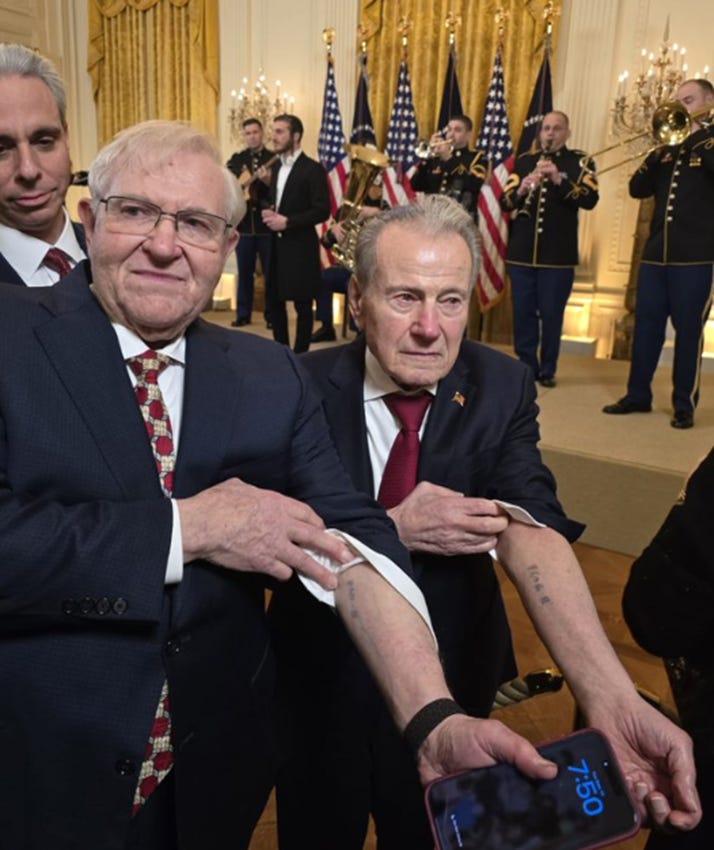
Recently we were treated to a piece of ‘Holocaust’ theatre in the media at the White House Hannukah Party with two so-called ‘Holocaust Survivors’ named Michael Bornstein and Jerry Wartski ‘showing off’ their ‘Holocaust tattoos’ to a photographer.
This photo was then uploaded to Twitter/X by one Marc Rod – who is a senior reporter for ‘Jewish Insider’ – with the following commentary:
‘Two Holocaust survivors, Michael Bornstein and Jerry Wartski, display their number tattoos at the White House Hanukkah party tonight. Photo courtesy of @BurkanJonathan’ (1)
The photo uploaded was as follows: (2)
For the record Bornstein is on the left of the photo, while Wartski is on the right.
Naturally enough I decided to look into both their stories, and I will address them both separately. Let’s start with the more interesting of the two which is that of the appropriately Wartski (his name makes me think of a human-shaped wart on skis every time I see it).
Wartski’s story as he recently explained to ‘Fox News’ is as follows:
‘In the nearly 75 years since the end of World War II, Jerry Wartski never uttered a word about what he endured after the Nazis invaded his native Poland.
Those around him knew him as a Holocaust survivor who survived Auschwitz-Birkenau, but the Manhattan businessman never offered any details.
He never spoke of losing his parents and his home to hate.
“I saw a lot of people were able to talk about it. I just couldn’t,” Wartski, 89, told Fox News in his first sit-down interview with the media, just ahead of the 75th anniversary of the camp’s liberation today. “My kids, they learned everything in school. They didn’t learn from me. … They didn’t even ask me a single question about it.”’ (3)
Now while it is perfectly possible; it seems rather odd that Wartski wouldn’t have mentioned that he was a ‘Holocaust Survivor’ at all to his children nor that his children allegedly didn’t know – or think to ask – about Wartski’s experiences during the Second World War and how he came to live in the United States upon finding out – as surely they must have done when asking where their grandparents were etc – that he was born in 1930 in Poland.
The fact that Wartski allegedly ‘never talked about it for 75 years’ seems ridiculous to me as it should to anyone who knows anything about the ‘Holocaust’ in that there was/is massive value – both in terms of financial compensation and also social clout – in being a ‘Holocaust Survivor’ or being ‘the children of a Holocaust Survivor’.
So either Wartski is telling porkies here and he did tell everyone about his story (which I suspect is probably the real truth here) or he doesn’t want to talk about ‘his story’ because there is something in that he is concerned about claiming/stating (for example he might not in fact be ‘Jerry Wartski’ but rather some other displaced person [possibly jewish or non-jewish] who adopted Wartski’s name and identity then used it to create a new life after the Second World War) which might get revealed as untrue by other people who were in the Osjakow Ghetto/Lodz Ghetto/Auschwitz with Wartski. So, by waiting till the end of his life Wartski has allowed nearly all those who could have contradicted his story to die off and thus be unable to call him on any potential nonsense he is spouting.
As to the details of Wartski’s claimed narrative we are told that:
‘Wartski was born to Jewish parents in Osjakow, Poland, on May 18, 1930. He was 9 when the Nazis invaded Poland – triggering the start of World War II.
“The news was already traveling from Germany. We knew that for the Jews it was not that good,” the soft-spoken survivor recalled. “It started right away. They put out the martial law, and we were told that Jews could not go to public school. …
“We were told Jews had to put armbands on and told that we weren’t allowed to walk on the streets. We had to walk in the gutters, not on the streets,” he continued, struggling to keep his voice steady. “Then they changed it to the Star of David that you had to wear.
“And that’s how it started.”
Several months into the war, the Third Reich began setting up ghettos in cities and towns across their occupied lands with the intention of segregating Jews and other “unfavorables” from the rest of the population. These anti-Jewish measures culminated in the policy of extermination the Nazis called “The Final Solution to the Jewish Question.”’ (4)
So far so good there is nothing too egregious in Wartski’s narrative although it does sound like Wartski has watched ‘The Pianist’ one too many times, but never-the-less we do know of multiple accounts that the German authorities decreed that jews were not to walk on the pavement but rather in the gutter. (5)
So that checks out.
Next, we read how:
‘Wartski and his family – his mother, father and brother – were sent to the ghetto in Osjakow in 1941. The mass deportations soon began.
“When the selection started, they looked left and right, old and young,” Wartski remembered. “The ones they took away, they put them in trucks, and outside of town (in Chelmno), they gassed them and then they dumped the bodies. So we lost all the children and all the elderly people all in one day.”’ (6)
Now this sounds fine, but the problem is that Wartski has managed to get his timeline completely wrong because the transports from the Osjakow ghetto to the Chelmno transit camp and the mass deportations occurred in August 1942 not in 1941 when the German authorities were still concentrating jews into the ghetto in Osjakow such as the jewish population of Kielczyglow in 1942. (7)
Further the first ‘mass gassing’ at Chelmno occurred on 8th December 1941 according to the official ‘Holocaust’ narrative so round ups and mass deportations of jews from Osjakow for mass murder in Chelmno’s gassing vans – remember that they were only small vans at this point (which Wartski clearly doesn’t know) – so it makes little sense for the jews of Osjakow – even just the numerous children and the elderly – to be mass deported to Chelmno in 1941 and ‘gassed’.
To be frank this again suggests what I’ve pointed out above: Wartski isn’t relating his own experiences here. He’s reciting a narrative he’s read in a book or heard in conversion/in a documentary so something like the following has likely occurred.
Wartski read/heard that gassing began at Chelmno in 1941 – without any dates attached – and he knows just enough to know that the jews of Osjakow were at least part deported to Chelmno but he doesn’t know when so instead he makes the ‘when’ 1941 not knowing that this – as we’ve seen above – renders his narrative almost impossible chronologically.
We can further see Wartski confabulating more nonsense when he tries to ‘explain’ why he – as an 11-year-old child at the time – wasn’t selected for gassing at Chelmno.
He writes:
‘After the deportees were put on trucks, the SS – or Schutzstaffel, Adolf Hitler’s brutal paramilitary force – returned to round up any remaining young children. Wartski, who was 11, said he and two other boys found some bricks to stand on to make themselves look taller. It seemed to work momentarily, but they were caught and sent to the ghetto’s front gate.
“But I was lucky because the last truck (had) already left. So I didn’t go,” he said. “That saved me. My first lucky star during the war.”’ (8)
So put another way: Wartski is claiming that he – and two other jewish boys – ‘found some bricks’ and ‘stood on them’ – it isn’t clear if they made a pile of bricks to stand on or whether they were already piled up – so the ‘Germans thought they were older’, which predictably didn’t work because the Germans are obviously capable of noticing bricks and looking at the feet of suspiciously young-looking six foot giants.
Then the standard ‘Holocaust miracle’ occurs – because there is no ‘Holocaust Survivor Story’ without at least one ‘Holocaust miracle’ in it in order to explain ‘how they survived’ but also to serve as the high point in the story ‘when the good guys win’ – which in this case takes the form of how Wartski and his two brick-obsessed confreres after being ‘found out’ are taken to the front gate of the Osjakow ghetto only for the trucks to have already left.
This is of course possible, but the problem occurs when we recognize that there were only 737 jews in entire of Wielun County and of which 674 lived in Osjakow. (9) So given this allegedly occurs before 500 jews from Kielczyglow were sent to the Osjakow ghetto in 1942 then it means that there were at most 737 jews in the Osjakow ghetto when these deportations to Chelmno were allegedly going on in 1941.
Thus, the Osjakow ghetto was a small place and the trucks at the front gate will be able to see that guards are still searching for/bringing other jews to the front gate; so, it is unlikely they would have ‘just left’ without Wartski and the other two young jews.
Further the fact that Wartski and the other jews were ‘standing on bricks’ to look older rather than hiding from the Germans under floorboards and in pianos – such as in the famous ghetto liquidation scene in ‘Schindler’s List’ – suggests that Wartski and the two other jewish children were actually standing near the front gate of the ghetto and so were caught almost immediately by the Germans which then makes the idea that the ‘trucks left without them’ even more ludicrous.
Thus, we can see that typically Wartski’s ‘Holocaust miracle’ makes little if any sense the minute we apply logic to it rather than simply take it at face value.
This further suggests that Wartski may well not be who he claims to be, since he is seemingly getting his ‘experiences’ from other sources.
He continues by stating that:
‘In summer 1942, the Nazis liquidated the ghetto, sending able-bodied Jews to another ghetto in Lodz and the rest to the Chelmno extermination camp, which had served as a pilot project for the Holocaust.
“They called it Litzmannstadt (the Lodz ghetto). And in Litzmannstadt, we saw that people had it much worse than we did,” Wartski recalled.
In Lodz, he and his family did what they could to avoid being selected for deportation by the SS. By early 1944, the Nazis began liquidating the ghetto – with the initial wave of Jews sent to Chelmno.
The rest went to Auschwitz-Birkenau, with its vast expanse of crude barracks and the Nazi-built crematoria, where 1.1 million people were fatally gassed and incinerated.
Wartski and his family were put one of the last transports out of Lodz, bound for Auschwitz.
“In Auschwitz, it was the same selections are before,” he recalled sadly. “That’s where I lost my mother. They gassed her in Auschwitz.”
He and his father and brother were only in the camp a few weeks when they were taken to a nearby forced labor camp.’ (10)
Now we’ve already pointed out that Wartski is correct here: the Germans did liquidate the Osjakow ghetto in the summer of 1942 – specifically in August – (11) but the split between the Lodz ghetto and Chelmno transit camp isn’t quite what Wartski is implying.
The thing is that Lodz ghetto was one of the most productive industrial enterprises in the Third Reich by 1942/1943 – it provided the labour for nearly 100 factories for example – (12) so much so that the Reich Ministry of Economics continually forced the SS and the German authorities in Poland to put off its liquidation till early 1944 when it was consolidated into the massive industrial complex that was Auschwitz and its numerous sub-camps which could make proper use of its large (and skilled) labour force.
So, the split between the able-bodied and the non-able bodied wasn’t homicidal at all; it was practical. The Germans were concentrating as much able (and skilled) jewish labour as they could in the Lodz ghetto to keep up (and increase) its production while moving those who were unwell or showed signs of ill-health to the Chelmno transit camp where they were essentially subjected to medical triaging and hot disinfectant showers.
Then a further decision could be made by the Germans as to where to send specific jews; so, any who showed significant physical improvement could be routed back to Lodz while those who were still unwell could be routed to camps with extensive medical facilities and isolation wards like Auschwitz. While those who arrived at Chelmno and were too sick to go on – rather like Edith Stein who arrived at Auschwitz suffering badly from scarlet fever or typhus in 1942 and died soon after (probably in Auschwitz I’s female infectious diseases ward) – were kept on site and then treated/given hospice care (accounting for the relatively small numbers of dead who have been found from mass graves in and around the Operation Reinhard camps).
The point is simple enough that what is claimed as the ‘evil Germans gassing people’ is a fusion of reality – lots of families were split up and significant numbers of (jewish and non-jewish) prisoners died in the ghettos and camps (largely from infectious disease, accidents and also a combination of malnutrition/exhaustion) – with wartime propaganda myths about the ‘genocide of the jews’ (which in truth was but one of many similar charges laid at the door of the Germans nearly all of which have now been quietly dropped) to form what we call the ‘Holocaust’ that was then ‘proven’ by the Nuremberg Trials.
So what Wartski is actually describing is a fairly sensible solution to the triple problem faced by the Germans in that they couldn’t have jews freely operating in German society with most of the state’s resources being devoted to fighting a multi-front total war, the ghettos had been a short term solution and quickly proved to be far more of a problem than a solution due to becoming an ideal breeding ground for infectious disease (as is explicitly stated in the Wannsee Protocol of early 1942) that then spread to the local non-jewish population (since contrary to popular claims the ghettos were notoriously porous and were usually located in cities and large towns at this point) so the Germans were progressively liquidating the ghettos into new more hygienic and geographically isolated concentration camps (like Auschwitz, Majdanek, Stutthof etc) and the problem of needing to free up manpower for the Wehrmacht as well as maintain and increase war production (not liquidating the Lodz Ghetto till early 1944, building up Auschwitz and other camps like it as major centres of war production; thus freeing up more essential workers for call up to the Wehrmacht).
We can see this in what Wartski says next:
‘In fall 1944, as the Soviet Red Army was making its way west through German-occupied Poland, Heinrich Himmler, the main architect of the Holocaust, ordered the SS hide evidence of the mass murders at Auschwitz by destroying the gas chambers and crematoria.
By mid-January 1945, thousands of Auschwitz detainees were evacuated on foot in death marches. The fewer than 9,000 who remained in the camp were deemed too sick to move.
“We went on a big march that took a long while and we lost a lot, a lot of people,” Wartski said. “They then put us in a cattle train – you couldn’t even move when we started. A week later, you could sleep on the floor because there weren’t many people left.”
The train stopped in Nordhausen, a sub-camp of the Dora-Mittelbau concentration camp. The camp was considered an extermination camp for ill prisoners, who died due to starvation or lack of medical care.
“My father passed away of starvation less than a month before we were bombed out,” Wartski said.
On April 3, 1945, Nordhausen was bombed by the U.S. Air Force, who thought it was a German munitions depot. The bombing killed many of the prisoners, but days later, the camp was liberated.
“I was still 14 years old,” Wartski said.’ (13)
So once again Wartski doesn’t seem to know what he should know if he survived Nordhausen as he claims, because while he was evacuated from Auschwitz (the so-called ‘death march’ is the Germans evacuating the prisoners west without any allocation of trains not some kind of ‘extermination’ or ‘torture’ practice) to Nordhausen.
He doesn’t seem to know that the purpose of Nordhausen was as a manufacturing facility for V1 and then V2 rockets for the German war effort and it wasn’t viewed as an ‘extermination camp’. He also doesn’t know that Nordhausen is the same camp as Dora-Mittelbau (we get ‘Nordhausen’ from the camp’s alternative name ‘Nordhausen-Dora’ after the nearby town of Nordhausen) and that Nordhausen wasn’t a sub-camp of itself – which is manifestly stupid – but rather was a sub-camp of Buchenwald.
What Wartski is thinking of is the Boelcke-Kaserne ‘sub-camp’ of Nordhausen which was in the town of Nordhausen itself which wasn’t an ‘extermination camp for ill prisoners’ but was in fact a hospice inside a former Luftwaffe barracks but due to lack of supplies; the Germans had to run it with little food and medicine. They did however fill the barracks with fresh straw so the inmates could rest/sleep as comfortably/warmly as possible given the situation (remember straw was the original mattress filler) of which we have photos taken at the ‘liberation’ of the camp by the US Army.
Further the Nordhausen camp itself was attacked by the RAF (not by the US Air Force as Wartski claims); in fact the town of Nordhausen was bombed (not the camp) on 3rd-4th April 1945 and because Boelcke-Kaserne was inside/next to the town of Nordhausen. Boelcke-Kaserne was bombed too resulting in roughly 1,300 to 1,500 dead inmates while 8,800 out 40,000 (or 22 percent) of the inhabitants of the town of Nordhausen were killed in the same attack.
Yet the dead German civilians of Nordhausen aren’t even mentioned by Wartski who even implies that most of those who were working at Nordhausen concentration camp were jewish when in fact most of them were political prisoners and non-jewish. (14)
It all goes to suggest that Wartski may well not be who he claims to be; since he allegedly didn’t reference his ‘Holocaust’ experiences to anyone until recently, he doesn’t know much about the camps and ghettos he was allegedly in and claims a classic ‘Holocaust miracle’ occurred to ‘spare him’ from being ‘gassed at Chelmno’ in 1941 which – as we’ve seen – is near enough impossible given his timeline.
In other words: Jerry Wartski is likely a ‘Fake Holocaust Survivor’.
References
(1) https://x.com/marcrod97/status/2001152347448250529
(2) Idem.
(3) https://www.foxnews.com/us/holocaust-survivor-jerry-wartski-auschwitz-liberation
(4) Idem.
(5) See for example: https://jewishgen.org/yizkor/Ciechanow/cie306.html#page310
(6) https://www.foxnews.com/us/holocaust-survivor-jerry-wartski-auschwitz-liberation
(7) https://www.shtetlinks.jewishgen.org/osjakow/Osjakow%201939-1945.htm
(8) https://www.foxnews.com/us/holocaust-survivor-jerry-wartski-auschwitz-liberation
(9) https://www.shtetlinks.jewishgen.org/osjakow/Osjakow%201939-1945.htm
(10) https://www.foxnews.com/us/holocaust-survivor-jerry-wartski-auschwitz-liberation
(11) https://www.shtetlinks.jewishgen.org/osjakow/Osjakow%201939-1945.htm
(12) https://www.yadvashem.org/holocaust/this-month/february/1941-2.html
(13) https://www.foxnews.com/us/holocaust-survivor-jerry-wartski-auschwitz-liberation
(14) https://encyclopedia.ushmm.org/content/en/article/mittelbau-main-camp-in-depth
Karl’s SubstackRead More


 R1
R1
 T1
T1


