

Periodically I come across claims by that jews that they invented something in history that they patently did not. One such claim is that made by the best-selling jewish historian and writer from Finland (of all places) Max Isaac Dimont in his 1984 book ‘The Amazing Adventures of the Jewish People’.
That claim is that the jews ‘created’ or ‘inspired’ Magna Carta.
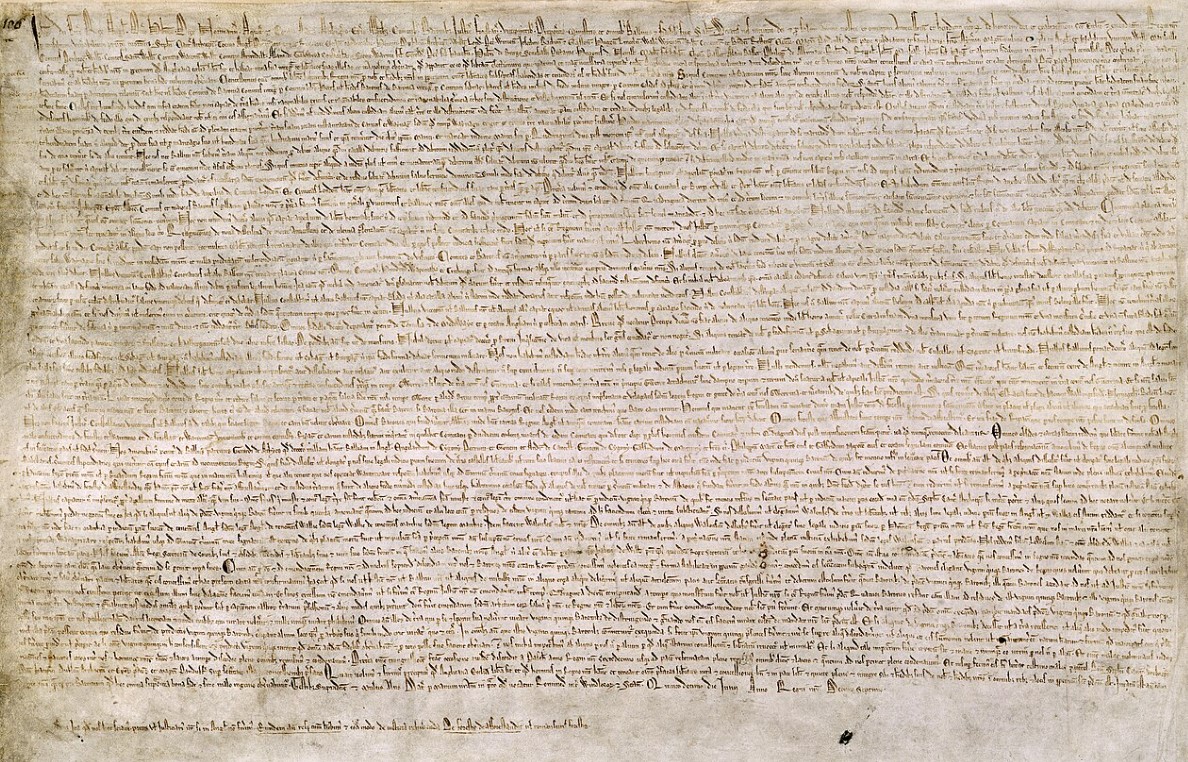
Magna Carta – first composed and signed in England in 1215 – is famously the foundation of much of the Constitution of the United States of America. (1) It is also the first true formalization of some key concepts of British common law like Due Process.
Dimont claims that:
‘Several of the main provisions of the Magna Carta (1215 C.E.) were concepts already embodied in the Torah or Talmud and introduced in England by the Jews. So, for instance, the due process of law provisions in the Magna Carta were first spelled out by Talmudists in the tenth century C.E. Maimonides stated it this way: “Every law which the king enacts for all… is not robbery. But when the king takes away from one person only, not in accordance with the law known to all… it is robbery.”
The two main provisions of the due process of law – that men have the right to live by laws applicable to all, and that no crime can exist until there is a law forbidding that act to all – were incorporated in the Talmud commentaries for centuries before they were incorporated into the Magna Carta and later into the American constitution.’ (2)
Dimont’s purpose here is obvious enough: he is trying to claim that the origins of Magna Carta lie among the jews so therefore the ‘freedoms and rights given by Magna Carta’ were ‘created’ or ‘inspired’ by the jews and therefore because Magna Carta was/is the theoretical basis for the US Constitution; therefore, the United States owes its constitution to the jews.
The problem with this of course is that it is complete nonsense – since as George Macaulay Treveylan explains – Magna Carta was not ‘inspired by jews’ (at least not in the sense that Dimont means it) but rather was the barons and common folk of the Kingdom of England enshrining a series of rights that they have exercised for more than hundred years before formally into law so that they were formally – rather than informally – binding upon the king.
He writes:
‘In England a hundred years before, and still in Scotland and on the continent, the policy of the Barons was each to maintain his individual independence and private ‘liberties’ upon his own estates to the exclusion of the King’s officers. But in England after Henry II, that was no longer to be dreamt of. The new English baronial policy, enshrined in Magna Carta, is designed to obtain public ‘liberties’ and to control the King through the Common Law, baronial assemblies, and alliance with other classes. When the Barons extracted the famous concession that no extraordinary ‘scutage or aid shall be imposed on our kingdom, unless by common council of our kingdom,’ ‘and in like manner it shall be done concerning aids from the City of London,’ — although they proceeded to define the ‘ common council ’ as a strictly feudal assembly of tenants-in-chief — they were none the less taking a step towards the principle of Parliaments and of ‘no taxation without representation.’ It was a very short step, but it was the first, and it is the first step that counts.’ (3)
Now I will handle the issue of whether due process – it in fact does not first occur in Magna Carta but rather occurs in the late Roman Empire specifically in the Corpus Iuris Civilis of Justinian (c. 535 A.D.) which had then just been re-discovered by the Latin West c. 1100 A.D. – (4) is ‘anticipated’ by the Talmudists – Dimont only mentions Maimonides as ‘evidence’ so I don’t see the validity of his plural here – in a separate article, but it is worth pointing out that the reason I stated that Magna Cart was not ‘inspired by jews’ in the sense that Dimont means it – which necessarily implies that jews did inspire Magna Carta but not its legal concepts – is that the reason Magna Carta was created was because King John of England – whose financial problems had been largely caused by his brother King Richard I of England (‘the Lionheart’) effectively selling his English subjects to jewish moneylenders to fund his famous crusading in the Holyland – (5) was being pushed by jewish moneylenders to engage in tyranny and use royal troops to guard them and extract/expropriate money/goods/lands from his subjects, which in turn triggered the revolt of the barons and the commons against John that in turn led to Magna Carta.
As I have explained in my article on the anti-Semitic origins of Magna Carta:
‘The second clause of Magna Carta contains the requirement that the jewish moneylenders operating under the English crown only try to recover their debts the same way that Christians had to and explicitly stated that jews were not allowed to charge usurious rates of interest.
Now this seems innocuous on the face of it – although this background is occasionally omitted from works of popular history that cover the topic – but think about what it is saying for a moment.
It is necessarily implying that the jewish moneylenders operating under the English crown didn’t follow the same debt recovery practices as their Christian compatriots and charged usurious interest rates. The fact that jews charged usurious interest rates is also well-known and well-attested within the literature on the subject.
Also, the debt recovery practices of the jewish moneylenders were notorious, because the jews were the personal property of King John and thus so were their debts. King John was extremely protective of his jewish moneylenders and was heavily en hoc to them financially after the English crown lost control of Normandy in 1204 and had to expend a large amount of capital to build up a fleet and an army to mount a counter-invasion.
To get the money to fund the English counter-invasion; John repeatedly taxed his subjects heavily and they were forced to take out loans with the what we would now called the ‘approved’ moneylenders – i.e. the jews – and then these debts would be subject to enforcement and recovery by royal officials and troops.
As early as 1207 the jewish moneylenders were already pressing John to use his officials and troops to strip assets and wealth from his subjects to pay the debts. This John proceeded to do in 1208 and began to stoke resentment against both himself and his jewish financial proxies.
This continued in a negative cycle until 1213 and 1214 when John was facing potential revolt all around his kingdom and he forced the jews to reschedule debt payments owed to them, because he feared – rightly as it happens – that a revolt would be occur if they did nothing.
This desperation however didn’t stop the popular revolt led by the barons that was explicitly anti-jewish in its rhetoric and was caused by the behaviour of the jews. This is all the more obvious both because of the anti-jewish clause within Magna Carta itself, but also because when the barons and their forces took the city of London from the King. The first thing they went after was the houses of the jews, found the debt registers contained within them and burned them and the jewish quarter to the ground.’ (6)
So, in other words jews didn’t ‘invent’ Magna Carta but their behaviour to the English people was so awful that it is inspired it!
References
(1) https://www.archives.gov/exhibits/featured-documents/magna-carta
(2) Max Isaac Dimont, 1984, ‘The Amazing Adventures of the Jewish People’, 1st Edition, Behrman’s Jewish Book House: New York, p. 110
(3) George Macaulay Trevelyan, 1926, ‘History of England’, 1st Edition, Longmans, Green & Co.: London, p. 170
(4) https://wisc.pb.unizin.org/ls261/chapter/ch-1-4-later-roman-law-due-process-roman-style/
(5) On this please see my article: https://karlradl14.substack.com/p/richard-the-lionheart-and-the-jews
(6) From: https://karlradl14.substack.com/p/the-anti-semitic-origins-of-magna (full citations in original)
Karl’s SubstackRead More



 R1
R1
 T1
T1


