

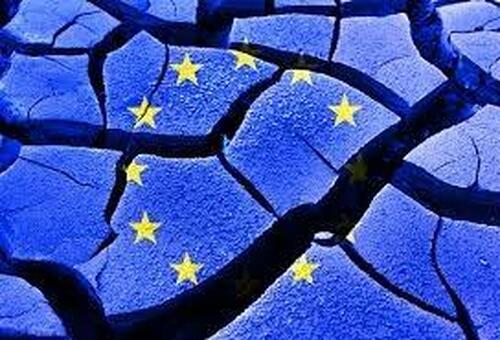
1956 & 2026: Bookends For Europe?
Authored by Michael Every via Rabobank,
As our senior strategist Ben Picton underlined yesterday, the US has total escalatory dominance in its clash with the EU over Greenland, which all emotions aside, is not in the EU or even in Europe: geographically, it’s in the Western Hemisphere / North America.
There is no field where the EU can hurt the US more than it hurts itself. In trade – it’s a net exporter; in tech – it uses US systems in the absence of its own; in energy – it now relies on US LNG, not Russian; in finance – it’s deeply interwoven into the Eurodollar system, which the US controls; and in defence – it still needs the US in Ukraine, and NATO, and can’t defend itself, nor Greenland… and certainly not from the US. This is not to be provocative, just to look at raw facts.
Europe may talk about using its trade ‘bazooka’ Anti-Coercion Instrument, but it seems unlikely to do so. Ironically, it’s too powerful, so would unleash too awful a retaliation. In this respect there’s a parallel to nuclear weapons, which France possesses independently of the US. Military strategists point out it’s also critical to have conventional capabilities at every level of the escalatory ladder, which Europe doesn’t, because otherwise every conflict either ends in nuclear war or defeat.
One must consider such thoughts when reacting to headlines like Denmark dispatching additional troops to Greenland. If, and it still seems extremely unlikely, the US were to take the world’s largest island by force, it would be over in the same timeframe it took to seize Venezuela’s Maduro. The idea of an EU-US war is of course ridiculous. Yet so are all Europe’s other geostrategic ‘options’. Is it going to strike a defence deal with Canada, which can’t defend itself? Or will it pivot to China, which implies embracing its own deindustrialisation and abandoning Ukraine/reaccepting Russia? The former would greatly irritate the US to no end effect for Europe. The latter would make the US an EU opponent in a way that dwarfs Greenland.
Logically, the EU –through clenched teeth– is likely to be forced to concede once a facesaving deal can be struck. Wolfgang Munchau argues the same via UnHerd stating: “So here is my bold prediction: Trump will win his battle for Greenland. The Europeans will not stop him, for they are weak and divided. The irony is that the EU chose this military and geostrategic weakness.” Some talk of Europe then upping its efforts towards strategic autonomy. If so, Stefan Auer argues either EU power needs to be pushed up to Brussels or back down to the member states, as the current structure cannot react fast or decisively enough in the geopolitical context. Even if either were achieved, the economic costs of the changes required are staggering: neomercantilism, not ‘we like free trade’ Merkelcantilism, and a near-war economy starting from large budget deficits and high public debt. Even if those obstacles were overcome, such steps would cause huge frictions with the US, which wants Europe to be a subordinate part of its neomercantilist bloc, not independent. The US would step in as the EU flag was being woven, let alone unfurled. In short, the logical path of least resistance, and damage, still flows back to concession.
For Europe, 2026 may well be seen by historians as a bookend to 1956. Then, the UK and France tried to show they were still Great Powers by sending their armies to Egypt after President Nasser had nationalised the Suez Canal. The US opposed the action and, using economic statecraft, caused a major run on both Sterling and the French Franc. Both countries were forced to retreat and accept they would only be supporting actors to the US on the world stage.
2026 sees the US join other powers in using realpolitik statecraft in its own national interests, as the UK and France did in 1956, even when it makes Europe look like Egypt. This shatters Europe’s view of itself as being an equal, if junior, partner in a joint enterprise, not just on Ukraine, but globally. Indeed, some are now using the words “vassal” or “client states” even as Brussels clings to the liberal world order like a shipwreck survivor to a plank of wood.
But does that actually move markets if we don’t see a shooting war over Greenland, nor an EUUS trade war?
As the Wall Street Journal puts it today, ‘Trump Wants Greenland. Markets Don’t Know What to Make of That: New world order may be so hard to imagine that investors just ignore it.’
Let me help with some ‘imagineering,’ as the Americans call it:
1. Greenland is just a symptom of the end of the liberal world order we’ve been warning of for over a decade. It’s important to focus on for Europe, but the logical outcome, assuming that emotions do not rule, is one that doesn’t shake up markets too much for too long.
2. The end of the liberal world order doesn’t just mean the end of WTO paraphernalia: it means the end of Westphalia, the 1648 European treaty that established the principles of state sovereignty and shaped international relations until recently. That has vast market implications. It’s not good for countries without power, because there’s no international system to prop them up with rules.
3. There’s a fat tail risk of West failure if we were see a EU-US split. That would mean see huge swings in markets – and ironically it’s perhaps Europe’s weakness that might end up being its best card –“We might try to burn down the casino rather than keep playing.”– if they can scare the US into thinking they really are prepared to burn themselves doing it.
Overall, lines on maps are going to move, as they did in the 19 th and 20th centuries. The new Trump Board of Peace is seen by some as an embryonic rival to the UN, not a group of technocrats to rebuild Gaza. Even Davos will this week echo to the thunder of Trumpian realpolitik, not its usual acronyms and technobabble. BlackRock CEO Larry Fink just warned attendees that, “Capitalism must evolve.” It is: back towards something we also saw more in parts of the 19th and 20th centuries, which were not very “Because markets!” in the way we see things now.
If lines on maps move, lines on screens will too.
The EU is applauding the EU-Mercosur trade deal: the US is applauding a $1.5bn deal to build a naval base in Peru near a Chinese-run port. Which will matter more in the long run for controlling trade flows – technocrats in committees talking tariffs and phytosanitary standards or those in uniform on the ground or at sea? That’s what markets shouldn’t ignore.
In short, markets are probably right to be relatively calm about Greenland headlines. Yet at the same time one should not ignore gold and silver soaring even higher, showing larger tectonic plates shifting.
Likewise, Japanese long bond yields are spiking again, if largely due to their own election-related dynamics, which the rest of the world is not immune to with a lag: the 40-year JGB yield just hit 4% for the first time since it was launched in 2007, for example.
Tyler Durden
Tue, 01/20/2026 – 10:00ZeroHedge NewsRead More



 R1
R1
 T1
T1


