

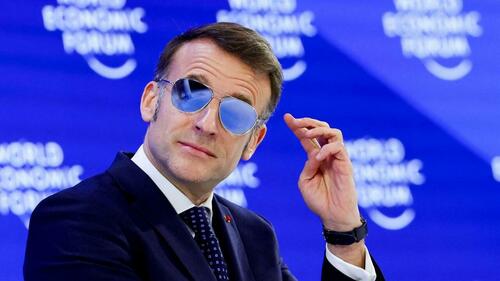
Pilot Attitudes
By Molly Schwartz, Cross Asset Macro Strategist at Rabobank
Macron spoke at the Davos Summit yesterday decked out in 2009 Louis Vuitton “Pilot Attitude” aviators with blue lenses. While c’est chic, it could also serve as a subtle nod to the five hazardous attitudes of pilots, which can lead to their ultimate demise: anti-authority, impulsivity, invulnerability, macho, and resignation.

If there is a single message to be taken away from yesterday’s headlines, it’s that the age of invulnerability in a world governed by a benevolent superpower has passed. Mark Carney made this very clear, using his time to “indirectly” call out Trump’s recent threats towards Greenland (and threats of tariffs on Europe), telling his peers to “stop invoking the ‘rules-based international order’ as though it still functions as advertised. Call the system what it is: a period where the most powerful pursue their interests using economic integration as a weapon of coercion.” In Carney’s telling, the Old New World Order is dead as the US eschews multilateral norms in favor of an anti-authority stance.
US Commerce Secretary Howard Lutnick also chimed in on the state of the world order, proclaiming that “globalization has failed the West,” criticizing what he views as the shortcomings of the World Economic Forum (WEF). “It’s a failed policy,” he argued. “It is what the WEF has stood for, which is export, offshore, far-shore, find the cheapest labor in the world and the world is a better place for it.”
If there were any lingering questions about where the Trump Administration believes the United States fits into this evolving landscape, Lutnick made the answer abundantly clear: “The fact is [globalization] has left America behind. It has left the American workers behind. And what we are here to say is ‘America First’ is a different model, one that we encourage for other countries to consider, which is that our workers come first.”
Japanese 10 year yields shot up 9bp on Tuesday—after a 7.7bp gain on Monday—up to 2.35%, the highest level since 1997. While yields have been grinding higher since Takaichi took office in October, the latest surge can be attributed to her plan to cut the 8% tax on food, leaving skeptics hungry for a credible offset to the projected JPY 5T (USD 31.6b) revenue loss. This has also left JPY as the worst performing G10 currency on the day.
Japan’s Finance Minister, Katayama, has for her part said that she “would like everyone in the market to calm down.” Unfortunately for her, asking nicely for things rarely makes it so—a lesson that the EU is learning the hard way.
When asking nicely fails, rather than sliding into resignation, another option is to fire a bazooka at your opposition. As mentioned by Mike Every in yesterday’s installment, the EU could resort to its so-called “trade bazooka”—or the Anti-Coercion Instrument (ACI) to be more precise. The ACI allows the EU the flexibility to adjust tariffs and restrict exports, or even impede on foreign direct investment. But unlike a normal bazooka, leveraging the ACI requires overcoming self-imposed bureaucratic hurdles.
While Brussels threatens to consider beginning the process of potentially starting conversations to employ the ACI, world leaders took to the stage (or perhaps the red carpet in Macron’s case) to come after Trump’s newly announced tariffs at Davos. If they’ve finally realized how negotiations really work when the other party holds all the cards, their recent spiels wouldn’t suggest as much, putting on a macho front as they face the world. Macron said that Trump was issuing “an endless accumulation of new tariffs that are fundamentally unacceptable,” while Ursula von der Leyen noted that “in politics as in business, a deal is a deal. And when friends shake hands, it must mean something.”
But Europe claims to have another weapon—offloading US Treasuries. Scott Bessent, however, appeared unperturbed by such threats, stating that “it’s been 48 hours, sit back, relax. I am confident that the leaders will not escalate and that this will work out.” While the eagerness to sell America may come across as impulsive, others frame is as a hedge against a weaker USD and deteriorating faith in US institutions. Déjà vu? The question remains, however; if we see mass dumping from European institutions, where do the dollars go?
Whether impulsive or prophetic, American assets did feel some heat yesterday as the S&P 500 closed down 2%. Meanwhile, US Treasury yields bear steepened with pressure concentrated on the long end, as the 10 year jumped more than 15bp since January 14 and reached levels not seen since August 2025.
Tyler Durden
Wed, 01/21/2026 – 11:00ZeroHedge NewsRead More



 R1
R1
 T1
T1


