

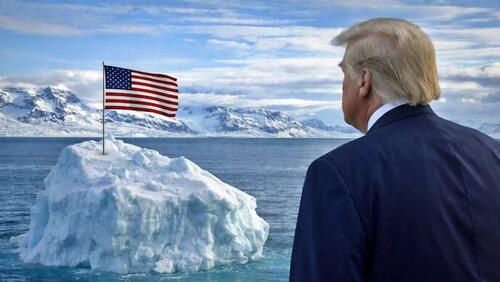
Trump’s “Green Deal” Has Fully Shattered The Liberal World Order
By Michael Every of Rabobank
Green Stocks Land
The Greenland crisis was logically always likely to end quickly, to market approval, due to European geostrategic weakness, but still herald a new world order that markets don’t understand and won’t like once they do. That’s exactly how it’s now played out.
At Davos, President Trump ruled out the use of force but gave Europe and NATO an ultimatum on Greenland: within hours, a ‘framework deal’ was struck and threatened US tariffs on eight EU countries have been removed. This reportedly echoes the post-imperial arrangement the UK has with Cyprus. The US gains time-unlimited (Trump: “Forever”) access to areas of Greenland around military bases, as well as concessions for critical minerals, and the island will host the US Golden Dome missile defense shield. There will also be a far greater, permanent European NATO focus on its defense and the Northern Passage.
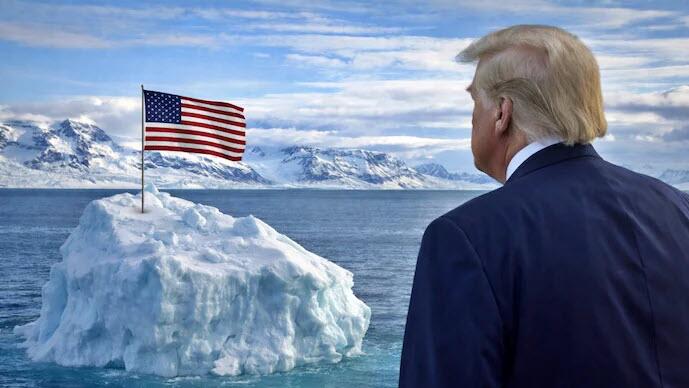
Those who say TACO all the time will cluck here. Those who see Republicans serve up ‘American Greenland’ cake at a Kennedy Centre event, Trump forcing vastly higher defense spending on all US allies, being paid tariff revenues that aren’t part of any agreed FTA, receiving trillions in pledged inwards FDI which the US will direct, and putting Iran’s nuclear programme under rubble and Venezuela’s Maduro in a New York courtroom, will argue it’s Europe that yielded, and will be forced to spend even more on Arctic defence, and to move even further under a US shield and a critical minerals processing compact, not its own independent ones.
For markets, that’s the good news. The bad news is that the liberal world order is shattered.
Trump didn’t invade – and he was never going to except in some fevered imaginations. Yet he demonstrated to Europe he could, as could others in the future, and there’s presently nothing they can do about it. That’s how the world always worked until the past few decades, and it’s how it will work again going forwards.
For example, as Europe looks north-west, this week saw the US suddenly withdraw support for the Kurdish region of Syria that has thrived in recent years as it opts to back the former-jihadi Syrian president instead: there are already reports of appalling violence being inflicted on Kurds there. If Europe noticed that development to its south-east, it’s completely powerless to do anything about it if it disagrees – which isn’t clear at all either.
Moreover, on top of trade, energy, tech, finance, and NATO/Ukraine as points of relative European geostrategic weakness, once one accepts realpolitik, consider that if Europe ever ‘pivots to China’, as some have whispered, the US can ‘pivot to Russia’ and arm it against Ukraine and Europe. If Europe thinks it has that China card in its pocket, it needs to be aware that the US still has more of them.
That’s hardly the foundation for a solid Western alliance. Indeed, even with tariff threats removed, the European establishment loves America but in private evidently wishes Trump were gone – ECB President Lagarde walked out of a Davos dinner after anti-EU barbs from US Commerce Secretary Lutnick. Equally, the US President states in public that he loves Europe and his admin that they wish its establishment was gone (see the NSS). So where to from here?
Logically, leaderships could change. November 2026 looms, as does the French presidential election in April 2027. Yet some genies aren’t so easily put back into bottles.
As such, it’s down to the realpolitik of who has the best cards. Canada’s PM Carney, who didn’t meet Trump at Davos, earlier made a much-publicized speech which stated: “Many countries are drawing the same conclusions – that they must develop greater strategic autonomy: in energy, food, critical minerals, in finance and supply chains. And this impulse is understandable. A country that can’t feed itself, fuel itself or defend itself has few options. When the rules no longer protect you, you must protect yourself.” That sounds exactly like Trump.
Yet as George Magnus points out, Carney citing Czech anti-communist dissident Vaclav Havel’s ‘The Power of the Powerless’ to call out Trump and the polite hypocrisies of the liberal world order doesn’t sit easily with him heading to China to strike trade deals. That’s Trump’s game, played with far weaker cards. Today, the powerless are… powerless.
Indeed, Trump noted from the Davos stage: “Canada lives because of the United States. Remember that, Mark, the next time you make your statements.” As the Canadian press puts it, ‘At Davos, a new great game dawns for the world. Which way, Canada?’ And all of us.
In the short term, green land – because TACO, or because Europe in 2026 is Egypt of 1956. In the long term, it’s unclear – and starkly binary.
Europe and others can try to go their own way. For example, Spain just urged the EU to create a joint army. Yet that’s the same Spain that adamantly refuses to spend 5% of GDP on defence within NATO. Talk is cheap. Preparation for war, or for strategic autonomy, is mind-blowingly expensive, and the US can block these moves every step of the way. Or European disunity can block itself: the European parliament just voted for the new EU-Mercosur deal to be given judicial review, which will delay it for a year. Trump deals seem to get agreed on a handshake or a tweet.
Or Europe and others will see policy after policy directed by the US. Consider the EU just watered down its green rules to ensure it can keep flows of Qatari LNG; and symbolically, the World Economic Forum is considering moving from Davos to new places. Like Florida?
Long-term planning is going to be very hard if you don’t know who is doing it for you – the US, or Europe – or China?
Domestic politics will also twist and turn in tandem. In Australia, the opposition coalition between the Liberals and the Nationals has just shattered again for the second time in a year. This time, it may not come back together as One Nation surge in the polls.
In markets, at Davos, ‘Wall Street Chiefs Try to Lay Low to Avoid Trump’s Trolling’ says Bloomberg, which summarises the mood.
Eyes are on the Supreme Court, which in hearing oral arguments expressed scepticism over Trump’s bid to sack Lisa Cook from the Fed, with specific mention of the importance of its independence. That Trump front matters as much, if not more, than Greenland, and potentially opens up a new world order to the same extent. If he wins there it would again mean green land at first, because “rate cuts!”, but then serious questions over what/where next.
There is also relative calm in Japan, which is also in the green following efforts to stabilize things after the wild volatility in JGB markets this week. That trend, which some try to paint as “a quarrel in a faraway land between people of which we know nothing”, with no implications for sensible developed markets like Europe, is also a warning. Japan just ran its fifth consecutive annual trade deficit in 2025, and it’s that development –alongside “it’s baaack” inflation– which is undermining its ability to stabilize its markets without relying on the kindness others.
That structural threat looms ahead for many economies and is another reason why they need to not only be ‘resilient’ but to run trade surpluses —which obviously not everybody can– or find a bloc they can sit within that will support them. And sometimes that choice is made for them.
Tyler Durden
Thu, 01/22/2026 – 11:05ZeroHedge NewsRead More



 R1
R1
 T1
T1


