

The AI Factor Behind Trump’s Power Play On China’s Oil Suppliers
Authored by James Gorrie via The Epoch Times,
Why is it so important to the Trump administration to take control of Venezuela and encourage the people of Iran to overthrow the Islamic regime?
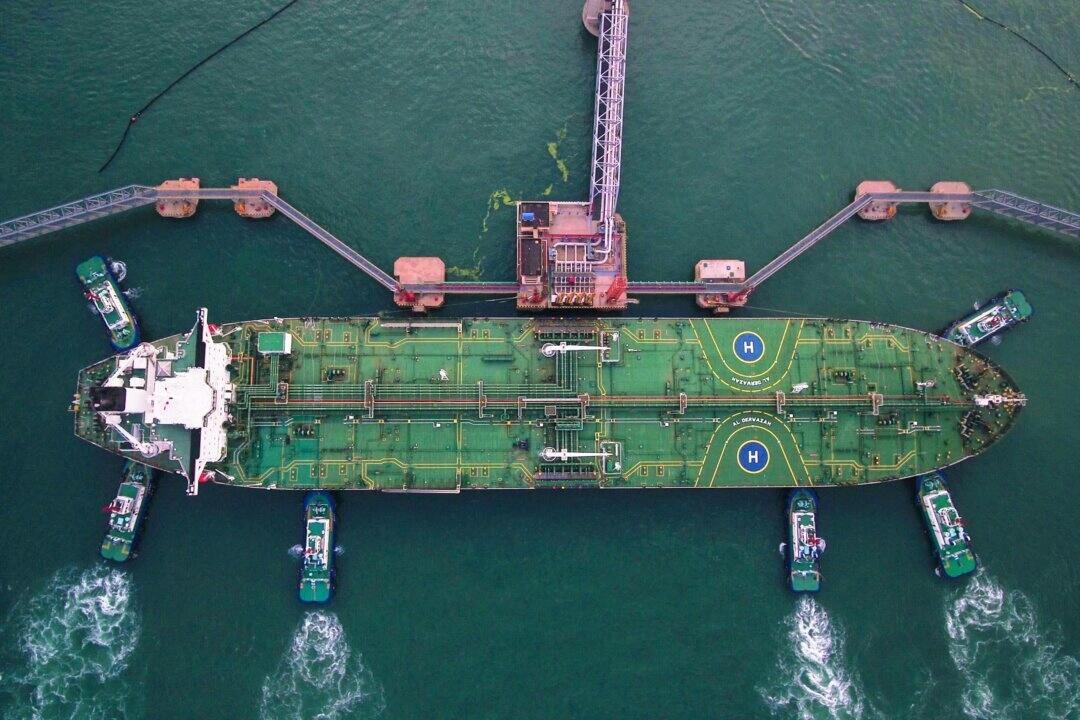
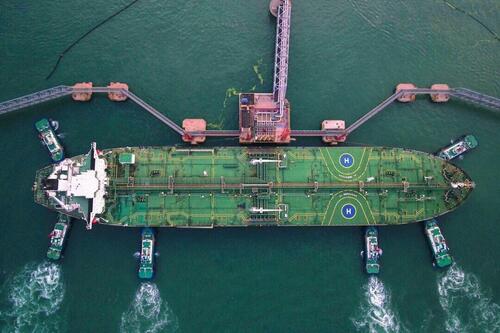
The link between the two is obviously oil.
Of course, the strategy in Venezuela involves oil, but also includes restricting China’s influence in the Western Hemisphere, undermining the BRICS currency, and shutting down Venezuelan drug trafficking, illegal immigration, and other nastiness.
Same for Iran regarding oil. Both are important energy suppliers to China, but especially Iran.
But it’s not the whole picture. President Donald Trump’s broader strategy is about restricting China’s access to cheap, reliable oil at the exact moment it needs that energy to compete with the United States in artificial intelligence (AI).
Venezuela Was a Great Deal—For China
Looking back, Venezuela was as an unbelievable good deal for China. Sanctioned by the United States and shunned by much of the West, Caracas sold heavily discounted crude to Chinese refiners willing to tolerate risk. It wasn’t glamorous oil—but it was dependable and cheap. Venezuela provided about five percent of China’s annual oil needs; not a huge figure, but enough to matter.
Trump’s decision to blockade Venezuelan oil exports and assert control over the country’s oil infrastructure effectively ends that dream deal. With U.S. control, China loses a meaningful slice of supply, about four percent, that helped buffer it from global price swings.
That matters more than it sounds.
As the world’s largest oil importer, even small disruptions force Beijing to scramble for alternatives—often at higher prices, longer shipping distances, or greater political cost.
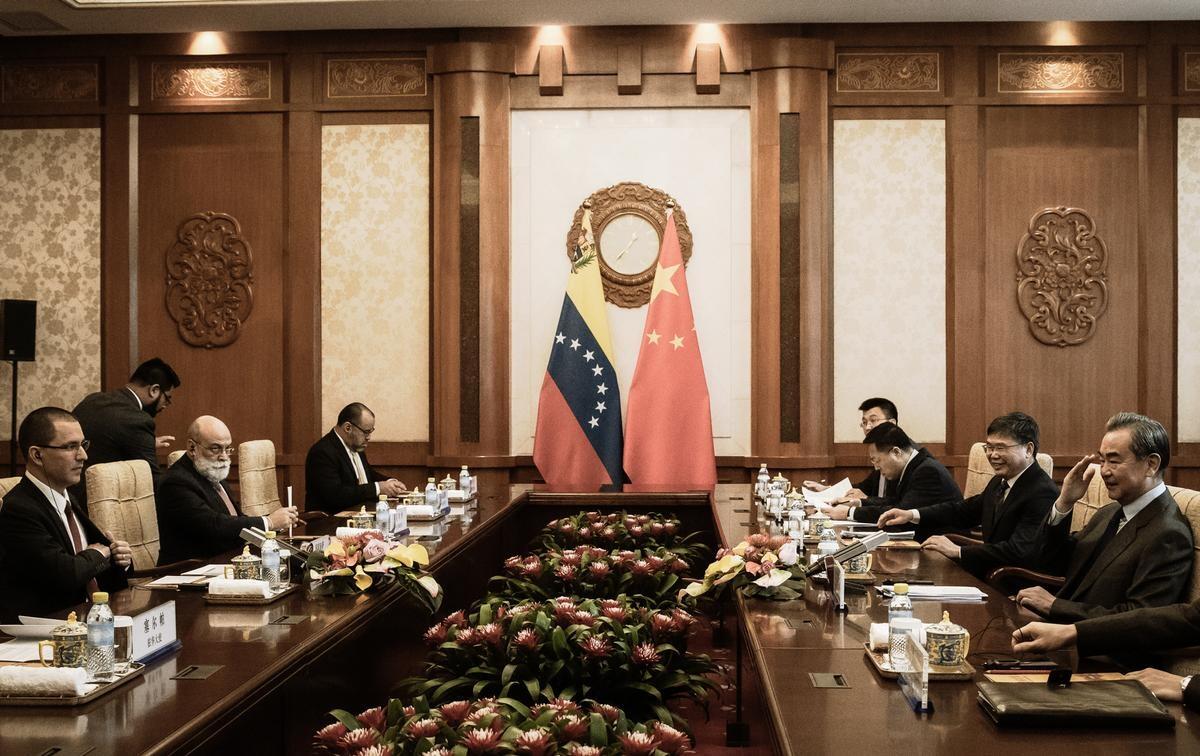
Chinese Foreign Minister Wang Yi (R) speaks during a meeting with Venezuelan Foreign Minister Jorge Arreaza (L) at the Diaoyutai State Guest House in Beijing on Jan. 16, 2020. Ng Han Guan-Pool/Getty Images
Iran: The Bigger Pressure Point
But the Venezuelan oil flow to China is small potatoes compared to that of Iran.
China is Iran’s largest oil customer, buying the vast majority of Tehran’s exported crude, up to 80 percent, often at steep discounts, and is the life blood to China’s independent refineries, its petrochemical sector, and its power-hungry industrial base. In other words, Iranian oil is critical to China’s continued economic and technological growth.
That fact puts Trump’s renewed pressure on the ruling Islamic regime in Iran in a different light. The tariffs, sanctions enforcement, secondary penalties, and encouraging rebellion by the Iranian people is more than just punishment for Tehran. It puts China in an energy bind.
Should Beijing keep buying Iranian oil and risk broader economic retaliation, or comply and lose one of the cheapest energy sources available?
Either way, Beijing pays more for less reliable oil supplies.
Why Oil Still Matters in the AI Age
There’s a popular myth that AI runs on “clean” digital infrastructure—clouds, algorithms, and software. In reality, AI runs on electricity, and electricity is still largely generated through nuclear power and fossil fuels, i.e., oil, natural gas, and coal. Training large AI models requires staggering amounts of energy, and a single hyperscale data center can consume as much electricity as a mid-sized city. Multiply that by hundreds of facilities, and energy, not chips, becomes the real bottleneck in the AI race.
Beijing understands this. That’s why it continues to approve a record number of new coal plants, expand its gas infrastructure, and secure long-term oil contracts—even while leading the world in renewables.
What’s more, China knows that oil and gas help stabilize power grids that support data centers. Intermittent renewables alone can’t guarantee the always-on power that AI systems require. Plus, AI hardware depends on petroleum-based products—plastics, resins, coolants, lubricants, and advanced composites used in chips, servers, and cooling systems. Oil is a non-negotiable industrial input.
Finally, oil is relatively inexpensive, lowering the cost of training models, which compounds quickly, because whichever nation can train more models faster and cheaper leads the AI race.
Cutting China off from discounted oil doesn’t just raise fuel prices, it raises the cost of intelligence itself.
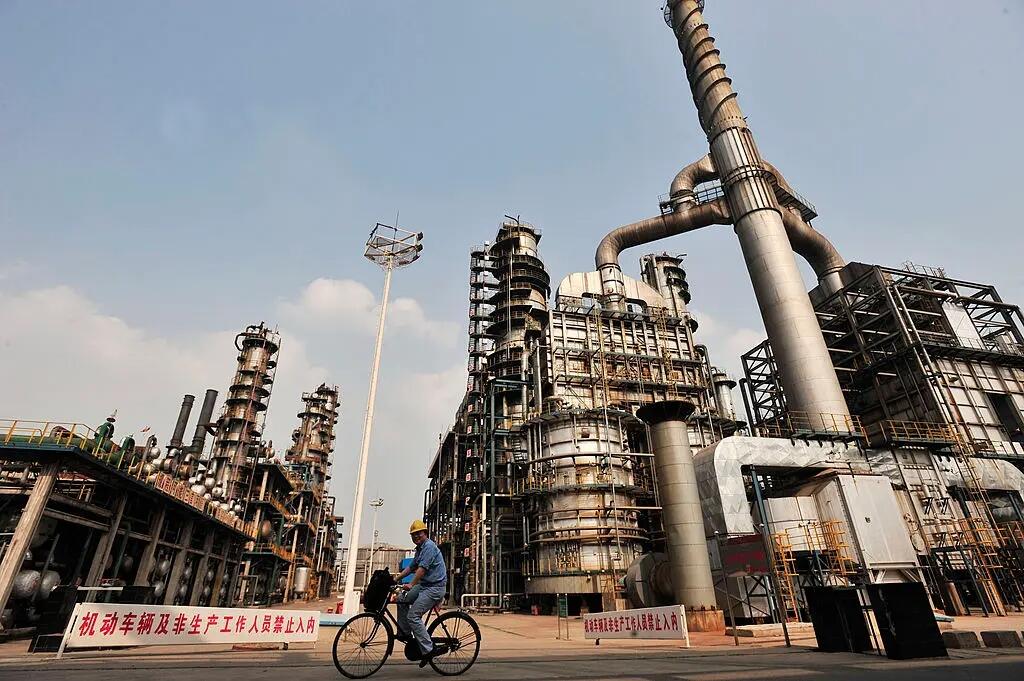
A worker rides bicycle at an oil refinery of China’s Sinopec in Wuhan, a city in China’s Hubei Province on May 10, 2011. STR/AFP/Getty Images
Energy as a Hidden AI Weapon
This is where Trump’s strategy becomes clearer.
The United States doesn’t need to out-build China in data centers if it can out-price and out-power them. America has abundant domestic oil and gas, expanding LNG exports, and deep capital markets to finance new, energy-hungry infrastructure.
China, by contrast, is vulnerable. It imports over 70 percent of its oil. Much of that comes from politically unstable or sanctioned states. Disrupt those flows, and China’s AI ambitions become more expensive, more fragile, and more dependent on geopolitical goodwill.
In that sense, oil becomes a second-order AI weapon, in that it is not something that directly attacks technology, but something that quietly determines who can afford to scale it.
What This Means for the Global Balance
Yes, Russia still matters in this equation—but more as a background variable than the main event. Lower oil prices and tighter markets can squeeze Moscow’s revenues and complicate its war financing. China’s increased reliance on Russian crude also deepens a partnership that carries long-term risks for Beijing.
But the real target of Trump’s energy denial strategy isn’t Russia. It’s China’s momentum.
Trump’s energy foreign policy is about slowing China’s rise without firing a shot—forcing it to spend more, plan more cautiously, and accept structural disadvantages in the most important technological competition of the century.
The Bigger Picture
AI dominance won’t be decided by who writes the best code. It will be decided by who can power the most machines, the longest, at the lowest cost.
By squeezing Venezuela, pressuring Iran, and reshaping global oil flows, Trump is betting that energy strategy, not algorithms, will decide the winner in the AI-driven economy.
And if that bet is right, the future of AI may be decided not in Silicon Valley or Shenzhen, but in oil fields, shipping lanes, and sanctions that most people aren’t paying attention to.
Views expressed in this article are opinions of the author and do not necessarily reflect the views of The Epoch Times or ZeroHedge.
Tyler Durden
Sun, 01/25/2026 – 07:00ZeroHedge NewsRead More



 R1
R1
 T1
T1


