
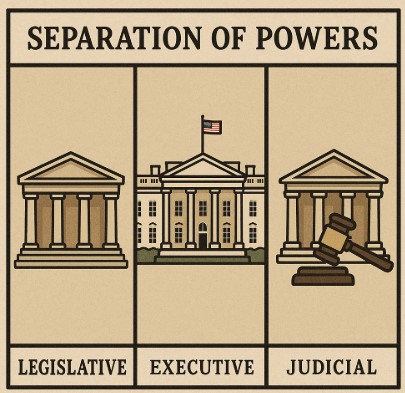
The last ‘jewish invention’ claim we have from Debbie Lechtman is the claim that jews created the first governmental system that had a separation of powers between different branches of said government.
Lechtman writes as follows:
‘SEPARATION OF POWERS
The Israelites were among the first — if not the first — to establish a system of checks and balances in government: (1) the Torah, responsible for communicating God’s will to the people, (2) Kehunah, or the priesthood, and (3) Malkhut, meaning civil rule, which is responsible for day-to-day business of civil governance.
Prior to the establishment of the Kingdom of Israel in 1047 BCE, the Hebrew tribes formed a loose confederation. Archaeologists and secular historians believe that there was no centralized governance during this period, but that instead each of the tribes was responsible for its own leadership; however, each of the tribes recognized the authority of the chieftains outside of their own tribe. These chieftains — or judges, as they are generally called today — were generally men, though arguably the most famous judge of the time was Dvora (Deborah), a woman.
Rabbinical courts, known as beit din, date back to antiquity. In ancient times, a beit din was the main legal structure preceding over the Land of Israel. While initially the judges to each court were appointed by their predecessors (in other words: a judge was appointed to the court by a judge in the court), by the fourth century, the selection process was democratized. That is, the people elected the judges, taking great care to choose the most qualified and impartial candidates. The standards for candidature were rigid, to ensure that they were “wise men, and understanding and full of knowledge,” who were charged to “hear the causes between your brethren and judge righteously between a man and his brother and the stranger,” to not be “partial in judgment,” and to “hear the small and the great alike; fear no man, for judgment is God’s.”
In small Israelite towns, a minimum of three judges were appointed to the beit din, so that, in case of a split opinion, the opinion of the majority prevailed. In large towns, too, judicial opinion was deferred to majority rule.’ (1)
The problem is that Lechtman’s claim is based entirely on taking the Book of Judges in the Tanakh as being a reliable historical document and claims that ‘secular scholars agree’ which is absolute nonsense because they in fact generally argue the opposite of what she claims.
For example, Elizabeth Bloch-Smith and Mark Smith write that:
‘The nineteenth and twentieth centuries witnessed the use of ‘biblical archaeology’ to support the view that Judges represents Israel’s historical reality in the pre-monarchic period, the era that the book purports to relate. The result was an optimistic representation of Judges’ historical background, as represented by John Bright’s History of Israel, in turn reflected in Robert G. Boling’s Judges commentary. While a half-century has passed since the halcyon days of biblical historicism, some scholars continue to see in Judges signs of an early period. For example, Israel Finkelstein suggests that a ‘vague memory’ of a late Iron I/very early Iron II conflict can be gleaned from the story of Ehud. By contrast, most critical scholars today would claim no such early historical record in Judges.’ (2)
While Lester Grabbe writes that:
‘Two points relating to history, however, can be made about the book of Judges: first, the picture of a tribal society without a unified leadership engaging in uncoordinated local actions seems to fit the society of the hill country in IA I, as evidenced by the archaeology….Secondly, perhaps the one exception to the historical ambiguity of the text is the Song of Deborah in Judges 5.’ (3)
The point is simple.
The Book of Judges is not a historical record in the normal sense of the term and cannot be read as historical evidence for things except for possibly the Song of Deborah which has long been suspected to be the sole piece that could be a near-contemporary survival from the actual time depicted in the Book of Judges. (4)
So thus the Book of Judges is out as evidence of anything much in regards to the historic Israelites which then per force throws out Lechtman’s entire ‘argument’ since she has misrepresented the historic consensus on the historicity of the Book of Judges in the say way we shouldn’t use the works of Homer as the sole evidence for Mycenaean religion because Homer’s works are not historical records pe se but rather can only be used to confirm/evaluate other evidence.
Now if we look historically, we do know exactly where the first confirmed mention of such a governmental separation powers occurs in Polybius’ Histories (c. 140 B.C.) when he is describing the Roman Republic, but he credits Sparta as being the first society where this occurred. (5)
This is in fact true according to modern scholars of Sparta given that Sparta had the Supreme Council of Elders – known as the Gerousia – that had been established in theory by Lycurgus whose members had been elected for life by acclamation by Apella (the citizen assembly of Sparta) and who acted as a counterweight to Sparta’s two kings and often contradicted/opposed them (most famously in sending the Spartan army to Thermopylae in 480 B.C.). (6)
Thus, we can date the first government with the separation of powers to the time of Lycurgus at Sparta (i.e., the 700 B.C. to 1100 B.C.) and it has absolutely nothing to do with jews!
References
(1) https://www.rootsmetals.com/blogs/news/israelite-jewish-inventions-during-ancient-times
(2) Elizabeth Bloch-Smith, Mark Smith, 2021, ‘Judges 1: A Commentary on Judges 1:1–10:5’, 1st Edition, Fortress Press: Minneapolis, pp. 18-19
(3) Lester Grabbe, 2017, ‘Ancient Israel: What Do We Know and How Do We Know It?’, 2nd Edition, Bloomsbury: London, pp. 117-118
(4) Ann Killebrew, 2020, ‘Early Israel’s Origins, Settlement and Ethnogenesis’, p. 84 in Brad Kelle, Brent Strawn (Eds.), 2020, ‘The Oxford Handbook of the Historical Books of the Hebrew Bible’, 1st Edition, Oxford University Press: New York
(5) Polybius, Hist., 6:11-13; you can read this yourself here: https://penelope.uchicago.edu/Thayer/E/Roman/Texts/Polybius/6*.html
(6) For example, see Douglas MacDowell, 1986, ‘Spartan Law’, 1st Edition, Scottish Academic Press: Edinburgh, pp. 123-143
Karl’s SubstackRead More


 R1
R1
 T1
T1


