The College Calculation Has Flipped
Authored by Jeffrey A. Tucker via The Epoch Times (emphasis ours),
Buried in new data from the Bureau of Labor Statistics (BLS) is a bearish sign for a college education, the first time we’ve seen this in 50 years. Trade workers without a college education are gaining new advantages in employment stability and even in earnings. On paper, a college degree still earns more but that edge is slipping too.

The Cleveland Fed explains: “For decades, college graduates have typically faced lower unemployment rates, found jobs faster, and experienced more stable employment than high school graduates without college experience. Combined with higher expected wages, these advantages reinforced higher education as a pathway to economic security. However, some of the long-standing job market advantages offered by having a college degree may be eroding.”
The BLS data is extremely revealing. The unemployment rate for people with no college education has dropped dramatically to 4.0 percent, while those with some college rose just as dramatically to 3.8 percent.
The trend line here is what is instructive. The obvious edge from holding a college degree seems to be slipping while those without such a degree are gaining steam. This is the first time we’ve seen this trend in half a century.
The income advantages are still there for a college education but even here, we are seeing a generational shift. The pace at which income is rising for those who choose trades has more upward energy than those without. The gap is there but narrowing.
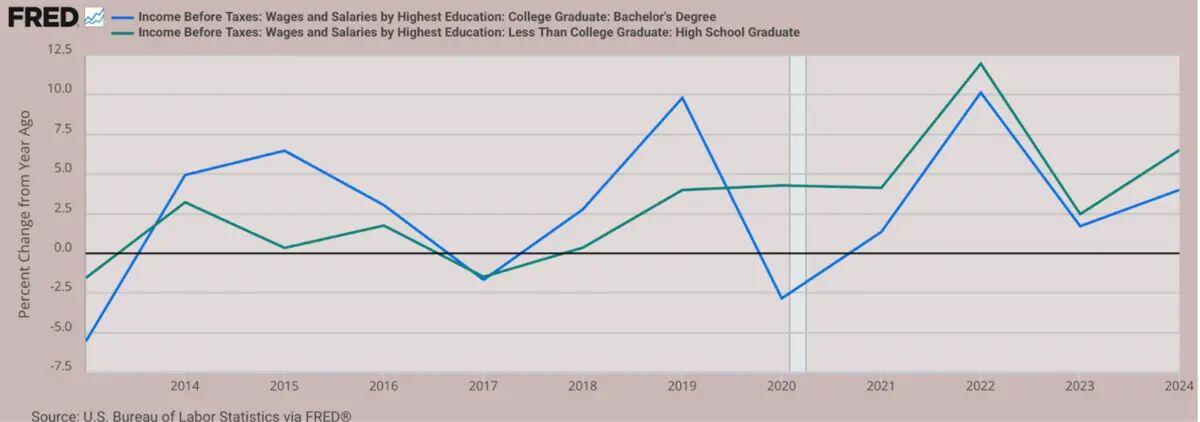
The Washington Post explains: “The unemployment gap between workers with bachelor’s degrees and those with occupational associate’s degrees—such as plumbers, electricians and pipe fitters—flipped in 2025, leaving trade workers with a slight edge for six months out of the past year, according to the Bureau of Labor Statistics. It’s the first time trade workers have had a leg up since the BLS started tracking this data in the 1990s.”
It’s a bit ironic that this story was posted just days before the Post itself laid off fully one-third of its workers, a gutting of the staff of a major paper that we’ve never seen before. No question that Artificial Intelligence has something to do with it, but, then again, AI is a convenient excuse for what these institutions knew they had to do to regain something approaching profitability.
There are two additional factors at play here.
First, everyone employed in a high-end professional setting knows with absolute certainty that all major corporations are wildly overstaffed and have been for many years, even decades dating back to the advent of artificially cheap credit in 2000. After that point, the banking system subsidized leverage over real capital and earnings. The consequence was a professional hiring boom like we’ve never seen.
Over several days, I spoke to many friends who are employed in these large institutions and asked for their estimates of how much in the way of overstaffing they face. I got estimates that range from 50 to 90 percent. In other words, in their own experience, at least half the workers in large institutions do not actually add value, if they do anything at all.
This is a remarkable testimony. Recall that the “Dilbert” cartoonist Scott Adams recently died. The main import of his column was all about satirizing the sheer waste in corporate America. The amount of bureaucracy is appalling as are the endless demands for meetings, committees, compliance teams, training, and absolute make-work programs that do nothing for the consumer or the profitability of the company.
We’ve seen what has happened to high-end management over the last three years. Most corporations are laying off workers—not those who face the customer but the managerial layers. The lockdown pandemic period essentially proved that these companies might actually perform better if this layer of worker stays home and goofs off. That period essentially convinced owners (stockholders) that vast numbers of people needed to be permanently terminated.
Recall that when Elon Musk took over Twitter, his first actions concerned personnel. He ended up firing an astonishing four-fifths of the legacy employees. He just did not see the need for them. Almost immediately, the platform became better. It is a private company so we don’t have a fix on profitability metrics today but it is easily the number one news app for the world today.
That example sent a signal to the whole of the corporate world. Layoffs were just a matter of time.
The second factor concerns earnings potential of college vs. no college. There has always been a basic fallacy at work in interpreting the data. The fallacy is called Post Hoc Ergo Propter Hoc, Latin for: after this therefore because of this.
To be sure, a college degree is associated with higher earnings, but is that because of the degree or because of the kind of person who hangs around long enough to earn a degree, can afford a degree, or is in a profession that requires a degree? Once you correct for all these confounding issues, it is not at all clear that the data are telling the truth. Certainly it is far from the case that a degree causes one to make a high income.
Consider the costs of college beyond the outrageous financial expense. We are taking people who are at the height of their learning potential, the very time of life when becoming an adult and a great worker is at a premium, and sticking them in childish environments. College encourages terrible lifestyle choices, finding shortcuts, drugs, drinking too much, and otherwise experimenting with dangerous choices.
And the student does this for fully four years, during the most impressionable early years of adulthood, leaving graduates with no work ethic and a wildly distorted view of what life is all about. It seems nearly unfair to throw such people into professional life. They are ill-equipped.
Compare this reality with someone who leaves high school to learn a trade, whether that is welding, construction, or coding. After four years, such people already have a gigantic advantage over their peers in college. They know what it is to get to work on time, do what the boss says, achieve things, manage money, and so on, essentially skills that kids matriculating in college do not have.
Hence the real cost of college is not even the out-of-pocket expense or the debt. The actual cost is four years lost during the most important years of one’s life. And as for the actual education one receives, times have dramatically changed. You have free access to all the professors and teaching you want. With some discipline, a person with a job can obtain a PhD-level education in any field on nights and weekends with zero financial expenditure.
Looked at this way, it was only a matter of time before the advantages of declining college would become obvious. Believe me, parents are paying close attention. The main reason they spend a quarter of a million to send kids to college is to guarantee a better income in the future.
When that promise is revealed to be a false one, everything changes. Then we are only left with the social and marital advantages of college—which might be enough to keep them open for another 10 years or longer. But the shine is fading fast and the edge is getting ever more dull. The trendline in the data these days is favoring the trades over the dorm room.
Tyler Durden
Tue, 02/10/2026 – 17:40ZeroHedge NewsRead More


 R1
R1
 T1
T1