

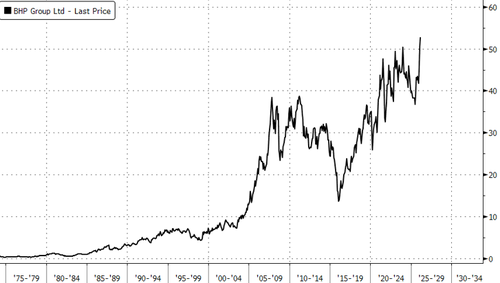
BHP’s Copper Pivot Pays Off With Surprise Dividend Bump, Record-High Stock Price
Shares of BHP Group, the world’s largest miner, jumped to a record high in Australia after it posted earnings at the top end of Wall Street expectations. The miner’s pivot into copper, aided by a surging rally in industrial metals, offset softer conditions in its iron ore unit.
BHP chief executive Mike Henry reaffirmed to investors earlier on a call that the miner is pivoting toward “future-facing” metals. In other words, he explained that the world’s largest miner’s shift away from operations focused on serving China’s steel mills has paid off, as copper has soared.
Henry said that acquisitions began to bear fruit, as did the improvements at Escondida, the world’s largest mine, all of which were helped by a record surge in the price of the industrial metal used heavily for power grids and AI-related applications.
“This is the result of our deliberate actions to grow our copper business,” Henry told analysts, adding, “Now, BHP is, by design, a diversified miner rather than focused on a single commodity.”
At the time of writing, iron ore futures on the Dalian Commodity Exchange were trading at depressed levels below $100 per ton, while copper on the London Metal Exchange was trading around $12,850 per ton.
BHP earnings highlights:
-
Underlying attributable profit rose 22% to $6.2 billion for the six months to end December. Shares in Australia jumped as much as 7.6% to a record.
-
Copper contributed more than half of the profit for the first time, motly because of higher copper prices and steady output. Copper division underlying EBITDA climbed 59% to $8 billion.
-
Iron ore earnings edged 4% higher and still make up close to half of the total, though BHP is dealing with “tough” negotiations with China’s state buyer, China Mineral Resources Group.
-
The Jansen potash project in Canada remains on track for first production in the middle of next year, though first-phase capex has risen to $8.4 billion.
-
On M&A: Recent gains include the 2023 purchase of OZ Minerals and the Vicuna joint venture with Lundin Mining. Attempts to buy Anglo American (and efforts around its tie-up with Teck Resources) were unsuccessful, so BHP is emphasizing organic growth and being more disciplined in deal-making.
-
Reiterated its plan to unlock up to $10 billion through asset sales and other transactions. It announced a $4.3 billion long-term silver streaming agreement with Wheaton Precious Metals tied to byproduct silver from the Antamina mine in Peru (BHP owns 33.75%). It also recently sold a $2 billion stake in the power network supporting Pilbara operations.
-
Declared an interim dividend set at 73 cents, equal to a 60% payout ratio
UBS analyst Dominic Ellis commented on BHP’s earnings, indicating “BHP Surprises With Dividend Bump.”
Ellis told clients:
BHP’s EBITDA beat by 3% in the first half of its financial year while EPS beat by 4%, but the surprise was the 16% increase in the dividend, on a 60% payout versus the baseline of 50%. Net debt stood at $14.7 bn, at the midpoint of the guided range, capex in line and guidance unchanged. Group EBITDA from copper was 51%, more than half of EBITDA for the first time. The stock has been a funding short for specialists, and while shares are performing well on these resutls, feedback from clients recently has been on the disconnect between iron ore (down sharply, now below $100/t) and iron ore equity resilience. BHP’s spot free cash flow yield is 3.5% this year versus Rio Tinto on 6.4%.
Reminder about the copper market:
Strong earnings and a copper-led pivot that’s cushioning a softer iron ore business have rewarded shareholders with record-high share prices in Australia.
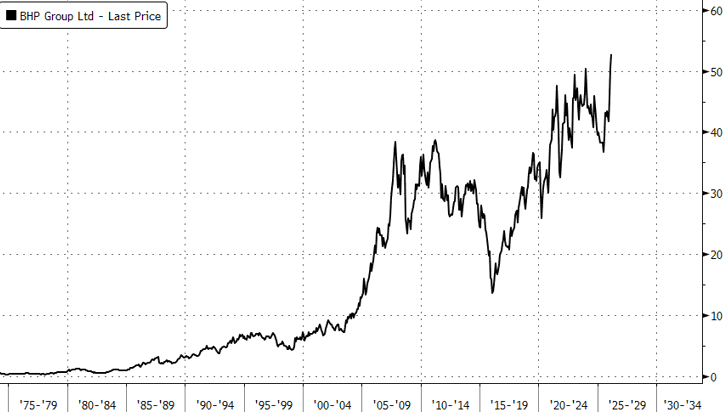
“In the last five years, the BHP CEO has set the business up with options,” said Glyn Lawcock, head of metals and mining research at Barrenjoey Markets Pty in Sydney. “Clearly, growth to 2030 is really potash and iron ore, but you hit the start of the new decade, it’s pretty much all copper.”
Tyler Durden
Tue, 02/17/2026 – 07:45ZeroHedge NewsRead More



 R1
R1
 T1
T1


