

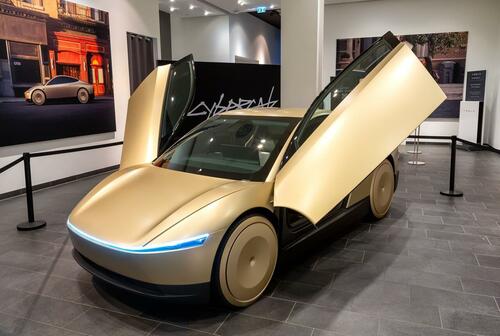
Tesla Scores FCC Waiver For Wireless Cybercab Charging System
On Wednesday, Tesla’s first Cybercab officially rolled off the production line in Texas. The Model Y robotaxi is a two-passenger, self-driving EV with no steering wheel or pedals, though it will have a human “safety monitor” in most cases.
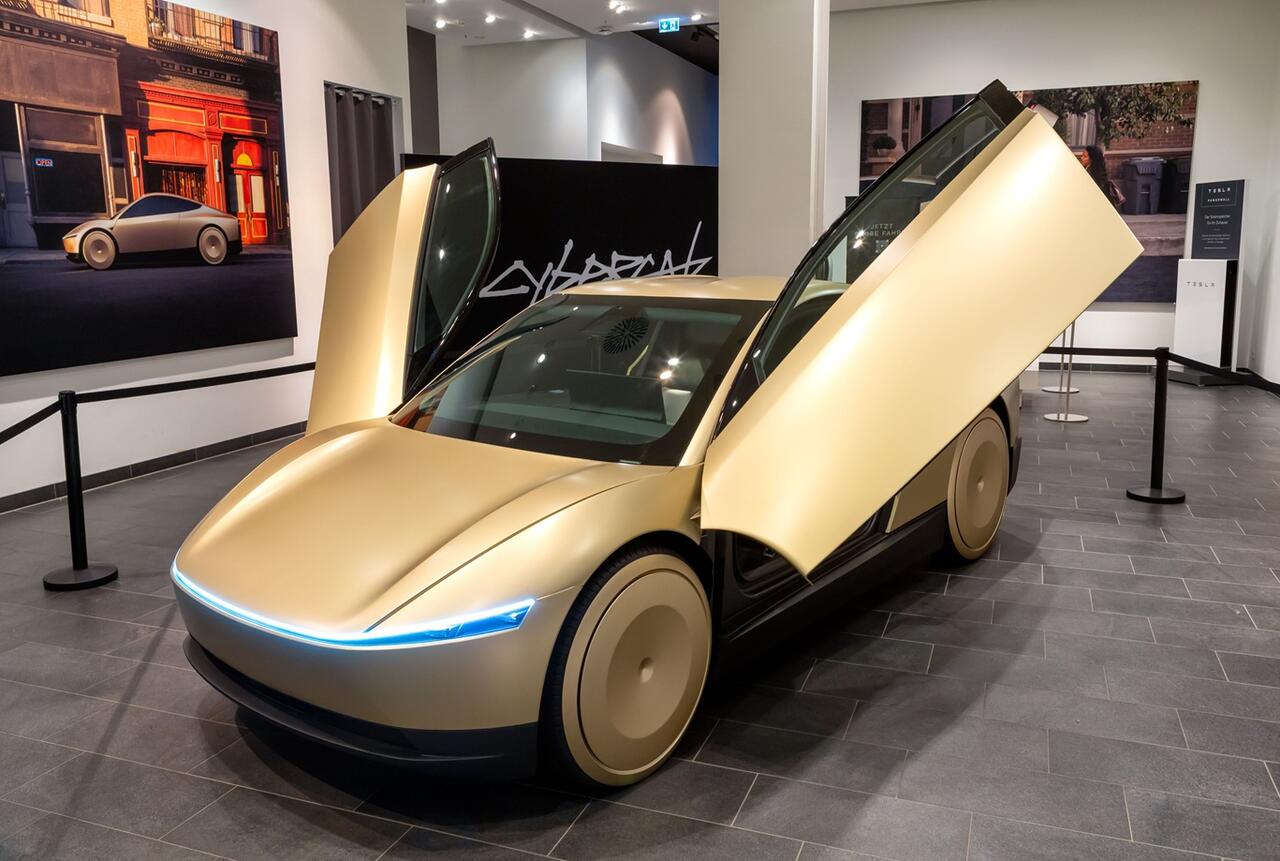
Congratulations to the Tesla team on making the first production Cybercab! https://t.co/TFSVQcbME5
— Elon Musk (@elonmusk) February 17, 2026
What’s more, Musk confirmed that they will cost under $30,000 – something he was challenged to do by YouTuber Marques Brownlee, who vowed to shave his head on camera if Musk could pull off that price point before 2027.
Marques Brownlee in October 2024 on the Cybercab being delivered before 2027 for $30,000:
“There’s no way they’re actually going to be able to do that. If they do, I will shave my head on camera. I’m that confident they won’t do it.”
Today, Tesla announced that the first… https://t.co/CDMz7IfGbG pic.twitter.com/6iu2QDR4Cl
— Sawyer Merritt (@SawyerMerritt) February 17, 2026
Yes
— Elon Musk (@elonmusk) February 17, 2026
Wireless Charging Bitchez
Today, the Federal Communications Commission (FCC) granted Tesla approval to use Ultra-Wideband (UWB) radio technology in its wireless EV charging system – granting the company a waiver so that Cybercabs recharging pads can be installed on fixed outdoor equipment, which is major.
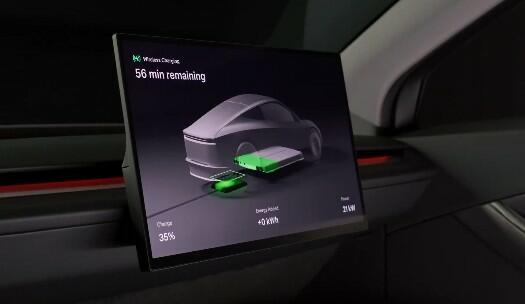
“The Tesla positioning system is an impulse UWB radio system that enables peer-to-peer communications between a UWB transceiver installed on an electric vehicle (EV) and a second UWB transceiver installed on a ground-level pad, which could be located outdoors, to achieve optimal positioning for the EV to charge wirelessly,” the company said in the FCC document granting approval.
As journalist Sawyer Merritt notes on X:
The FCC today officially granted @Tesla a waiver allowing it to use Ultra-Wideband (UWB) radio technology for its wireless EV charging system that will be used to wirelessly charge the Cybercab.
Normally, this kind of radio must be handheld and can’t be installed outdoors on fixed equipment. Tesla’s charging pad is fixed and could be outdoors, so they needed an exception.
The FCC said yes because:
• The signal is very low power
• It only turns on briefly while parking
• It works at very short range
• It won’t interfere with other systemsMore information from the filing: “The Tesla positioning system is an impulse UWB radio system that enables peer-to-peer communications between a UWB transceiver installed on an electric vehicle (EV) and a second UWB transceiver installed on a ground-level pad — which could be located outdoors — to achieve optimal positioning for the EV to charge wirelessly.
Prior to the UWB operation, the vehicular system uses Bluetooth technology for the vehicle to discover the location of the ground pad and engage in data exchange activities (which is not subject to the waiver).
When the vehicle approaches the ground pad, the UWB transceivers will operate to track the position of the vehicle to determine when the optimal position has been achieved over the pad before enabling wireless power charging.”
In its waiver request, Tesla states that the UWB signals occur only briefly when the vehicle approaches the ground pad; and mostly at ground level between the vehicle and the pad, and that the UWB signals are then significantly attenuated by the body of the vehicle positioned over the pad.
BREAKING: The FCC today officially granted @Tesla a waiver allowing it to use Ultra-Wideband (UWB) radio technology for its wireless EV charging system that will be used to wirelessly charge the Cybercab.
Normally, this kind of radio must be handheld and can’t be installed… pic.twitter.com/pve5NSoqtc
— Sawyer Merritt (@SawyerMerritt) February 19, 2026
We assume that in the not-too-distant future your human-skinned Tesla Optimus will have its own cute little charging pad at home, whichever model you choose. Cyber-Fleshlight not included.
Tyler Durden
Thu, 02/19/2026 – 21:20ZeroHedge NewsRead More


 R1
R1
 T1
T1


