

SpaceX Official Reveals New Details About Next-Gen Cell Service
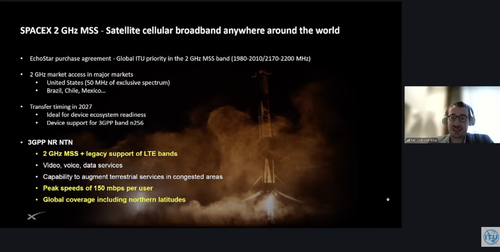
SpaceX satellite policy lead Udrivolf Pica told participants in the International Telecommunication Union Space Connect webcast about the next-generation Starlink direct-to-device cellular service for smartphones. The revelation of the new service follows SpaceX’s October 2025 U.S. trademark filing for “STARLINK MOBILE” and comes as Elon Musk has recently hinted at Starlink mobile ambitions.
“We are aiming at peak speeds of 150 Mbps per user,” Pica said, adding, “So something incredible if you think about the link budgets from space to the mobile phone.”
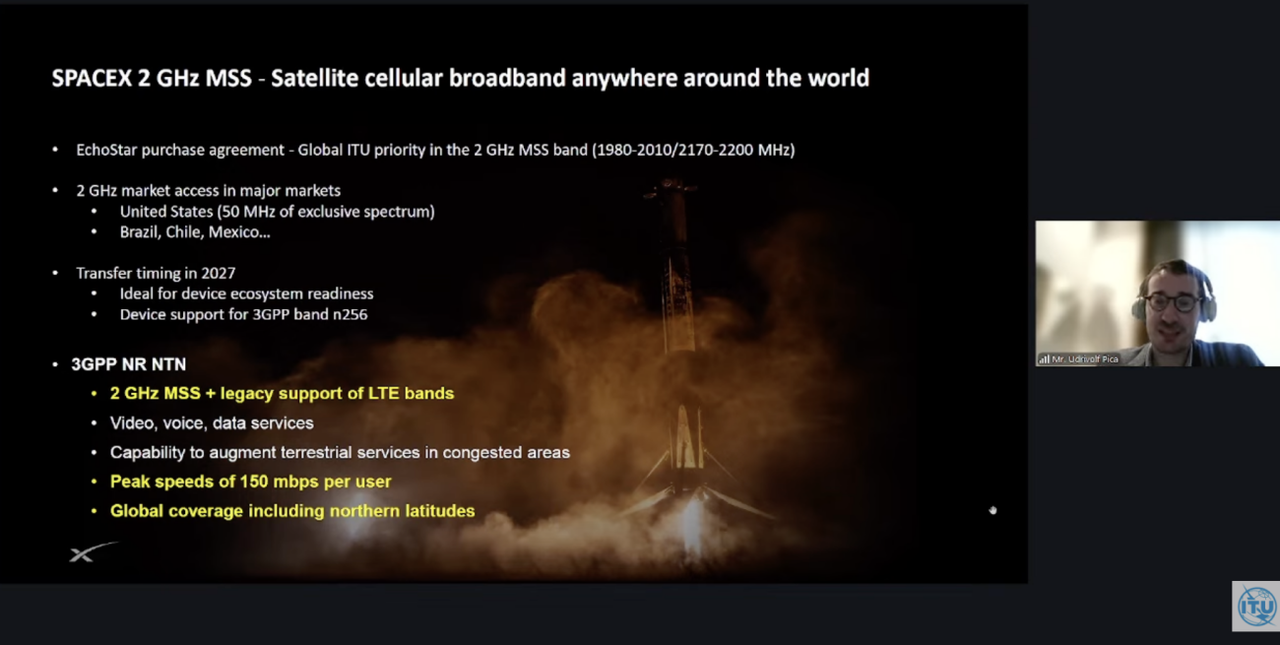
PCMag reporter Michael Kan was the first to report Pica’s comments, as SpaceX plans to launch new cellular Starlink satellites into low Earth orbit.
Kan continued:
If SpaceX can hit its speed goal, the upgraded cellular Starlink service promises to deliver speeds close to those of traditional cell carriers’ 5G networks on Earth. The median download speeds for T-Mobile’s 5G network currently reach 309 Mbps, while AT&T’s 5G network comes in at 172 Mbps, according to Ookla’s Speedtest.net data.
SpaceX has been offering the service through T-Mobile’s T-Satellite, allowing users in cellular dead zones to remain connected. However, the current iteration of the cellular Starlink service has bandwidth constraints. Although it can power low-resolution video calls, texts, and select mobile apps using orbiting SpaceX satellites, download speeds only reach an estimated 4 Mbps per user.
SpaceX is preparing to upgrade the technology by using newly acquired radio spectrum from Boost Mobile’s parent, EchoStar. In addition, the company has requested regulatory permission to launch another 15,000 satellites for the cellular Starlink service; the current system spans only about 650 satellites. The new system promises to unleash “video, voice, and data services, clearly,” Pica said during the panel.
On acquiring the EchoStar radio spectrum, Pica added, “More spectrum means a bigger pipeline, and this means that we can expand what we can do with partners. We can expand the quality of service. And again, we can do cellular broadband basically, cellular broadband use cases, like AI or daily connectivity needs.”
. . .
As for SpaceX, the company aims to launch the upgraded cellular Starlink service in late 2027, when its deal for the EchoStar spectrum officially closes. In addition to T-Mobile, SpaceX has been partnering with a growing number of carriers worldwide, including Rogers in Canada and KDDI in Japan, to offer cellular Starlink service.
In September, All-In’s Chamath Palihapitiya asked Musk: “Elon, is your vision that instead of having an AT&T account and then roaming when you’re in the UK or India, we could have one direct deal with Starlink that works all over the world? Maybe not today, but eventually, is that the end goal?”
Musk responded: “Yes.”
$ASTS: Elon interview
– Crystal clear he wants to directly compete against AT&T, Verizon and T-Mobile in fixed wireless and now mobile wireless
– It’ll take at least 2 years to deploy this spectrum as it requires a completely new satellite and mobile phones with compatible… pic.twitter.com/G1nNPNEbv3— Anp🅰️nman (@spacanpanman) September 10, 2025
By mid-October, Starlink filed to register the “Starlink Mobile” trademark with the United States Patent and Trademark Office.
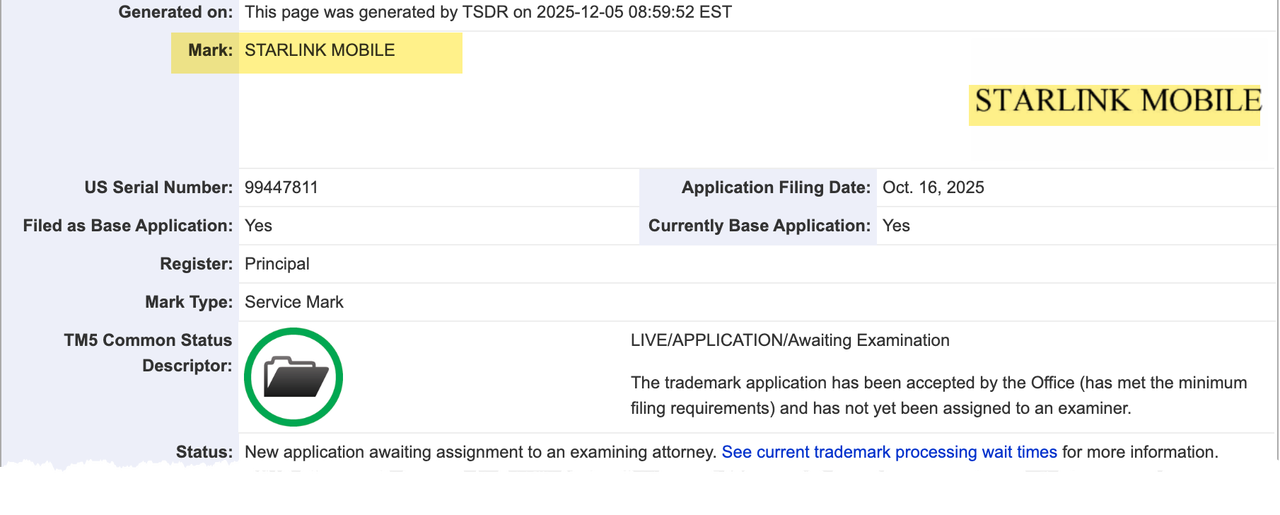
Starlink’s USPTO filing describes the service as: “Satellite communication and transmission services; transmission of data, voice, image and video via satellite; collecting and transmitting real-time data and images obtained via satellites; telecommunications services, namely, cellular personal communication services.”
Back to the All-In podcast, David Friedberg asked Musk: “Could you buy some carriers to acquire more spectrum? Maybe buy Verizon?”
Musk replied: “Not out of the question. I suppose that may happen.”
Tyler Durden
Wed, 02/25/2026 – 15:45ZeroHedge NewsRead More



 R1
R1
 T1
T1


