

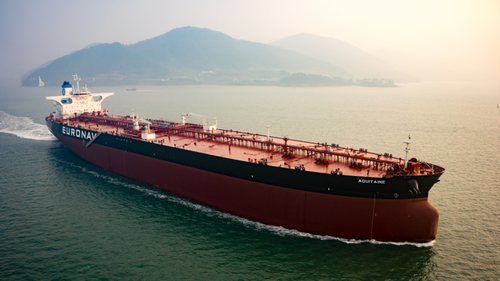
Supertanker Rates Hit Six-Year High: Here’s What Driving It
Global very large crude carrier (VLCC) rates have jumped to six-year highs due to two recent catalysts: first, a growing war-risk premium tied to the possibility of a US-Iran conflict, and second, ongoing consolidation in fleet ownership that is tightening vessel availability.
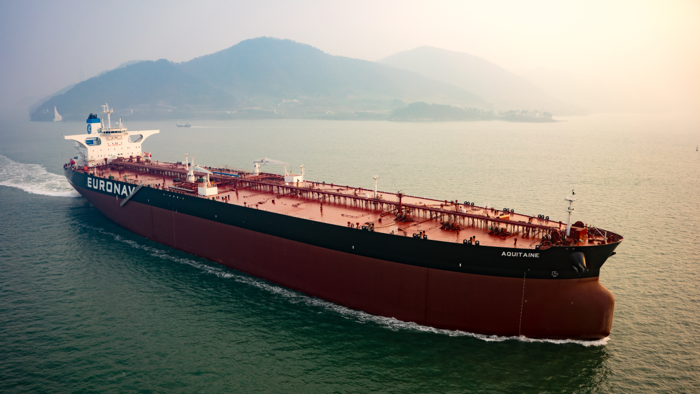
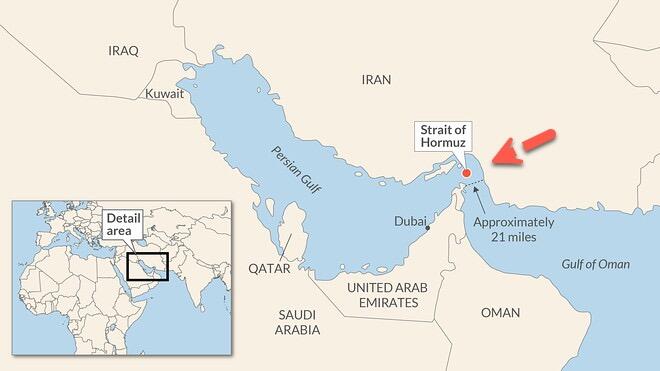
Let’s begin by noting that war-risk insurance premiums are rapidly being priced into VLCC tanker rates. The Strait of Hormuz has once again come into focus as the world’s most important energy chokepoint, where any flare-up in a US-Iran conflict could prompt Iranian commanders to shut the strait down, sparking what would only be immediate panic in global energy markets.
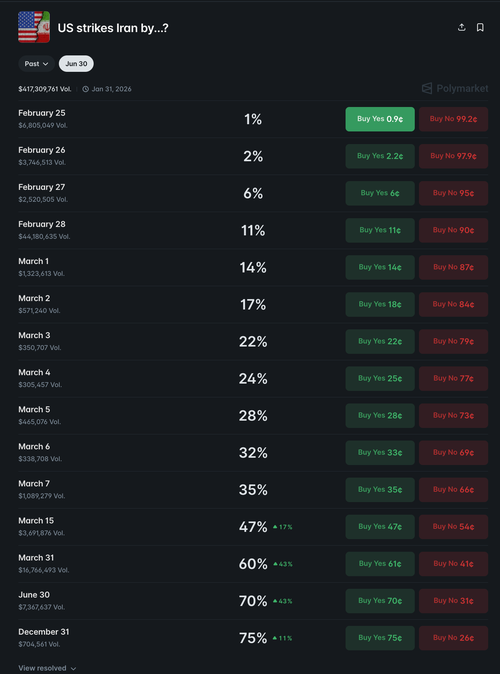
Latest Polymarket pricing for “US strikes Iran by…?” implies a 47% probability of a U.S. military strike by March 15.
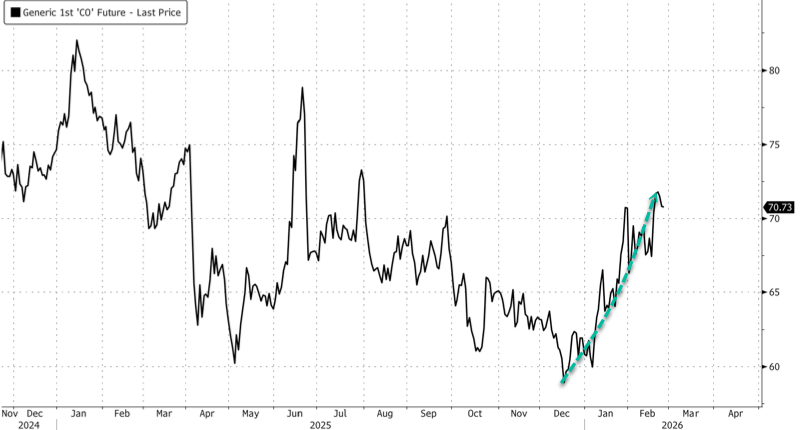
A war-risk premium has also been priced into Brent crude futures, with prices trading above $70 per barrel late Wednesday morning.
Bloomberg reports that Bahri, the National Shipping Co. of Saudi Arabia, chartered five VLCCs to transport up to 2 million barrels from the Middle East to China at a rate of $200,000 per day. According to the Baltic Exchange in London, that is the highest rate in six years. One of the ships Bahri chartered, the DHT Jaguar, was booked at $208,000 per day.
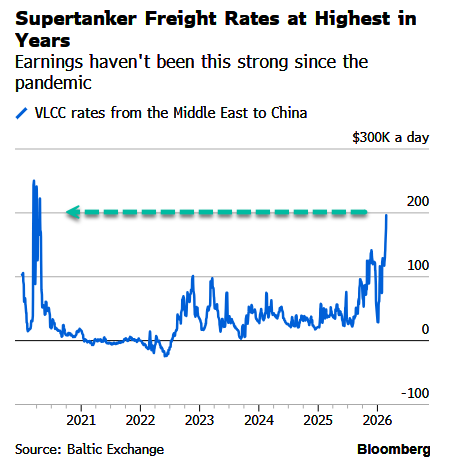
Supertanker rates are rising for two reasons:
-
Rising fears of a potential US-Iran conflict, and a vessel supply squeeze caused by a South Korean shipowner aggressively putting on charters.
-
South Korea’s Sinokor group has recently amassed control of roughly 120 VLCC supertankers, dramatically tightening global supply and contributing to the rise in tanker rates.
“You have one party or group of people who are working together who effectively control around a third of the available or traded tanker VLCC fleet out there,” Ole Hjertaker, chief executive officer of shipping firm SFL Corp., told investors on a call earlier this week, without naming the parties.
Svein Moxnes Harfjeld, chief executive of tanker company DHT Holdings Inc., told investors on another call that a “fundamental shift” in global fleet consolidation is underway.
“We can say with confidence that this is taking place and already making an impact, both on freight rates in the spot market, customer demand for time charters, and values of second-hand VLCCs,” Harfjeld said. “This consolidation is shifting the pricing dynamics and is putting pressure on timely availability of ships.”
Aristidis Alafouzos, chief executive officer of Okeanis Eco Tankers, noted, “This market consolidation, occurring at an unprecedented level, by a buyer with deep financial power, occurs at a time when market fundamentals continue to get tighter. It all creates an amazing opportunity if you have tankers on the water today, and the commercial ability to capture such market to its full extent.”
June Goh, a senior analyst at Sparta Commodities, said, “VLCC freight rates have seen many positive fundamental drivers, starting with Venezuela barrels moving on legitimate freight vs a dark fleet before, increased OPEC+ production and healthy crude demand from refineries, particularly from India, which has moved from Russian to Middle Eastern barrels.”
“Suezmax and Aframax markets will soon receive the spillover effects in the dirty freight market,” Goh said, referring to smaller tankers.
Tyler Durden
Wed, 02/25/2026 – 16:40ZeroHedge NewsRead More



 R1
R1
 T1
T1


