

Top Energy Analyst Says Iran’s Navy Too Weak To Completely Choke Hormuz
FGE NexantECA Chairman Emeritus Fereidun Fesharaki told Bloomberg TV on Monday morning that any attempt by the Islamic Revolutionary Guard Corps to choke off the critical Strait of Hormuz using warships, drones, and missiles would likely be short-lived, as the regime’s naval capability is too weak to sustain a blockade against U.S., British, and French naval forces.
“It’s just a fear factor,” Fesharaki said earlier on Bloomberg TV, following his prediction one week earlier on Bloomberg TV: “I don’t think the U.S. has a choice but to go to war. It is very hard for me to see a scenario in which they would simply avoid this, turn the ships around, and go home.” Fesharaki has tracked the market for decades.
Fesharaki said this morning, “The Revolutionary Guard navy is a minor force compared with what the American navy, the British, and the French can bring in.”
Fesharaki’s comments about the duration of the war mirrored President Trump’s remarks to The Daily Mail on Sunday, in which he said Operation Epic Fury would last about four weeks. He also described the IRGC as a “paper tiger.”
On Sunday, Trump announced that nine Iranian naval ships had been sunk in the operation.
“I have just been informed that we have destroyed and sunk nine Iranian naval ships, some of them relatively large and important,” Trump wrote in a post on X, adding that Iran’s naval headquarters has been “largely destroyed” in a different attack.
“We are going after the rest — they will soon be floating at the bottom of the sea, also!” Trump wrote.
Rapidan Energy Group analyst Fernando Ferreira provided more insight on the Strait:
Iran understands that threatening traffic through Hormuz is its most credible asymmetric lever. Even limited interference can raise oil prices and impose immediate economic costs on the U.S. and its partners, increasing pressure on Washington to de-escalate.
We expect at least moderate disruptions to Gulf oil flows in the coming days, with the risk tilted toward something more severe if tensions escalate further.
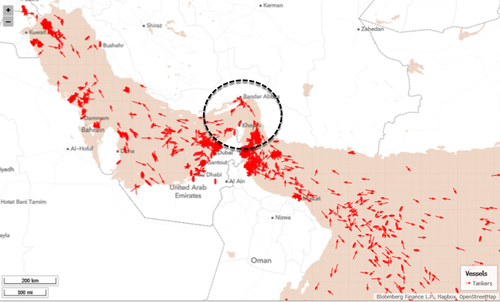
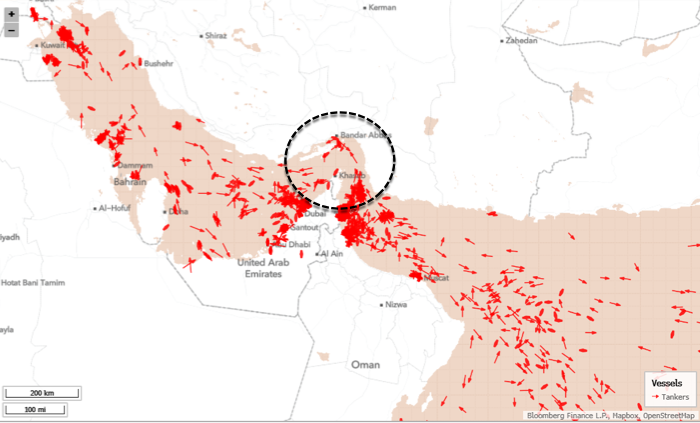
As of Monday morning, Automatic Identification System (AIS) vessel-tracking data via Bloomberg shows that tanker activity in the critical maritime energy chokepoint has mostly frozen, with limited transits.
Related:
-
“Expect Moderate Disruptions”: Oil Tankers Avoid Strait Of Hormuz As Operation Fury Hits Iran
-
Three Maritime Incidents Reported In Strait Of Hormuz Energy Chokepoint
Goldman analyst Adam Crook told clients over the weekend that any prolonged disruption of the Strait could push Brent crude prices toward $100/bbl. Currently, Brent crude futures trade around $79 as of 0900 ET.
Tyler Durden
Mon, 03/02/2026 – 13:40ZeroHedge NewsRead More



 R1
R1
 T1
T1


