New Iran Supreme Leader Chosen, But Identity Concealed, As US-Israeli Strikes Obliterate Tehran’s Energy Resources
Iran officially announced Sunday that it has chosen its next supreme leader, though the identity of the successor remains under wraps for now, given that already the Assembly of Experts had last week paused the selection process amid the ongoing heavy US-Israeli bombing campaign. The other big concern is that the next Ayatollah of the Islamic Republic will have big target on his back while under the bombs.
According to Iran’s ISNA news agency, the Assembly of Experts reached their decision following emergency deliberations triggered by the killing of Ayatollah Ali Khamenei in the opening hours of the war which kicked off early on February 28. “The most suitable candidate, approved by the majority of the Assembly of Experts, has been determined,” Mohsen Heydari, a member of the body, declared Sunday.
Fars News further cited another member, Mohammad Mehdi Mirbagheri, who confirmed that “a firm opinion reflecting the majority view has been reached” – but again, the name has not yet been publicly disclosed.
Israeli officials have made clear they will strike any figure chosen to replace Khamenei, raising the prospect that Iran’s new supreme leader could face assassination almost immediately after going public and assuming power. But presumably there are command bunkers hidden deep underground, and all across the country.
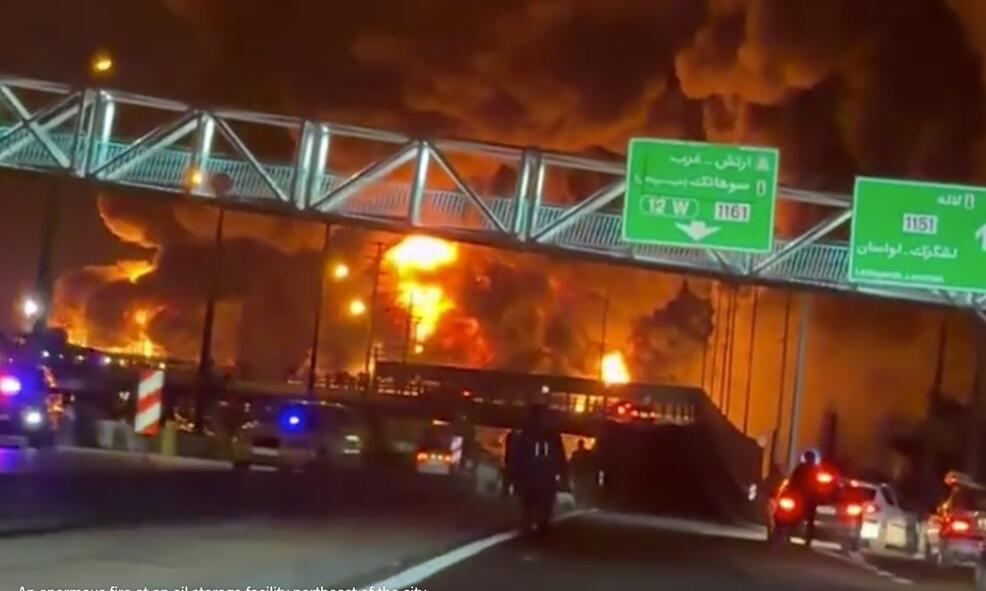
Saturday and overnight saw the war expanding into a new phase, with US and Israeli forces now hitting Iranian oil depots and refining facilities in Tehran for the first time – also what’s said to be fuel storage for the country’s armed forces, which has sent thick clouds of black smoke all over the densely-packed city of Tehran, which is comparable in size and population to New York City.
Oil-soaked rain even came down, and massive oil depot fires have burned through the night into Sunday…
JUST IN 🇮🇷🇺🇸: The fires in Tehran keep burning into the morning after last night’s airstrikes on the oil depots.
Teh air quaility is usually bad in tehran but this is making it much worse. Pray for the people that have to breathe this air. https://t.co/bjWup2DYN6 pic.twitter.com/4OsHeM2TT5
— Ryan Rozbiani (@RyanRozbiani) March 8, 2026
Currently there are reports that the US is contemplating seizing control of Iran’s largest oil export terminal on Kharg Island. Per regional reports:
A senior US official vowed to take control of Iran’s oil on Friday as the devastating regional conflict triggered by the US-Israeli war on Iran neared its second week.
“What we want to do is to get such massive oil reserves in Iran out of the hands of terrorists,” White House advisor Jarrod Agen said in an interview with Fox Business.
Iranian officials are also warning of environmental fallout from the expanding attacks on energy infrastructure. Foad Izadi, a professor at the University of Tehran, claimed in an interview with Al Jazeera that the strikes were timed deliberately ahead of rainfall.
The future of the vital Kharg Island looms large as China is still getting (some of) its oil.
PHOTO OF THE DAY: China is still getting (some of) its oil.
Nine days into the war, Iran continues loading oil supertankers from Kharg Island.
Tehran has sent some of them across the Strait of Hormuz into the high seas wihthout any problem.
Photo @CopernicusEU March 7th 2026 pic.twitter.com/uzSkzntOOB
— Javier Blas (@JavierBlas) March 8, 2026
“And I think they have done it purposely. They wanted to hit these oil facilities so they could create this huge smoke, and with all this contaminated rain, it looks like black ink,” he said.
He warned that runoff from damaged facilities could contaminate drinking water supplies in and around Tehran. “So people are going to get sick if these types of attacks continue, and we don’t have any signs that Trump and Netanyahu are stopping their war against Iran,” Izadi said. “So I think we are facing a serious environmental disaster.”
March 8, 2026 – Tehran at sunrise today. But the sun is hidden behind a sky filled with smoke. After a night of intensive strikes on oil facilities, thick black clouds now hang over the city, turning morning into something that feels like night. pic.twitter.com/7MghBnWRRw
— RKOT (@RKOTOfficial) March 8, 2026
Iran’s retaliation across the region continues, with the Islamic Revolutionary Guard Corps (IRGC) having taken a far harder line as the conflict slides, warning regional governments that Tehran will continue striking if US or Israeli forces operate from bases on their soil – strikes which appear to have continued – though the extent of damage on US bases appears to currently be censored by the Pentagon and some compliant entities like foremost commercial satellite imaging company Planet Labs.
Gulf states including Kuwait, Qatar, Saudi Arabia and the United Arab Emirates reported new missile and drone activity, despite Iranian President Masoud Pezeshkian having earlier ‘apologized’ for strikes hitting neighboring countries and pledging to halt attacks if their territory is not used for operations against Iran. But there’s evidence that the IRGC and military apparatus is overriding any potential ‘olive branch’ offered to the Gulf or US. Israel too appears to still be getting hit by Iranian missiles and drones, and also Hezbollah rockets on the north.
An interesting live coverage moment on NBC News…
Notable contrast between some drooling American “expert” talking about installing a “pragmatic” leader in Tehran and Tehran delivering a missile to its target in Tel Aviv.
Our elites manifestly do not understand this country we’re at war with.pic.twitter.com/1SqJ1I1JoL
— Andrew Day (@AKDay89) March 8, 2026
For example, as we reported previously an Iranian drone strike caused material damage to a desalination plant in Bahrain, according to the country’s interior ministry. The incident follows Iranian accusations that US forces bombed a freshwater desalination facility on Qeshm Island days earlier, which Tehran described as setting a “precedent”.
On the question of finding a diplomatic solution, the sides don’t appear to be talking, and in fresh comments Trump brushed off threats from Iran’s top security leadership, saying, “I couldn’t care less” while signaling that the pace and scale of attacks are only set to continue. This as Pentagon billion-dollar radar systems appear to be getting degraded quick:
Spokesman for the Iranian Armed Forces: we targeted and destroyed 4 radars of the U.S. THAAD system in the past hours.
Currently, even some among Iran’s ‘professional opposition’ in exile in places like London and the United States have expressed horror and concern at the images of whole portions of Tehran on fire, with black oil-infused smoke and rain inundating the capital and sprawling civilian neighborhoods.
Told Wolf Blitzer on @cnn that many Iranian-Americans were happy to see Khamenei killed, but they are turning against the war as it is becoming clear that the country is being destroyed and that hopes that this would lead to a quick collapse of the theocracy are being dashed. pic.twitter.com/0R4SpEI4bu
— Trita Parsi (@tparsi) March 7, 2026
Over in Lebanon, which can be viewed as a second Israeli front, the whole country has been pulled deeper into the fighting as Beirut and countryside regions get bombed. An Israeli airstrike on a hotel in Beirut reportedly killed at least four people over the weekend, after hundreds have already been killed, and IDF troops have also suffered some casualties.
European powers are increasingly reacting to the widening war, with French President Emmanuel Macron scheduled to travel to Cyprus after Iranian-made drones struck the island earlier in the week. Paris has already deployed the aircraft carrier Charles de Gaulle to the Mediterranean along with a frigate and additional air defense units. But it’s anything but clear the degree to which a country like France – which has sought to distance itself politically from Trump’s Operation Epic Fury – will directly support operations. Instead, like Italy, it looks to just be bolstering anti-air defenses of allies.
Macron is meeting wtih Cypriot President Nikos Christodoulides and Greek Prime Minister Kyriakos Mitsotakis to demonstrate “solidarity” and coordinate steps to “strengthen security around Cyprus and in the eastern Mediterranean,” according to the Elysee Palace.
Trump talks of changing the map of Iran, which goes even beyond regime change… hints at dismantling the nation:
Trump now openly speaks about end to Iran’s territorial integrity.
Combined with bombings of national infrastructure tonight, many Iranians will perceive targeting of Iran as a nation-state with a military capability.
That could quickly shift sentiments inside Iran. https://t.co/iWhF74s0C8
— Mohammad Ali Shabani (@mashabani) March 7, 2026
Criticism of the US-Israeli campaign is emerging from other parts of Europe as well, with Switzerland’s defense minister Martin Pfister said the strikes violate international law, while Spain has similarly condemned the bombings as reckless and illegal.
Iran is meanwhile likely looking to impose steep enough pain and a big cost on the attacking powers in order to ensure they never so easily make the decision to bomb the country again. A fresh statement in Tasnim news agency cites the IRGC boasting of new strikes on Tel Aviv and Beersheba, as well as the Muwaffaq al-Salti airbase in Jordan – which it described as “the largest and most active offensive base of the American aggressor fighter jets.”
“The volume and depth of the attacks of the Iranian armed forces on the enemy will expand in the coming hours and days,” the IRGC statement said.
Parts of Tel Aviv increasingly looking like Gaza:
اسرائیل اور اس کے دفاع پر مامور اعلانیہ اور غیر اعلانیہ اتحادیوں پر ایرانی میزائلوں کی 24کھیپیں برسانے کے بعد تل ابیب اب تک ابیب نہ رہا، غزہ بن گیا pic.twitter.com/NUYoJhQD8k
— Shahid Hussain (@ShahidHussainJM) March 7, 2026
At this point, a full week in, the death toll has surpassed that of last June’s 12 day war. According to the US-based Human Rights Activists News Agency (HRANA), at least 1,205 civilians have been killed in Iran since the US and Israel began their attacks, including 194 children. The HRANA has highlighted child deaths despite largely being seen as a Washington-friendly NGO and what might be called part of the anti-Tehran activist opposition, and based in Fairfax, Virginia.
Across the region over 1400 have been killed, including mounting casualties in Israel. As for the Pentagon it has not released a fresh US troop casualty update in several days – and official American servicemembers killed stands at six. There are Sunday reports of two more people killed in Kuwait, also as Saudi Arabia says its air defenses are active in intercepting inbound projectiles.
Tyler Durden
Sun, 03/08/2026 – 09:55ZeroHedge NewsRead More



 R1
R1
 T1
T1