

Credit Image: © Emmanuele Contini/NurPhoto via ZUMA Press
Continued from Part I.
The retreat of Pan-Europa
This was the pre-war high point of Coudenhove’s movement. In October the US stock market crashed, signaling the beginning of the worldwide depression. “Country after country turned in on itself,” writes Mr. Bond; “economic self-sufficiency was the order of the day.” Germany’s Stresemann died unexpectedly.
A second Pan-Europa Congress was held in Berlin in May 1930, but participants were fewer and less distinguished. Several governments declined to be represented, including Austria and Italy. The main item on the agenda was the French government’s Memorandum on European Union — the outcome of Briand’s initiative of the previous year — whose release coincided with the Congress itself. Mr. Bond describes this document:
The Memorandum was the result of internal compromises, initially within the French government, and then between the French and other European governments, who one by one had all watered down the original text to make it what [Coudenhove] described as “a long and detailed document couched in vague and over-careful terms.” Its main thrust — to establish regular meetings of European leaders to discuss common issues — was in no way adequate to reverse the deteriorating political and economic situation, let alone inspire the younger generation to create the United States of Europe.
Coudenhove always envisioned Pan-Europa as an elite enterprise; he did not mind having only a few thousand members provided they were men of standing and accomplishment. But events were moving in the opposite direction, toward what Spanish philosopher José Ortega y Gasset characterized as “the revolt of the masses.” Armed gangs of stormtroopers and communist militants were now regularly confronting one another in the streets of Germany, and Coudenhove reluctantly had to admit that his select gentlemen’s club could not compete.
Accordingly, at the Third Pan-Europa Congress held in Basel in October 1932, he announced his intention to convert his Union into a mass party, the “European Party.” He drew up a program for the new organization, which his biographer summarizes. The most interesting item to me was “a ban on hate speech.” Mr. Bond is certainly being anachronistic, for no such expression existed in 1932. But the seed of “intolerance of the intolerant” was clearly already being planted; in our time this has blossomed into an administration of justice that sometimes penalizes criticism of foreign rapists more severely than rape itself.
The change in strategy toward an embrace of mass politics was too little too late. The “European Party” never got off the ground, and support for Pan-Europa continued to decline.

Flag of the International Paneuropean Union, with stars added after 1955.
On January 30, 1933, just as German President Hindenburg was appointing Adolf Hitler chancellor, the count was lecturing in downtown Berlin on “Germany’s European Vocation.” After listening to his appeal for a “Europe united not by force but on the basis of reconciliation, equality, and mutual interest,” the dispersing audience was compelled to run a gauntlet of celebrating stormtroopers and torchlight parades that filled the streets of the capital. That spring, Coudenhove’s books were among those publicly burned as “un-German,” and the remaining members of the German branch of the Pan-Europa Union in Germany were forced to dissolve their organization.
The dispute between Pan-Europa and National Socialism was not over democratic procedures. Back in Austria, Coudenhove had no problem when Chancellor Dolfuss assumed emergency powers two months later, nor when he banned the Communist and Nazi parties a few months after that, nor when he banned the Social Democratic Party in 1934 and promulgated a new constitution commonly described as “clerico-fascist.” Coudenhove even continued to have hopes for Mussolini until the latter allied himself with Hitler.
During the next few years, a much-diminished Pan-Europa Union continued its work, but became hardly distinguishable from an effort to forge an anti-Nazi alliance. A fourth Congress was staged in Vienna in 1935; it focused on economic issues as the political situation continued to deteriorate.
On March 11, 1938, the Coudenhoves were hosting a private dinner party at their Vienna home when Hitler delivered his Anschluss ultimatum to Austria. An anonymous telephone call warned them that they were high on the Gestapo’s hit list and advised them to leave Austria immediately. With the help of Swiss embassy personnel, they were driven to the Czechoslovak border. From Bratislava ,they proceeded to Budapest and Zagreb; Mussolini then granted them safe passage across Italy to Switzerland, where the couple had bought a small vacation house a few years before.
In Switzerland, Coudenhove wrote a new book that showed his optimism was undiminished. He predicted that Hitler would lose the coming war, following which
there would arise a realization that all European states needed to federate for their own safety, both internally and externally. The United States of Europe as foreseen by Pan-Europa would then be the obvious and the only solution.
Such faith must have been necessary to keep him going, for with Hitler now in control of almost the whole of German-speaking Europe, the Pan-Europa Union’s membership was reduced by more than half. This loss had one silver lining: Coudenhove began getting support from formerly aloof Britain. His last months in Europe were spent shuttling between Switzerland, Paris, and London.
Following the fall of France in June 1940, the Coudenhoves undertook a difficult and risky escape by automobile across war-torn France, eventually crossing Spain and reaching Lisbon. In the six weeks they spent there, they tried to get a visa for any country that would have them, including Britain, Canada, and Japan. The US came through first, so on August 3, 1940, that is where they went.
Starting over
The small circle of sympathizers Coudenhove had assembled on his first visit to America in the 1920s proved its worth, arranging employment for him at New York University. He published a volume of memoirs, Crusade for Europe, went on lecture tours, made radio broadcasts, helped prepare a draft constitution for a postwar Europe, and even held a fifth Pan-European Congress in New York in 1943, the first outside Europe itself. He had no success influencing the Roosevelt administration, however, due to his intransigent opposition to America’s Soviet ally.
Coudenhove’s prediction that Hitler’s defeat would pave the way for greater openness to the ideal of European unity proved correct. As early as March 1943, not long after Germany’s defeat at Stalingrad, Winston Churchill called for “a Council of Europe, a real effective League, with a High Court to adjust disputes, and with armed forces, national or international, or both, held ready to impose these decisions.”
Churchill continued to urge European unity in the postwar years following his 1945 electoral loss to Clement Attlee. Speaking in Zurich in September 1946, he called for recreating the European family, “or as much of it as we can.” This latter qualification was a recognition that Eastern Europe would remain under Soviet domination for many years. He gave credit to Coudenhove’s pioneering work: “We must build a kind of United States of Europe. Much work has been done upon this task by the exertions of the Pan-European Union which owes so much to Count Coudenhove-Kalergi.” Churchill also agreed with the count on the importance of reconciliation between France and Germany: “There can be no revival of Europe without a spiritually great France and a spiritually great Germany.”
After the end of hostilities, Coudenhove built a new organization, the European Parliamentary Union (EPU), separate from the existing Pan-Europa Union. The members were legislators from different countries favorable to the cause of continental unity. He sent out thousands of invitations and received 1,818 replies, of which 1,766 were positive and only 52 negative. France, Italy, and Greece proved most receptive, while the response from Britain and Scandinavia was more reserved. (Germany was still under occupation and had no legislature.) No answers were received from any Communist parliamentarians, which Coudenhove considered a vindication.
In a speech to an organizing committee of the EPU, he said he wanted to start an “Open Conspiracy:”
The aim of our conspiracy is to organize immediately, throughout Europe, parliamentary majorities strong enough to compel the governments to execute our program: a United Europe within the framework of the United Nations. Let us never forget that it is up to the parliaments to constitute and to overthrow governments; and that, consequently, parliamentary majorities and not governments represent in Western Europe the original source of power.
The EPU was meant to pressure governments to set up a constituent assembly for the United States of Europe. Its first official meeting in Gstaad, Switzerland, in September 1947 included nearly 150 parliamentarians from a dozen countries, and resulted in pro-unity resolutions in several national parliaments afterwards.
May 1948 witnessed a major milestone in the movement for European unity in the form of the Congress of Europe held in the Hague. Coudenhove was the second speaker on the program, immediately after Winston Churchill. Many of the 750 participating delegates were also parliamentarians involved in his EPU. The congress resulted in the establishment of the Council of Europe with its Parliamentary Assembly, the first European intergovernmental organization.
On May 9, 1950, French Foreign Minister Robert Schuman announced plans for the creation of the European Coal and Steel Community, a supranational organization to coordinate economic policy between France, West Germany, Italy, and the Benelux countries. The anniversary of the Schuman Declaration is now celebrated as Europe Day, and that body would evolve into the European Economic Community, and eventually today’s European Union.
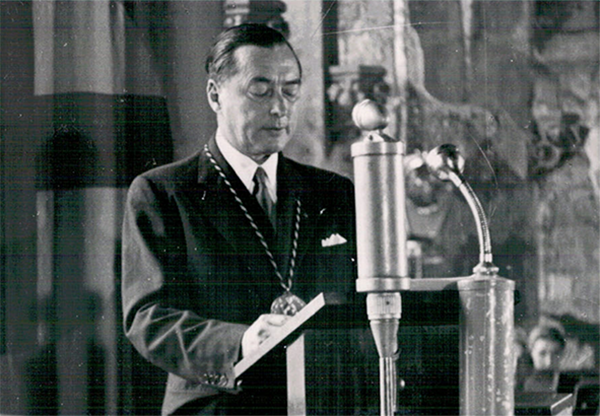
“On Ascension Day, 18 May 1950, Dr. phil. Richard Nikolaus Graf Coudenhove-Kalergi was presented with the 1950 International Charlemagne Prize of the City of Aachen in the Coronation Hall of the Town Hall, the former imperial palace, in recognition of his life’s work in shaping the United States of Europe.” Source.
Britain continued to be more skeptical of European federation than most continental powers. It favored a closer association between the European states, but saw this as more of an intergovernmental project than a process of integration. Coudenhove came to place greater hopes in France and more especially in Gen. Charles de Gaulle, with whom he corresponded regularly for many years.
One letter to the French President sometime in the 1960s will be of special interest to those who have heard of the alleged Kalergi Plan to swamp Europe with foreign races. In Mr. Bond’s words:
He revealed his growing hostility to the way that the UN was expanding too quickly in the age of decolonization. It risked marginalizing Europe, and [Coudenhove] could see in this much more of a threat than an opportunity. He wrote: “The UN represents for Europe, indeed for the whole of the white race, the worst danger since the days of Genghis Khan.” Over time, he feared that the nations of a growing Afro-Asian bloc would outnumber the static number of “white” European and American states, creating a stalemate in the UN and “making the Soviet bloc and its supporters the arbiters of the fate of the West.” By taking an initiative now, he suggested, de Gaulle could head off this disaster. If France called Americans, Russians, and Europeans to a peace conference to end the Cold War, it would bring to the same table almost all representatives of the white race in the whole world, and these states had overwhelming military force at a global level.
Should we grant a place for the half-Japanese Coudenhove-Kalergi among the historic defenders of the white race?
Legacy
Coudenhove remained active in the cause of European unification right up to his death in August 1972. The importance of his contribution to this process is beyond dispute; as Mr. Bond writes: “Across the European Union, the European flag now flies in every city, citizens use the common EU currency, travellers have a European passport, and the European anthem is played at major European events” — and all of these are realizations of ideas first proposed by Coudenhove. Yet the EU has evolved into a clumsy and costly bureaucratic behemoth that burdens as much as it protects.
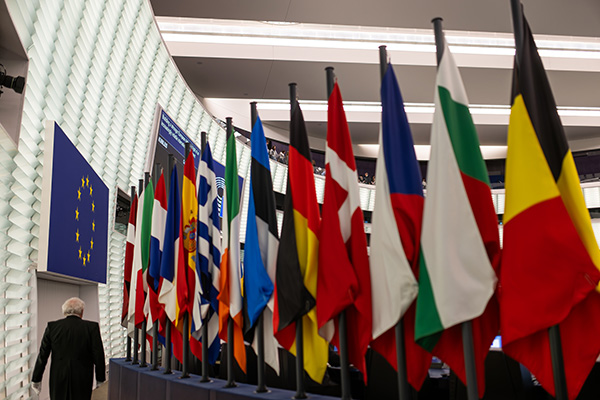
An usher walks alongside the flags of the member states towards the flag of the European Union in the plenary chamber of the European Parliament. (Credit Image: © Philipp Von Ditfurth/dpa via ZUMA Press)
Hitler looms large in Martyn Bond’s retelling of Count Coudenhove’s life, to the point of his name appearing in the title of the book, while that of the book’s actual subject is relegated to the subtitle. This, of course, is no accident. All political regimes have their creation myths, and the postwar order has always sought to derive its legitimacy from the defeat of the wickedest man who ever lived. Mr. Bond thus repeatedly characterizes Coudenhove as the diametrical opposite of Hitler and everything he stood for: the good cosmopolitan whose ideas promote peace as opposed to the evil nationalist whose ideas led to the most destructive war in history.
I would have been grateful for a little more detail to back up such assurances. As Coudenhove himself once wryly noted, it is not the idea of European unity as such that distinguished Pan-Europa from Hitler — nor from Stalin for that matter. Either of these men would have been happy to “unite” Europe on his own terms.
Moreover, European nationalists today clearly understand that their countries are parts of a larger racial and civilizational whole. “No more brothers’ wars” is their constant watchword. So where does the essential opposition between Coudenhove’s ideal and that of nationalism lie?
Is it in the Count’s rejection of race? This seems unlikely, because the views expressed in his early essay “Nobility” were certainly “racist” by today’s standards. Indeed, it was not easy to find anyone in the 1920s who thought biological inheritance of no significance, as we are commanded to believe today. Mr. Bond is visibly scandalized by Coudenhove’s letter to de Gaulle expressing a concern to avert “danger to the white race.”
Since the count’s death in 1972, a clear affinity has developed between antiracism and the aggressive pursuit of European unity: it is generally the same people we see promoting both. But matters were much less clear during Coudenhove’s lifetime. Nothing in Mr. Bond’s biography suggests that Coudenhove would have sought to bring tens of millions of Africans and Asians to Europe, despite his early speculation that “the man of the distant future will be mixed race” (NB: his critics usually omit the word “distant” when quoting this passage, as in the version with which this review began). It is impossible to say from the evidence of this biography what Coudenhove would have thought about the hostile aliens within today’s Europe; this was not a challenge he had to face.
I would put the difference between nationalism and cosmopolitanism as follows: Human beings approach the universal through the particular, not by ignoring or opposing the particular. It is because a Frenchman is French that he is also European, not in spite of his national identity. Today’s nationalists understand this. The cosmopolitan makes the mistake of seeing the particular as the rival or even enemy of the universal. In an early letter to his wife quoted above, Coudenhove stated his belief that nationhood was a “lie” based on the trivial circumstance that people happen to speak different languages. He thought the Frenchman’s identification with France was what led him to hate Germans. He therefore sought to create a European identity by deprecating the national attachments that are the indispensable basis for the larger identity.
For most of history, the nation has been the most extensive human grouping with which the average man has any capacity to identify. Our lives are largely spent among family, friends, work colleagues, and rivals in our immediate surroundings. For most men, therefore, nationalism represents a summons to rise above these personal relations by identifying with something greater. If one can go beyond this to an awareness of the unity of Western civilization, so much the better. But trying to make men better Europeans by working against their national loyalties is like trying to strengthen a community by urging people to neglect their families.
Many of the statesmen Coudenhove sought to influence certainly understood the intimate positive relation between national and European identity, including both de Gaulle and Churchill. Indeed, they were themselves nationalists, despite sharing the count’s awareness of the desirability of increased European cooperation. Furthermore, no supranational bureaucracy issuing regulations can ever bring about a revival of the European spirit; what is needed is a deepened sense of national and civilizational identity, something certain to be called forth by the obvious and growing threats we now face.
Count Richard von Coudenhove-Kalergi was no Bond-villain plotting to mongrelize Europe before crushing it beneath a Jewish bootheel, but neither will his ideal of European federation be the salvation of our race and civilization. The picture that emerges from Hitler’s Cosmopolitan Bastard is of a decent but flawed man whose thinking combined some good ideas with some wrongheaded ones.
The post Pan-Europa and the Kalergi Plan, Part II appeared first on American Renaissance.
American RenaissanceRead More



 R1
R1
 T1
T1


