

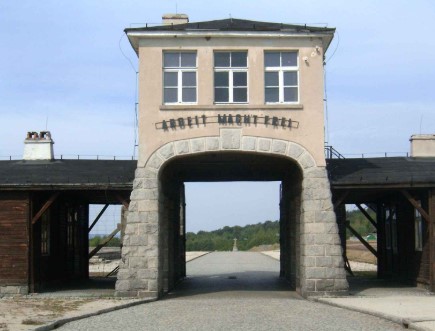
Continuing on from my articles documenting various historical incongruities in the Third Reich’s concentration and alleged ‘extermination’ camp system before and during the Second World War – we’ve already covered things like the zoos of Buchenwald (1) and Treblinka, (2) Sobibor’s bowling alley (3) as well as the swimming pools for inmates at Auschwitz (4) and Novaky – (5) another example is the garden of Gross-Rosen concentration camp.
Now for those who don’t know Gross-Rosen was a German concentration camp operational between August 1940 to February 1945 that was originally a sub-camp of Sachsenhausen. The purpose of the camp was to provide forced labour to work the nearby granite quarry for the purpose of using the granite for building materials. (6)
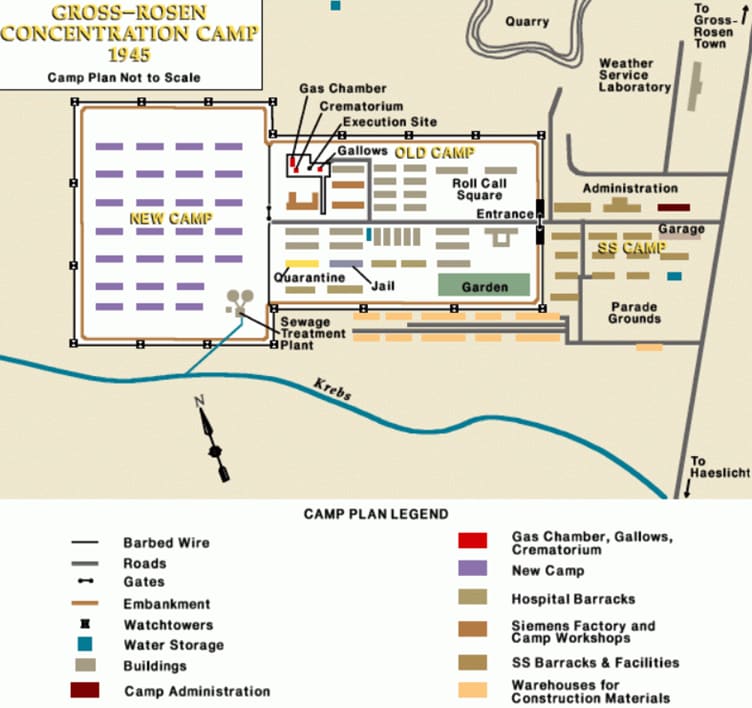
It wasn’t a classic ‘death camp’ but along with Auschwitz III (better known as Monowitz) it is often seen as an ‘extermination through labour camp’ despite the fact that the ‘United States Holocaust Memorial Museum’s’ map of Gross-Rosen includes a ‘gas chamber’ that I can otherwise find little to no reference to, (7) but I assume was claimed at some point in the Nuremberg Trials and was subsequently quietly dropped by ‘Holocaust’ historiography.
What is interesting however is the fact that Gross-Rosen had a garden for the use of its inmates as we can see from the ‘United States Holocaust Memorial Museum’s’ map of Gross-Rosen below: (8)
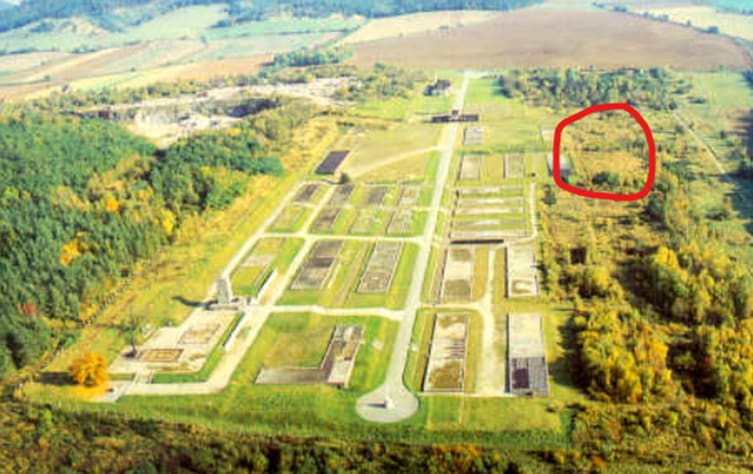
You can actually see the place where Gross-Rosen’s camp garden was in a modern aerial photo of the camp: (9)
Now given the general configuration of German concentration camps it means that the building circled below was the inmates camp kitchen:
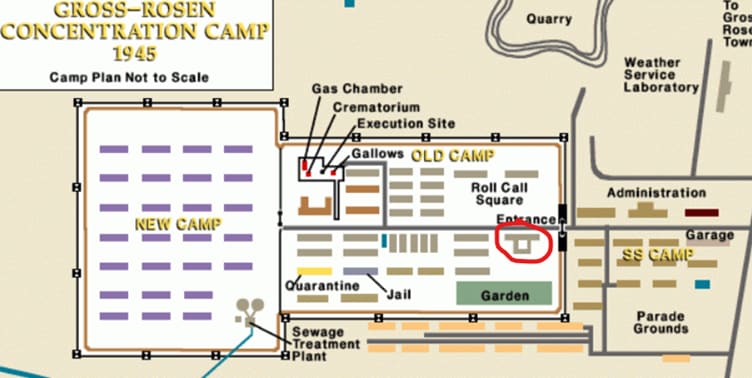
This then makes sense of why Gross-Rosen would have had a garden in that it was dual-purpose in that it was used as an herb and vegetable garden to supply the camp kitchens (10) as well as to supply medical herbs to the camp hospital to replace or be a substitute for normal medical drugs that were in increasingly short supply as the war went on. (11) Further we know that the Germans also used these kinds of herb and vegetable gardens as a kind of therapy for convalescing prisoners in the camp hospital – much as they used the swimming pool in Auschwitz I (‘the Stammlager’) for this purpose – which also holds true with Gross-Rosen given that the inmate garden is once again rightly next to both the inmate’s camp kitchen but also the inmate’s camp hospital, which is here:
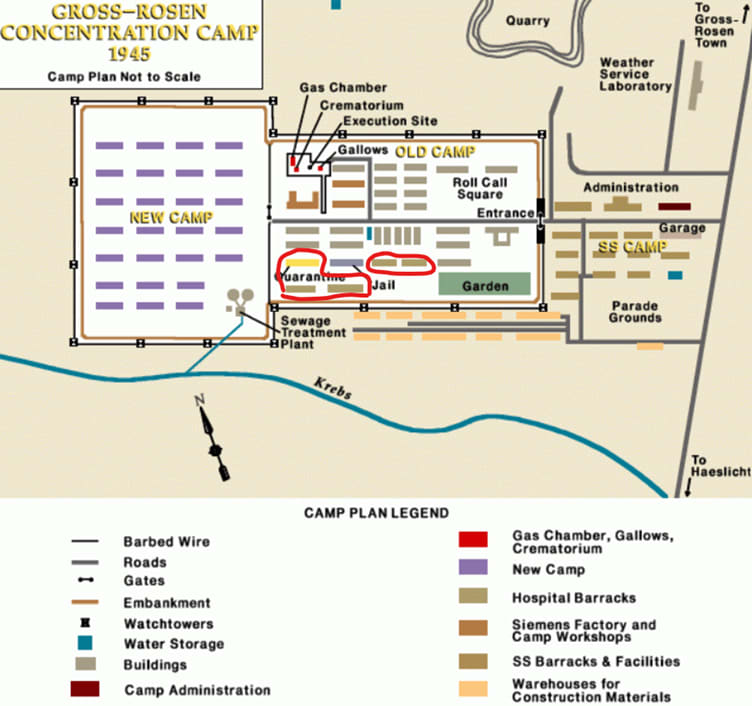
Thus, we can see that contrary to the usual interpretation of concentration camps like Gross-Rosen as ‘hell on earth’ the Germans in fact made every accommodation to ensure that the inmates of the camp – largely jews, Poles and Soviet prisoners – were kept fit and healthy but were also expected to work hard for their keep per the credo of National Socialism.
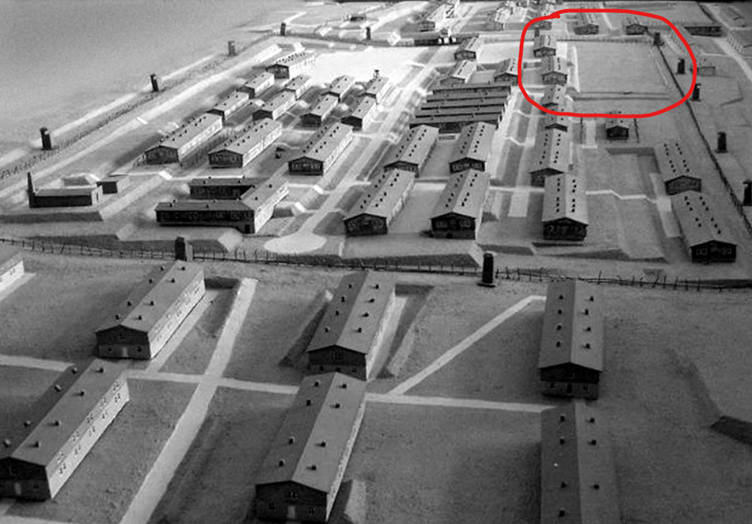
The fact that mainstream ‘Holocaust’ historiography has tried to cover this up is predictable with the Rogoznica Museum in Poland’s model of Gross-Rosen deliberately not highlighting that this location in the camp in the camp was a sizeable herb and vegetable garden for the benefit and use of the inmates.
We can see this here: (12)
So why are they covering it up?
Because it completely deconstructs of the myth of ‘extermination through labour’ that was allegedly a German policy to kill off both jews as well as other alleged undesirables like Slavs, Romani, political prisoners, homosexuals etc. When in fact while the Germans worked the concentration camp inmates hard; they made sure that they were also looked after to the best of their ability to do so including getting rather innovative with medicines to ensure that the inmates could get what they needed.
References
(1) On this please see my article: https://karlradl14.substack.com/p/the-zoo-of-buchenwald-concentration
(2) On this please see my article: https://karlradl14.substack.com/p/the-zoo-of-treblinka-extermination
(3) On this please see my article: https://karlradl14.substack.com/p/the-bowling-alley-of-sobibor-extermination
(4) On this please see my article: https://karlradl14.substack.com/p/understanding-the-swimming-pool-of
(5) On this please see my article: https://karlradl14.substack.com/p/understanding-the-swimming-pool-photo
(6) https://en.gross-rosen.eu/historia-kl-gross-rosen/
(7) https://encyclopedia.ushmm.org/images/large/ca104af8-d840-472b-91d5-b0af45abe206.gif
(8) Idem.
(9) https://en.gross-rosen.eu/historia-kl-gross-rosen/
(10) Carlo Mattogno, 2016, ‘Healthcare in Auschwitz: Medical Care and Special Treatment of Registered Inmates’, 1st Edition, Castle Hill: Uckfield, pp. 16; 222
(11) Ibid., pp. 16; 47; 49; 58; 222
(12) Ibid., p. 222
(13) https://en.wikipedia.org/wiki/Gross-Rosen_concentration_camp#/media/File:Gross_Rosen_(b&w).jpg
Karl’s SubstackRead More


 R1
R1
 T1
T1


