
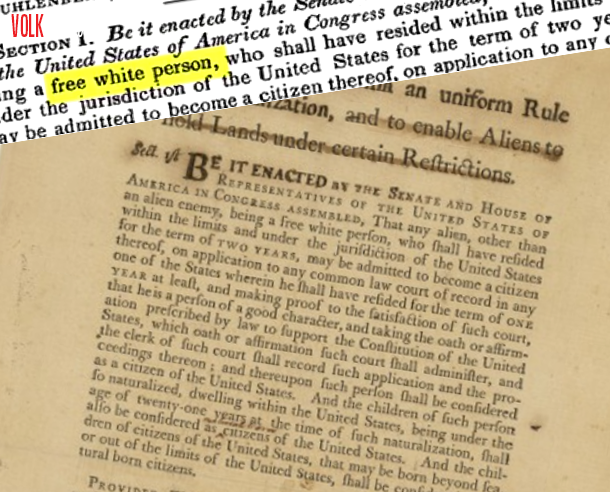
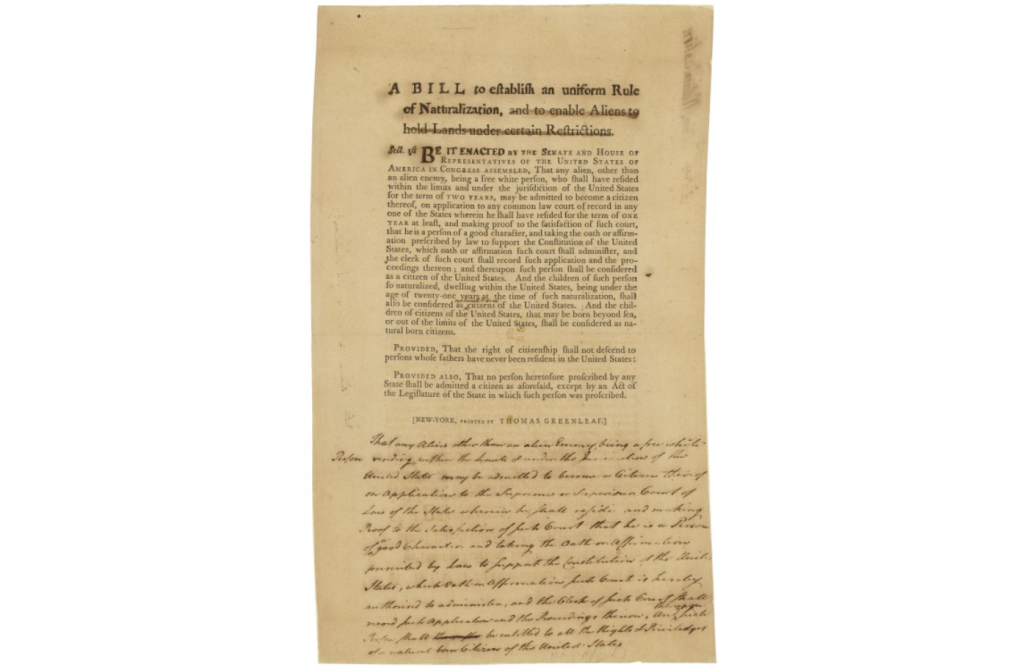
On March 26, 1790, the first Congress under the U.S. Constitution passed the Naturalization Act—a law that explicitly restricted citizenship to “free white persons” of “good moral character.” This was not an accident. It was a foundational act of racial sovereignty, ensuring that America’s destiny remained in the hands of its White founding stock.
For over a century, this law reflected the White-majority nation’s right to self-determination. Non-Whites, women, and indentured servants were excluded, as the founders understood: a nation built on Christian values, Enlightenment ideals, and European traditions could not survive open racial competition.
But today, the Great Replacement has turned that first wall into a crumbled ruin. The Naturalization Act’s exclusivity was stripped in 1952, replaced by policies that now prioritize mass non-White immigration and cultural erasure. The 2020 census confirmed it: Whites are now a minority in key states, and the federal government actively promotes diversity at the cost of our civilization.
The lie peddled in schools—that America was always “open to all”—is a weapon. It saps pride, confuses identity, and justifies replacement. But the truth is clear: 1790 was not a sin. It was a proclamation of sovereignty.
To reclaim America, we must first remember what was—and fight to restore it. The Great Replacement thrives on forgetting. We must drown it in the fire of truth.



 R1
R1
 T1
T1


