
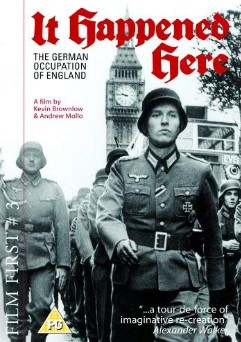
The amateur British film ‘It Happened Here’ from 1964 is not a well-known piece of cinema but it has long been recognized as one of the best amateur films to have ever been made with even the BBC’s Mark Kermode endorsing its excellence in a piece-to-camera for the British Film Institute on the film; (1) this is all the more surprising because the film’s creators Kevin Brownlow and Andrew Mollo were 18 and 16 years old respectively when they began work on the film.
The film itself tells the story of an alternative historical timeline where the Third Reich wins the Battle of Britain and successfully launches Operation Sealion in 1940 and then subsequently launches a successful Operation Barbarossa in 1941 which has driven Soviet forces back behind the Urals as of 1944 and where – due to a powerful new Soviet offensive – the Third Reich has pulled as many of its regular troops out of Western Europe as it can to shore up the Eastern Front. (2)
Further the United States has entered the war – presumably after Pearl Harbor in December 1941 as occurred historically – and has now stationed its 7th Fleet off Ireland and is using carrier-based aircraft to ‘harass the Germans in Britain’ as well as drop troops and supplies onto the British mainland to pull together and supply a ‘new anti-German partisan’ movement in Britain.
This would have of course been possible historically but extremely unlikely in practice given that a fleet off Ireland would have been routinely attacked by the Luftwaffe and the Kriegsmarine; who – without having to fight in the Mediterranean, the North Sea or the Arctic – would have been significantly more dangerous than they were historically especially with a blended German-British-French industrial and scientific base that had not been significantly bombed and would largely have been free to produce what the Third Reich’s military forces needed.
Thus, in reality such a strategy could not have been successful as an American fleet off of Ireland would have been likely all but destroyed after several weeks of operations and counteroperations.
Even less plausible is the German strategy to ‘deal with the partisan movement’ in western Britain of simply evacuating all civilians and then sending in the Wehrmacht and volunteer British SS troops plus police units to fight the partisans. Historic Germans strategy was simply to flood the affected area with personnel, identify the local partisans and resistance ringleaders using local collaborators and/or forced intelligence extraction (e.g., if you don’t co-operate, we’ll send your son to do forced labour) and then execute/imprison/turn them while sometimes deporting their families to concentration camps to reinforce the point not ‘evacuate the area and send in troops to kill anything that moved’. (3)
The point I am getting at here is that ‘It Happened Here’ is not very good on military strategy but yet it does make a lot of effort to keep itself as accurate to history as it could be… as it stood in the 1960s. This is the key element to understanding ‘It Happened Here’s’ more anachronistic scenes of English SS troops gunning down women and children randomly – it also shows partisans doing exactly the same thing and while this isn’t really true outside of the Eastern front it is exactly the sort of thing claimed to have been true at Nuremberg – and also the mass phenol injections being used as a method of killing Polish workers – including young children – with incurable tuberculosis at a British sanitorium. These are the exact kind of claims made at Nuremberg, and which were still widely credited as true at the time – remember in the 1960s the lampshades and shrunken heads were also commonly claimed as true too and were featured into museums labelled as such – so we have to take into account that ‘It Happened Here’ is very much a product of its time.
Yet ‘It Happened Here’ also features some timeless sequences like its extended scene of a London occupied by German troops happily getting along with – as well as dating – the locals, which even includes – what looks like – ethnic Kazakh troops recruited by the Germans from the Soviet Union getting their cavalry boots shined.
Another sequence that stands out is the lecture scene where an actual British National Socialist from the 1960s – who I believe to be the late Colin Jordan – gives an educational lecture about civics in a National Socialist state to the new recruits to the Fascist organization ‘Instant Action’, while later in the rest and recreation sequence other British National Socialists also promote their ideological talking points to the lead actress Pauline Murray (whose actual job was as a nurse not an actress).
This gives ‘It Happened Here’ the kind of sheer authenticity that it is extremely hard to come by in any kind of film or television series, because it tries to be fair to both sides – as far as still largely propagandistic 1960s history would allow anyway – and also allows ‘real bad guys’ to put over their viewpoint without ostensibly trying to make them look like ‘the bad guys’.
It is a truly rare film and while it is very much pro-Allies in its orientation within alternative history; it is a fun watch without all too much of the usual ‘evil Nazis’ dross.
References
(1) https://www.youtube.com/watch?v=cE_-_AX50TU
(2) You can watch the film yourself here: https://archive.org/details/it-happened-here-1964-pauline-murray-sebastian-shaw-alternate-ending-to-wwii
(3) On this cf. Philip Blood, 2006, ‘Hitler’s Bandit Hunters: The SS and the Nazi Occupation of Europe’, 1st Editon, Potomac: Sterlin
Karl’s SubstackRead More


 R1
R1
 T1
T1


