
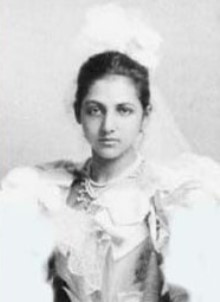
I have written multiple articles addressing the claims about the so-called ‘Other Schindlers’ which have been in ever increasing number – in fact countries often try to find them to in essence claim to have been ‘part of the good guys’ during the Second World War – but a new one that has come to be pushed recently by the Indian government is a mixed race Indian princess named Catherine Duleep Singh. It also helps their cause in that Duleep Singh was in a long-term lesbian relationship with her older German former governess Lina Schaefer, (1) who died in Germany just before the Third Reich got around to dealing with the lesbian question. (2)
The promotion of Duleep Singh as the ‘Indian Schindler’ began recently with Mark Wood writing in the ‘Jewish Chronicle’ that:
‘The remarkable story of an Indian princess who rescued Jewish families from the Holocaust features in a major exhibition opening in London later this month.
Among the exhibits going on display at Kensington Palace is a never seen before item of jewellery that sheds new light on the bravery and humanity of Catherine Duleep Singh, one of the last princesses of Punjab.
The pendant belonged to the family of Ursula Hornstein, a Jewish girl who fled Germany with her family just months before the Second World War.
It was given to her by Catherine who sponsored the family’s escape to Britain.’ (3)
Wood provides little detail of the claims around Duleep Singh but happily the ‘Holocaust Memorial Day Trust’ has a substantial biographical piece on where – aside from the all the fluff about how ‘wonderful’ she was – we get this account of her ‘Schindler style’ activities:
‘During the 1930s throughout the rise of the Nazi party, and as Germany became a more and a more dangerous place for Jews to live, Catherine continued to live with Lina and helped German-Jewish families by providing a passage to England. The couple’s neighbours are reported to have said that ‘The local Nazis disapproved of the old Indian lady’. Nevertheless, the pair continued to help German-Jewish families until Lina passed away on 26 August 1937 aged 79. Catherine was deeply upset by her death. In her will, she requested that a quarter of her ashes be ‘buried as near as possible to the coffin of my friend Fraulein Lina Schäfer’.
After Lina’s death and with the threat of war looming, Catherine felt that Germany did not have much to offer. She decided to return to England and settled in Coalhatch House in Penn, Buckinghamshire, with her two sisters. Coalhatch House would become a refuge for several Jewish families who had fled Germany and to evacuees from the Blitz.
The details of many Jews Catherine managed to help are still emerging but, in some circles, she is referred to as the ‘Indian Schindler’ in honour of the German Industrialist, Oskar Schindler, who saved hundreds of Jews by employing them in his factories. One Jewish family that Catherine saved was the Hornstein family. Wilhelm Hornstein, a government lawyer from Braunschweig, Germany, was arrested by the Gestapo and sent to Sachsenhausen Concentration Camp, on the outskirts of Berlin, for several weeks. Luckily Wilhelm was released because capacity at Sachsenhausen had been overestimated and he emerged from this experience thoroughly shaken. He fled immediately, without any money or possessions, to London.
His wife, Ilse and their two children Klaus-George and Ursula, made their own plans to leave the country. A group of Quakers helped them to secure a passage to Australia in the following September, but this meant staying in Germany another nine months. The family met Catherine in Berlin, and she offered to let them stay with her at her home in Buckinghamshire. She arranged visa sponsorship letters to enable the whole family to be reunited in England. In 2003 Ursula reflected on the kindness of Catherine:
A perfect stranger to do that…what you might call a good Samaritan.
Catherine passed away at her house in Buckinghamshire on 8 November 1942.’ (4)
The problem with this narrative is glaringly obvious in that Duleep Singh left Germany sometime after August 1937 and died in November 1942, so the time overlap of her activities and the so-called ‘Holocaust’ is at most ten months (the Wannsee Conference in late January 1942 to her death in late November 1942) and in practical terms we probably talking roughly half that in terms of the alleged implementation of the ‘Holocaust’ as an actual policy.
Further Duleep Singh had no idea about the ‘Holocaust’ and she wasn’t ‘saving jews from the Holocaust’ but rather acting as a financial sponsor to several jewish families from Germany so they could immigrate to Britain rather than say Palestine or the United States.
One of the significant historical lacunae in orthodox ‘Holocaust’ historiography is the German policy of emigration and what this meant. Western countries are usually blamed for ‘not wanting to take more jews’ but this is a grossly unfair reading of history given that jews had multiple emigration options up till June 1941 in terms of ways (and places) to migrate from Germany but many jews simply decided they wanted to go a specific country (usually a difficult one to get an entry visa for like Britain and the United States) rather leave for any safe country (for example the Soviet Union). (5) Orthodox ‘Holocaust’ historiography simply removes all agency from the jews and blames everyone else for their decisions.
Duleep Singh’s case illustrates this rather well because she wasn’t ‘protecting jews from the Nazis’ per se, but rather acting as a financial sponsor of formerly wealthy jews who had decided they wanted to immigrate to Britain rather than say go to Palestine or the Soviet Union. She didn’t have any idea about the ‘Holocaust’ – it was after all allegedly top-secret German policy at the time – and certainly didn’t ‘rescue’ any jews from it (she seems to have been doing this between 1938 to 1940). So, trying to claim she was the ‘Indian Schindler’ is simply ludicrous and a rather bad attempt to manipulate history to suggest something that is clearly untrue.
References
(1) https://homegrown.co.in/homegrown-voices/meet-the-anti-fascist-lesbian-punjabi-princess-who-saved-countless-jewish-lives
(2) On this see: Richard Plant, 1986, ‘The Pink Triangle: The Nazi War Against Homosexuals’, 1st Edition, Henry Holt: New York, pp. 113-117
(3) https://www.thejc.com/news/world/the-indian-princess-who-rescued-jews-from-the-holocaust-pr3if25a
(4) https://hmd.org.uk/resource/catherine-duleep-singh/
Cf. Ingrid Weckert, 2004, ‘Jewish Emigration from the Third Reich’, 1st Edition, Theses & Dissertations: Chicago
Karl’s SubstackRead More


 R1
R1
 T1
T1


