
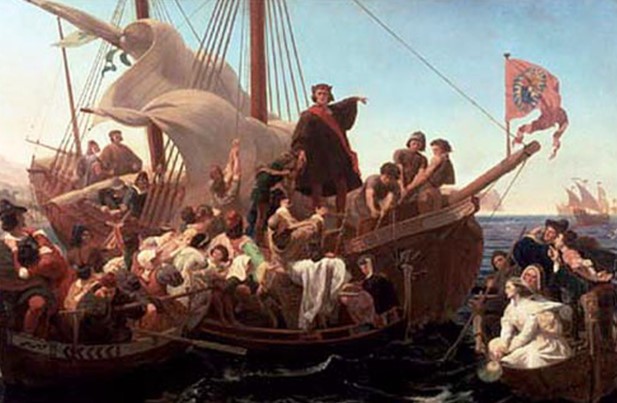
One of the more rhetorical arguments made for Columbus’ jewishness is the alleged link between Columbus’ date of sailing for his first expedition which was 3rd August 1492 and the date the Alhambra Decree of King Ferdinand and Queen Isabella (aka the complete expulsion of all non-converted jews from their lands) went into effect. The effective date of the Alhambra Decree is often claimed to be 2nd August 1492.
I believe the origin of this claim is from Meyer Kayserling’s 1894 book ‘Christopher Columbus and the Participation of the Jews in the Spanish and Portuguese Discoveries’ which suggests that the reason ‘there were so many jews in Columbus’ expedition’ – which as I have documented elsewhere is almost entirely a myth – (1) is because Columbus set sail around the time of the Alhambra decree coming into enforcement. (2)
The problem is that there was only one jew on board Columbus expeditions that this could have applied to which was one of the expedition’s doctors named Master Bernal and no one else. (3)
Kayersling himself is crystal clear however that the Alhambra Decree had absolutely nothing to do with when Columbus’ first expedition sailed as it actually had to do with Columbus’ ongoing disagreement with King Ferdinand of Aragon as to the legal terms of his voyage should he be successful.
He writes that:
‘On April 30th, the very day on which the expulsion of the Jews was everywhere publicly announced. Columbus was ordered to equip a fleet for his voyage to the Indies, and at the same time he received the contract which on April 17th had been arranged in Santa Fe between him and Juan de Coloma, the latter acting on behalf of the Spanish sovereigns. Ferdinand, who had long energetically opposed the expedition, was obliged to yield, thanks to Columbus’ persistency, and was obliged to accept the explorer’s excessive demands, which had twice caused the negotiations to be discontinued. He granted him the title of admiral, with all its privileges, and made him viceroy and governor-general of all lands which he might discover or acquire. Columbus was not content with dignities and honours for himself and his descendants. He desired also to derive considerable material profit from his voyages. The chief aim of his explorations was, in fact, to find gold, and in a letter to the queen he frankly declared that this gold might even be the means of purifying the souls of men and of securing their entrance into Paradise. Thus he stipulated that he was to have a tenth of all pearls, precious stones, gold, silver, spices, and other wares, — in short, a tenth of everything found, bought, bartered, or otherwise obtained in the newly discovered lands; he was also to have an additional eighth of the profits of the present enterprise and of all similar ventures undertaken in the future, provided he should contribute an eighth of the expense.
Columbus now made preparations for his voyage. He went from Granada directly to the little port of Palos, which for some delinquency had been ordered by Ferdinand and his consort to equip two caravels within ten days. There he soon enlisted on behalf of his enterprise the services of the rich brothers Pinzon, who enjoyed a very high reputation among navigators. In Palos he also secured his sailors and travelling companions.’ (4)
Kayserling’s point here is that the timing is coincidental and completely unrelated to the Alhambra Decree. Simon Wiesenthal in his 1973 book ‘Sails of Hope’ however engages in what I can only describe as an exercise in obfuscation when he dates the Alhambra Decree’s enforcement to the end of 2nd August 1492, but because Columbus’ first expedition left on the morning of 3rd August 1492 Wiesenthal then claims that Columbus requiring all sailors ‘to be on board’ by midnight of 2nd August 1492 is linked to the ‘enforcement of the Alhambra Decree’. (5)
The problem here is that Wiesenthal is making a material error in the date he give for the beginning of the enforcement of the Alhambra Decree – presumably based on Kayserling’s error of dating the beginning of the enforcement of the Alhambra Decree to the end of 2nd August 1492 but as Wiesenthal doesn’t cite Kayserling on this point I can only surmise this to be the case – which I will comment more on in a moment, but also Wiesenthal is also constructing a mystery where there is none in order to make a rhetorical argument. Requiring your sailors to on board the night before you sail rather than on the morning you sail is as much common practice now as it was then. You need your sailors to be on ship by the time you need to leave especially if – as Columbus was – you are dependent on the tide to leave, and Columbus left Palos de la Frontera on the ebb tide at circa 8 a.m. on 3rd August 1492.
Thus, Columbus requiring his sailors to be on ship by midnight on 2nd August 1492 has absolutely nothing to do with the Alhambra Decree and everything to do with standard nautical practice.
Further – as we’ve already seen – the date given of when the Alhambra Decree of 1492 was to come into effect is given by Kayserling as 2nd August 1492 – which I believe Wiesenthal copied without attribution – but this is simply wrong and something of an urban legend.
The text of the Alhambra Decree makes this quite clear since it states:
‘And so that the said Jews and Jewesses during the stated period of time until the end of the said month of July may be better able to dispose of themselves, and their possession, and their estates, for the present we take and receive them under our Security, protection, and royal safeguard, and we secure to them and to their possessions that for the duration of the said time until the said last day of the said month of July they may travel and be safe, they may enter, sell, trade, and alienate all their movable and rooted possessions and dispose of them freely and at their will, and that during the said time, no one shall harm them, nor injure them, no wrong shall be done to them against justice, in their persons or in their possessions, under the penalty which falls on and is incurred by those who violate the royal safeguard. And we likewise give license and faculty to those said Jews and Jewesses that they be able to export their goods and estates out of these our said kingdoms and lordships by sea or land as long as they do not export gold or silver or coined money or other things prohibited by the laws of our kingdoms, excepting merchandise and things that are not prohibited.’ (6)
So, the Alhambra Decree didn’t come into effect on 2nd August 1492 at all but rather on 31st July 1492. There are some – as far as I can see unsubstantiated – claims that an extension was given to some special cases till 10th August 1492, but even this clearly indicates that the Alhambra Decree has nothing to do with Columbus’ sailing date.
Wiesenthal predictably doesn’t mention the other far more serious problem with his claim of there being a connection between the Alhambra Decree and the timing of Columbus’ voyage, which is that when Columbus and his expedition sailed from Palos de la Frontera on 3rd August 1492; it wasn’t the last time they were on Spanish soil and required to adhere to the Alhambra Decree.
Wiesenthal skips over this because it completely removes his speculation from consideration since Columbus sailed from Palos de la Frontera to Gran Canaria and San Sebastian de La Gomera in the Canary Islands – which was also a Spanish possession and under the Alhambra Decree – arriving on 9th August 1492 and then departing again for the true voyage of the expedition on 6th September 1492.
If Columbus’ expedition was meant to avoid the Alhambra Decree of 1492 in any way, shape or form for either him and/or his crew then he quite frankly did an absolutely awful job of doing so as he sailed right to another Spanish territory in which he and his crew spent nearly a month ensuring that had the Alhambra Decree been an issue; it would have affected them there.
Thus the truth is that unless substantial new evidence is presented the Alhambra Decree had absolutely nothing to do with Columbus choosing to sail from Palos de la Frontera on 3rd August and it had everything do with his quarrel with King Ferdinand – which was ended in the Capitulations of Santa Fe on 17th April 1492 – as well as Columbus’ ability to get the necessary ships and crew together to do so.
It is that simple.
References
(1) On this please see my article: https://karlradl14.substack.com/p/why-did-christopher-columbus-take
(2) Meyer Kayserling, 1894, ‘Christopher Columbus and the Participation of the Jews in the Spanish and Portuguese Discoveries’, 1st Edition, pp. 87-92
(3) On this please see my article: https://karlradl14.substack.com/p/why-did-christopher-columbus-take
(4) Kayserling, Op. Cit., pp. 85-87
(5) Simon Wiesenthal, 1973, ‘Sails of Hope: The Secret Mission of Christopher Columbus’, 1st Edition, MacMillan: New York, pp. 3-6
(6) http://www.sephardicstudies.org/decree.html
Karl’s SubstackRead More


 R1
R1
 T1
T1


