
Credit Image: © Zach D Roberts/NurPhoto via ZUMA Press
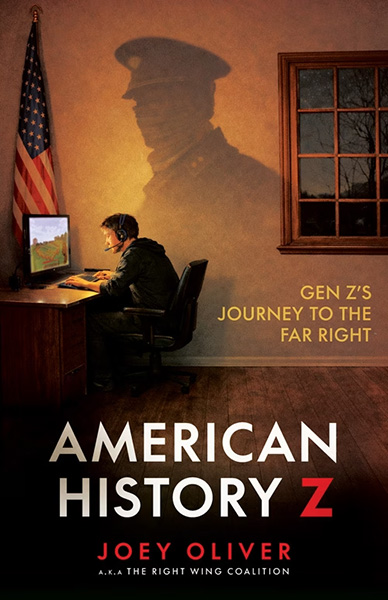
Joey Oliver, American History Z: Gen Z’s Journey to the Far Right, Arktos Media, Ltd., 2026, 224 pages, $22.95 paperback, $4.99 ebook
American History Z, with a foreword by Jared Taylor, just broke Arktos Media’s record for first-day sales and is shaping up to become a bestseller. It seeks to answer a question older loyalists of the political establishment ask almost in desperation: What could possibly be turning young men so powerfully toward “right-wing radicalism?” The generation in question, popularly termed “Gen Z” or “the Zoomers,” is commonly defined as Americans born between 1996 and 2010. Joey Oliver, born 1998, is therefore a fairly senior member of the cohort whose political education he describes in his first work of nonfiction after an earlier novel called The Grey Lion.
This generation can just about remember George W. Bush’s America: already riddled with the corrupting influence of liberalism, but outwardly still a continuation of the America of their fathers. There were still plenty of what we politely call “nice neighborhoods” with “good schools” — places where whites were free to be ourselves and raise our children. But those children are Generation Z, now coming of age or already young adults, and they see clearly that the world they glimpsed early in life is gone. They cannot, therefore, simply approach life on the same terms as their parents, but will have to fight for things their parents took for granted.
Like several generations before, they were raised on liberalism. They initially took to it so well they could hardly believe anyone had ever thought any other way:
The very idea that White, land-owning men had once been the sole demographic with a say in society was ridiculous. Women’s suffrage was heralded as another monumental victory in our battle to establish a world where everyone had an equal say. We couldn’t believe that a society that made distinctions between groups of people had previously existed at all. We’d solved the problem of government [and] were now waiting for everybody else to catch up.
Nevertheless, they learned that their remoter ancestors had somehow managed not to be liberals. In the process, they had done horrible, illiberal things such as enslaving Africans, murdering American Indians, and expecting women to be faithful wives and mothers. These crimes must never be forgotten, they were assured, and who were they to disagree?
So the young liberals-in-training cheered as a black man became President, trusting the assurances that the “post-racial era” had finally arrived. They were wholly disabused of that notion by his actual administration, however. The simple ideal of hiring the best man for the job, for example, was still a long way off due to all the injustice that had accumulated during past ages when their ancestors had inexplicably failed to be liberals:
It turned out that non-Whites still could not be evaluated based on their objective skills and achievements. Our society was so entrenched in racism that these people never had a chance to succeed. There was only one way to get them on our level: we would have to step down willingly. So, we did. It was their turn, whether or not they’d earned it. But surely, now that we’d cleared the way for these people to get a fair shot, inequality should vanish soon, right? Well, it most definitely did not.
When the promised results failed to emerge, it was explained that this was because we hadn’t tried hard enough. If something isn’t working, this proves we need more of it. Eventually it began to dawn on the young that no possible outcome could ever make the partisans of racial quotas say: “We have succeeded, and our work here is done.” Racial justice was not a result that could actually be arrived at, but an eternal struggle — more specifically, an eternal struggle against white people like themselves.
An important early landmark in the education of Mr. Oliver’s generation was the coverage of the death of Trayvon Martin in 2012. The initial story was that a black child had been wantonly gunned down by some fellow named Zimmerman. Nobody knew much about Zimmerman, but he was presumed to be a white racist. The police had not bothered to arrest him, because they were just as racist as he was. An online petition to arrest and charge the mysterious Zimmerman quickly gained more than 2,000,000 signatures. Massive protests erupted, and coverage was overwhelmingly sympathetic.
Gradually, the facts of the case emerged. The black “child” was 17 years old and close to six feet tall. George Zimmerman was an Hispanic of mixed racial heritage, not a “white racist.” At the time of the shooting, Martin was on top of Zimmerman, delivering blows to his face, and slamming his head into a concrete sidewalk. Zimmerman managed to pull out a pistol and fire a single shot. Local police released him because they thought he fired in self-defense.
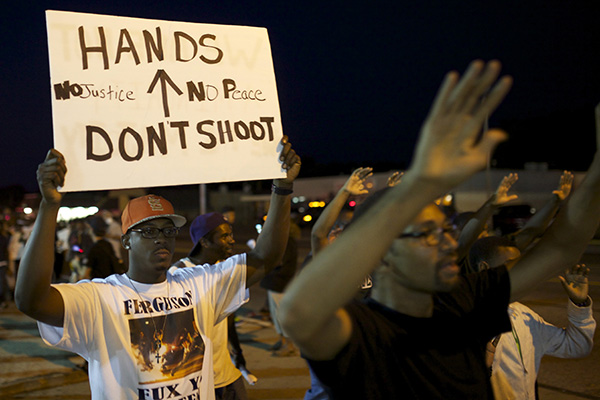
Two years later, in August 2014, the youngsters of Gen Z heard, along with everyone else, that Michael Brown, a black 18 year old, had been shot to death by a white policeman — as poor Michael held his hands up begging, “Don’t shoot!” Outraged mobs rioted through Ferguson, Missouri, for a week. They did millions of dollars in damage, and were stopped only by the National Guard. In November, a grand jury decided that they wouldn’t be bringing any charges against officer Darren Wilson, and there was more rioting.
Credit Image: © Raffe Lazarian/ZUMA Wire/ZUMAPRESS.com
Once again, it took a while for the facts to come out, but they eventually did. Michael Brown was a 300-pound criminal who had just robbed a convenience store and assaulted the clerk, when police officer Darren Wilson saw him wandering in the middle of a road and asked him to stick to the sidewalk. Brown punched the much smaller Wilson in the face several times and tried to reach for the officer’s gun. He disregarded police orders, never put his hands up or begged “don’t shoot,” and was charging at the officer like a bull when he was finally brought down.
“Zoomers” began to grasp the pattern: A black man gets killed, and tales about white racism are instantly broadcast to the entire world. Some time later the facts emerge, but it doesn’t matter: blacks and “antiracist” allies go right on with their struggle against a mythic “white racism.”
If those in positions of influence and authority had so recklessly disregarded the truth in these cases, how could they be trusted to talk about Martin Luther King, the Civil Rights Movement, or race in general?
Like so many before them, these youngsters awakening to the fraudulent nature of liberalism first assumed the cure must lie in the universally recognized opposition to liberalism known as conservatism. But among the most heartening things Mr. Oliver reports is the speed with which many of his generation avoided that trap. They found that conservatism was an unprincipled, self-seeking operation that followed liberalism like a shadow wherever it went, was entirely dependent upon it, and seemed far more interested in crushing any stirrings of white racial consciousness than in challenging the liberal regime. He writes: “Gen Z men . . . know that anything that’s allowed a seat at the table must be serving the larger, unified machine. They wouldn’t permit something that was an actual threat.”
More specifically, when the subject comes to race, American conservatism enforces a strict party line that black problems are traceable to a dysfunctional “black culture.” “According to them,” writes Mr. Oliver, “there was nothing wrong or different about blacks besides annoying rap music and fatherlessness. They preached about how the welfare state was what was actually hurting blacks.”
This is not necessarily wrong — indeed, it is not wrong — but it involves a cowardly avoidance of an enormous body of information on race and genetics now easily available to anyone with an internet connection. Gen Z is the first to grow up in a world completely saturated by the internet, and the old-fashioned gatekeeping and snobbery that supposedly protected respectable conservatism from “racism” is now as effective as a slingshot in a nuclear war.
We started to ask some questions. The first thing we asked was if it could be possible that blacks were arrested more, not due to discriminatory profiling, but because they committed more crimes. Some of us decided to look into it. With almost zero effort, we found that there was no chance that the differences in crime rates between the races could be explained away by prejudice. We found that black men in America between the ages of 14–34, who only make up about 3–4% of the population, were committing around half of our nation’s murders every year.
The 15-point IQ gap between blacks and whites was just as easy for Zoomers to discover. The racial differences they could observe began to make sense, and they couldn’t be explained because “democrats are the real racists:” They were rooted in nature.
Donald Trump first impressed himself on the young as a breath of fresh air in a world where everything had become uniform, rehearsed, risk-free, and awash in euphemism. They cheered as he called Rosie O’Donnell a fat slob, said Third World countries were shitholes, and even bragged he could shoot someone on Fifth Avenue and get away with it. “Donald Trump publicly and unashamedly rejected the approved script that we’d been hearing for our whole lives. It was hilarious and it was real.” Furthermore, he “was about as American as someone could possibly be […] and he was telling us that despite what we’d learned growing up, it was actually good to be from America. If we followed his lead, we didn’t have to be ashamed to be American anymore.”
Political principle was the last thing on the Zoomers’ minds; they were too young to have worked out a coherent set of beliefs. Rather, they liked something they sensed in Trump:
In the minds of young men, Trump versus Hillary boiled down to a contest between exhilaration and boredom. We wanted to see what would happen if this guy managed to get into office at all. We were sick of our plastic cage filled with endless safety nets. We didn’t want to wear a seatbelt or use training wheels anymore, and Trump was a motorcycle.
The young were confused, however, by the press’s alternate insistence that Trump was both a borderline retard and a terrifyingly competent dictator-in-waiting who lusted to turn America into the Fourth Reich. They had always assumed news reports were as honest and reliable as weather reports.
But in the first year of Trump’s presidency the lies became too big to ignore. The police shut down a protest of the removal of a Confederate statue from a city park in Charlottesville, Virginia, and let counterprotesters riot. The press picture was almost the direct opposite: Law enforcement and counterprotesters bravely resisted a violent white supremacist uprising.
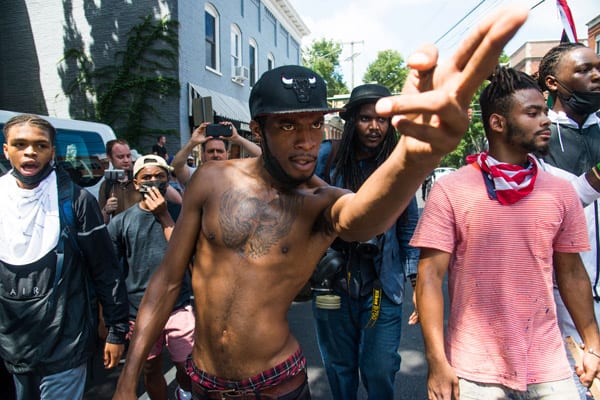
Counter-protesters line the route taken members of the ‘alt-right’ during the ‘Unite the Right’ rally. (Credit Image: © Zach D Roberts/NurPhoto via ZUMA Press)
As events were still unfolding, Donald Trump was asked what he thought. He said there were “very fine people” on both sides of the debate over Robert E. Lee statue. A journalist then claimed there were neo-Nazis present. Trump clarified that his remark didn’t apply to them.
The media twisted Trump’s words into something unrecognizable:
They edited the original clip to remove Trump’s denunciation of neo-Nazis, and brazenly reported that Trump had said that there were very fine people on both sides, with the implication being that he was defending the neo-Nazis. This became known as the “Very Fine People hoax.” A shocking amount of people went on to believe the Very Fine People lie for years. Many still do. But enough were shown the full segment of Trump’s response that it ended up becoming a watershed moment for a lot of normies. Politically neutral people had now seen undeniable proof that the press had intentionally lied about Trump. The media hadn’t been mistaken or uninformed. They had clearly lied, and it’d been coordinated across multiple outlets.
Around this time, Mr. Oliver was attending Washington State University, so it is natural that he has much to say about the campus atmosphere of the Trump years.
Some colleges were declaring certain days to be White-free. White people were told not to show up out of respect to minorities. Universities were hosting events to discuss the dismantling of Whiteness. Students were forced to watch videos about how each and every White person was a racist. The hatred was gratuitous. It was like a parody.
The tenets of liberalism we’d learned throughout childhood had been thoroughly abandoned. White people were shamed for their immutable traits while every other group was celebrated for theirs. After years of praising the end of segregation as the Second Enlightenment, we were now seeing racially separated graduation ceremonies. This time, they were being done at the request of the colored students. Segregation was okay, so long as White people were the second-class citizens being excluded.
Mr. Oliver recalls noticing that around the mid-2010s, campus leftists abandoned reasoned debate altogether, realizing that sheer intimidation was easier and more effective. Mainstream conservative speakers were forcibly shut down by university radicals, and the authorities refused to intervene. The “Proud Boys” originated at this time as voluntary security. They thought the failure of campus police to arrest Antifa signified a reluctance to make arrests at all. As a result of this miscalculation, there were incidents in which the Proud Boys themselves got arrested for the crime of being attacked. Obvious police bias was an important part of Gen Z’s political education.
Whether by temperament or early instruction in liberalism, the author’s cohort was inclined to an easygoing, live-and-let-live approach that extended even to toleration of vices such as soft drugs and gambling that did no clear and immediate harm to third parties. Like other recent generations, they had been induced to take a sympathetic view of homosexuals, reasoning that such people had not chosen their inclinations, supposedly as natural to them as eye or hair color. This is, of course, an application of the liberal principle that we should not be condemned (or “discriminated against”) for matters over which we have no say.
But now “gender transitioners” were being added to the homosexual coalition, and the old argument no longer applied. Clearly, nothing forced any young person to have his genitals mutilated in pursuit of an impossible dream of switching to the opposite sex. The trans explosion was what finally got young men to suspect that this movement may not be what they had been told. Sympathy for homosexuality itself even began to decline for the first time within living memory as people became more aware of what actually goes on at so-called pride parades (such as men urinating on one another in public). “We knew just by looking at these people that this behavior wasn’t something that had been historically stifled by oppressive and backward societies. We were seeing an intentional inversion of the natural order.”
As for the trannies, their apparent fascination with children was deeply suspicious, and “their insistence on unfettered access to the women’s bathroom also didn’t help their case. This was the most obvious example of a wolf in sheep’s clothing that we’d ever seen in real life. It was not okay and everyone knew it.”
In 2016, Canada passed a law making it a crime not to indulge transsexuals in their preferred modes of address (to “misgender” them). A professor of psychology named Jordan Peterson countered that there should be no compelled speech in a free society, and said he would defy the new law. He quickly became a hero to many young men frustrated with crazy constraints on what they could say. They soon discovered Mr. Peterson had been uploading lectures to YouTube, introducing his audience to a number of worthwhile ideas:
We started to understand life outside of the banal, materialistic way in which it had always been presented to us. Not only was Jordan compelling us with his rich narration of history and myth, but he was telling young men to . . . shoulder as much responsibility as we could. He explained that life was suffering, and despite the fact that we’d been perpetually instructed to cling to comfort and safety to avoid it, we should seize the mantle of suffering. He told us to voluntarily accept our fate and do something that society had told us to avoid. Once we willingly undertook suffering, we’d find our meaning.
However much an effeminate society may suppress it, there is something eternal in young men that craves adventure. Mr. Peterson understood this, and it goes far to explain his popularity. He was soon appearing on Joe Rogan’s podcast, the most popular in America and a haven for various forms of nonconformity.
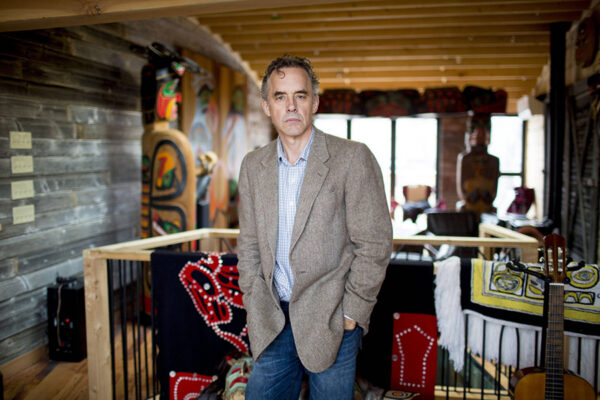
Dr. Jordan Peterson, the University of Toronto prof at the centre of a media storm because of his public declaration that he will not use pronouns, such as ”they,” to recognize non-binary genders. December 6, 2016. (Credit Image: © Carlos Osorio/The Toronto Star via ZUMA Wire)
Mr. Peterson’s emphasis on the freedom to speak the truth was echoed by a number of mostly Jewish classical liberals who became known as the Intellectual Dark Web; they included Sam Harris, Dave Rubin, and Bret and Eric Weinstein. Gen Z appreciated their principled defense of free speech and debate, but noticed their shyness when the subject turned to more “sensitive” issues such as race. The coronavirus soon tested these men’s devotion to their stated principles, and most did not get high marks.
Mr. Oliver devotes a chapter to Covid hysteria, another lesson in our elite’s obsession with control and unconcern with truth. The young watched in fascination as Dr. Anthony Fauci was openly caught in lies and refused to admit them. “The virus jarringly forced so many of us to realize that there’d be no scenario where we would get to be left alone by these people. The only way out of this mess was to take power and impose our will.”
Within a couple months of the beginning of Covid, the biggest racial hoax of all erupted. On May 25, 2020,
George Floyd, a 6’4”, 220-pound black man, was pinned down on the hot Minneapolis street. While his head was pressed against the pavement, a White man knelt down on his neck as surrounding officers stood by. Floyd yelled out that he couldn’t breathe. He screamed for his mama, begged for water, and cried out while the White cop’s knee remained steadily on his neck. Floyd went limp. . . .
The riots began the day after the incident. Hordes took to the streets to violently reject the evil racism that was embedded in our society. Rioters blocked freeways, threw Molotov cocktails, looted, and vandalized everything in sight. The reaction in Minneapolis was nearly apocalyptic. We watched as the Minneapolis Police Department’s 3rd Precinct was set on fire, forcing the cops to flee. Cities across the nation saw similar destruction. The mayhem even led to the burning of St. John’s Church in Washington, D.C., causing Trump to take shelter in a bunker. The memorial service had Al Sharpton literally comparing George Floyd to Jesus Christ. Don Lemon declared that George was a saint. Floyd’s body was wheeled out in a golden casket where Jacob Frey, the mayor of Minneapolis, wept over it.
The dishonesty of news reports was once again breathtaking. On May 29, an MSNBC reporter announced that Minneapolis was experiencing “mostly a protest that was not, generally speaking, unruly” — while viewers could see a building burning in the background. Some journalists wondered why protests should have to be peaceful at all.
Within a few days, police officers began kneeling in a show of submission to the rioters. Calls to defund the police erupted, and some yelled for police departments to be abolished nationwide.
Everybody wanted in on the action. Companies made sure everyone heard about their support for the rioters, and quota hiring became much more aggressive. “Chief Diversity Officer became the newest C-suite position within companies all across the nation,” Mr. Oliver writes. “There was an outrageous salary always attached to it, too. Their entire job was to hire unqualified minorities and criticize White people.”
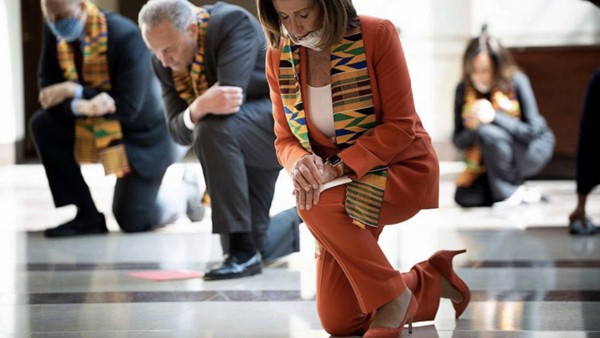
Aunt Jemima and Uncle Ben suddenly disappeared because it was learned that it had been somehow racist to put their images on packages. Amazon enjoyed a bonanza as sales of “antiracist” titles increased 68-fold. The Washington Redskins changed their name. Senators and Congressmen dressed up in African garb to kneel in George Floyd’s honor. The Smithsonian explained that punctuality, hard work, and the scientific method were key components of white supremacy.
Once again, attentive Zoomers gradually learned the true story of George Floyd; he
had taken a large dose of fentanyl right before his interaction with police. George also had heart disease, which made the use of this drug even more dangerous. But the most damning thing we learned was that Floyd had been complaining that he couldn’t breathe long before he was put on the ground. Even worse, the technique used by Derek Chauvin was the instructed form taught to Minneapolis police officers. It wasn’t some racially charged assertion of dominance. It was standard procedure, and it certainly didn’t look like it had the capacity to kill Floyd through its implementation alone.
We then learned a little bit about George Floyd’s criminal past. We were quickly shown that this likely was just some degenerate exhibiting his same historical pattern of behavior. Saint Floyd had been arrested nine times up to this point, and in one of the more gruesome offenses, he’d held a gun to a woman’s stomach as he robbed her.
They compared the madness they were witnessing on their television screens with their own lives:
Almost no White person remembered any personal instance of a truly racist act occurring in their whole lives. In fact, we recalled the opposite. We remembered all the times that we gave minorities preferential treatment on the basis of their race.
And for these young people, the race issue was no longer about who would get into his favorite college: People were unashamedly expressing violent hatred, and there was open discussion about exterminating Whites. “Antiracism” no longer sounded like To Kill a Mockingbird. For these reasons, many of the young were losing patience with liberals like those of the Intellectual Dark Web (IDW):
Their problem with DEI was that it took immutable characteristics into account during its decision-making process. The IDW’s true issue was that the procedural mechanism of DEI violated the colorblind, neutral ethic of classical liberalism. They’d always explain that no matter what, we needed to fight our evolutionary programming for tribalism and treat everybody as a unique yet universally aligned individual. Some of us were starting to wonder if a system like that was seriously viable. If Whites agreed to be impartial to race, nobody else would be, and the systems which were currently in place already discriminated against Whites anyway. We didn’t understand what our gain would be besides being able to say we’d successfully committed to a fantastical principle. If it ended in our destruction, what was the point of the principle? We decided that we couldn’t continue to accept being the one group that wasn’t allowed to have an identity.
A combination of growing radicalism and the free flow of information on the internet allowed Gen Z to learn more quickly than their elders. Mr. Oliver was arriving in his mid-twenties at ideas I did not seriously consider until nearly 40.
American History Z continues the story of Gen Z’s political education into Donald Trump’s second term in office, but I will let readers discover the rest for themselves.
In closing, I will highlight one more of the book’s strengths that distinguishes it from the work of older identitarians: Mr. Oliver is highly conscious of the distinctively womanish nature of the despotism closing in on us.
We are constantly assured that the increasingly onerous restrictions on our freedom are meant only for our own safety. Our opponents no longer try to argue that our opinions are false; only that they lack “compassion.” They don’t want to convince us; just exclude us (“cancel culture”). All this is very female. For white women in particular, “wokism” is a way of joining the winning team and achieving partial absolution for the real or alleged sins of their race — at the expense of scorning their own men, of course. When they are young, this sounds like a good trade-off; as they age and begin to ask where their husbands are hiding, their perspective will change, but for many it will be too late.
Mr. Oliver notes that, as with antiracism, feminism was initially supposed to be a reconciliation, but has become open resentment and seeks retribution.
Women now had it all — education, careers, contraception, no-fault divorce, affirmative action — you name it. But instead of contentment and success, we got the most unhappy female population in recorded history. We were doing everything we could for women, but it wasn’t enough. We tried to give them what they asked for, and they still hated us. So, after the endless efforts and concessions, lots of us young men gave up on trying to appease any of these people [meaning both women and non-whites]. We don’t have an obligation to be nice to people who hate us.
Young white women may soon have to learn even more quickly than the men of Gen Z. This is among the greatest challenges now facing our race.
The post A Rising Generation Challenges a Declining Regime appeared first on American Renaissance.
American RenaissanceRead More


 R1
R1
 T1
T1


