“Power Up America” Needs 500,000 Highly Skilled Workers
We’ve already pointed out that money isn’t the problem in America’s unprecedented data center construction buildout. Big Tech’s AI capex splurge is effectively endless thanks to “circle-jerk” vendor-financing schemes, and land is plentiful.
The real bottleneck? First, it was power – or rather, the lack of it – as the grid struggles to hook up hyperscalers sprinting toward ever larger and more power-hungry AI server racks.
True.
That is why Bitcoin is based on energy: you can issue fake fiat currency, and every government in history has done so, but it is impossible to fake energy.
— Elon Musk (@elonmusk) October 14, 2025
Beyond a power grid already stretched thin due to limited capacity, the Trump administration is now scrambling to fix this with an accelerated nuclear push before the 2030s. We’ve identified another problem that central bankers can’t print their way out of: skilled labor. And no, we’re not talking about the need for cheap, unskilled migrant labor. We’re talking about a highly skilled workforce required to build, run, and maintain data centers, as well as expand the power grid and operate nuclear power plants.
Wow:
“In 2025-28, we project ~57 gigawatts (GW) of US data center power demand, and we quantify available power capacity to serve this demand as: near-term grid access of ~12-15 GW, plus ~6 GW of data centers under construction, resulting in a ~36 GW shortfall of US power… pic.twitter.com/4PArdYY9qO
— zerohedge (@zerohedge) December 16, 2024
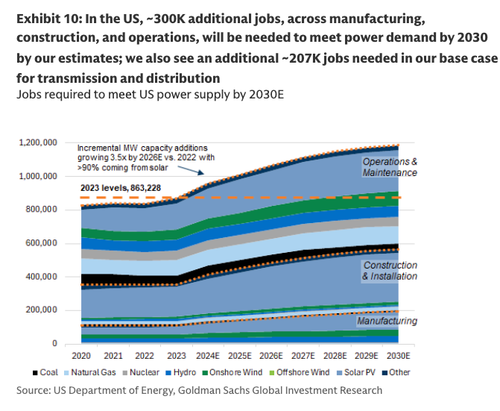
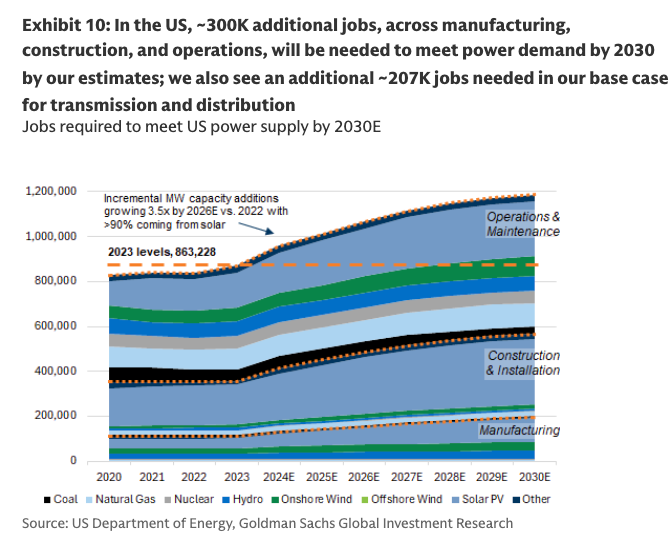
In early October, Goldman noted that data center buildouts will require an additional 300,000 workers across manufacturing, construction, and operations to meet power demand by the end of the decade.
And then there is the issue of where the US gets 300,000 engineers to build all this missing power supply by 2030 https://t.co/a18crhqZ4v pic.twitter.com/tinW8SHDwM
— zerohedge (@zerohedge) October 14, 2025
Now, Goldman analysts led by Carly Davenport are telling clients that the power industry will need over 500,000 new workers by 2030 to meet the surging electricity demand from data centers and the broader economy-wide electrification push.
Davenport explained:
“The US power industry is poised to require >500,000 new workers by 2030 or a significant acceleration in labor productivity. This growth enters a labor force already facing strain from aging and a limited pipeline of skilled labor. Labor-demand challenges to meet levels of US power-demand growth not seen since the 1990s are rising amid the Demographic Dilemma — a shrinking productive labor pool tasked to support an aging population — which raises the risk of G7 labor-force strains. This is elevating investor/corporate debates on industry execution and whether/when rising power, equipment, and labor costs could constrain growth.”
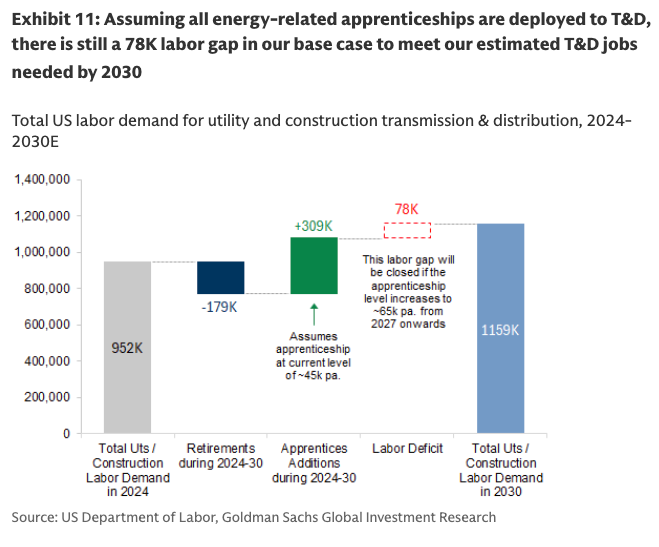
Generational growth to achieve 2.6% CAGR in electricity demand through 2030 could require ~510,000 US power and grid jobs (a 28% increase versus the 2023 US energy workforce).
“We estimate the need for ~300,000 incremental jobs across manufacturing, construction, and operations/maintenance (Exhibit 10)…
…plus an additional 207,000 across US transmission and distribution (Exhibit 11).“
What’s critical to understand is that the trillions in investment flooding into the economy through the 2030s will require far more than steel, concrete, silicon chips, and copper wire. They will demand a massive expansion of highly skilled workers.
Right now, there is a terrible oversupply of college-educated workers and a deepening shortage of talent for non-degree, hands-on jobs – a widening gap highlighted in a recent Goldman note by analyst Evan Tylenda.
Our advice for young people struggling to find a real job: ditch the useless gender-studies degree and learn a trade that’s becoming increasingly valuable to “Powering America.” For college students who haven’t been brainwashed by Marxism and wokism, aim for fields that will actually matter, such as engineering, energy systems, and nuclear science – all of which will be in red-hot demand in the 2030s.
The labor market is shifting fast. It’s time to move with it and choose a career that won’t be automated into oblivion anytime soon.
Tyler Durden
Tue, 12/02/2025 – 21:20ZeroHedge NewsRead More








 T1
T1