China’s Real Estate Collapse Sends Local Debt To Record $18.9 Trillion
Almost 20 years ago, when the Lehman/AIG collapse and the ensuing global financial crisis sent the world into a brief but acute depression, it was China’s massive debt-fueled growth dynamo that kick started the world economy and lifted the globe out of what would have been a lost decade – if not worse. The one trade off to this historic kickstart: China ended up doubling its total debt, which then continued growing at an exponential rate until the covid collapse sent China’s property sector – the biggest asset of its massive middle class – into a tailspin, and sparked a historic economic crisis. Only this time, because its total debt was already at 350% of GDP, Beijing no longer could wave a magic debt wand, inject a few trillions in credit, and make it all go away. Instead, the housing market has been in steady decline for the past 5 years and if anything, the decline has accelerated now that China’s Vanke – the last remaining state-backed property giant – is on the verge of collapse.
Unfortunately for China, which has done an admirable job of shoving all its economic woes under the rug while pretending it is growing at a immutable 5% year in and out, it’s about to get worse.
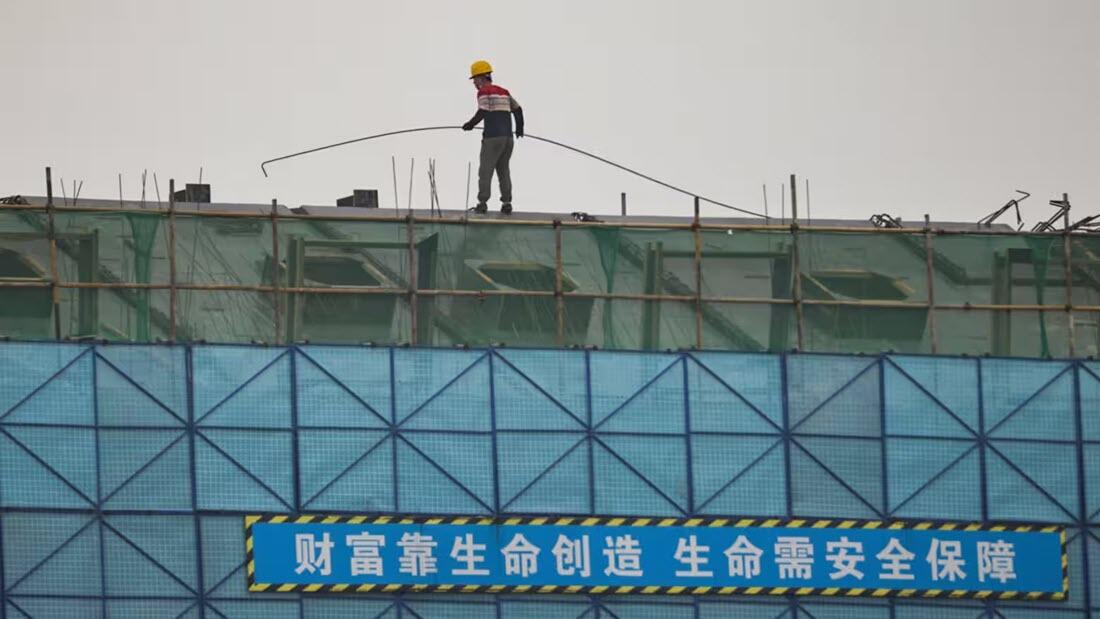
As Japan’s Nikkei reports, China’s local government debt continues to balloon as the prolonged, 5-year-long and counting, real estate slump has led to slumping income from property sales, pushing local government bond issuance for the year to a record high.
The total owed by local governments and the local government financing vehicles (LGFV) that fund their projects now sits at an estimated 134 trillion yuan ($18.9 trillion), which suggests that total public debt to GDP is far above 200%… and rising (by comparison in the US it is 100%… and rising). Add another 200% in private sector debt, and you can see why China debt problem is even bigger than that of Japan. It’s also what, according to Rabobank’s Michael Every, underlines China’s structural necessity to maintain capital controls and a vast, neo-mercantilist trade surplus (i.e., China will continue dumping goods and exporting deflation as the alternative means game over).
And while China’s record low interest rates may cover up and put the problem off temporarily, it will also draw out deflation further, further depressing growth, leading to even more debt, and so on as the deflationary debt vortex expands.
“We’ve set aside 500 billion yuan for local governments,” said China’s Finance Ministry said in an October notice, explaining that it had approved additional debt expansion.
The funds are to be used to reduce local government debt and unpaid bills, as well as for investment projects.
“Right now, local governments are focusing on issuing bonds, placing them quickly and realizing their benefits as soon as possible,” said Li Dawei, who leads the ministry’s new debt management department.
Issuance of local government bonds this year totaled over 10 trillion yuan as of the end of last month. This exceeds the total for all of last year – 9.7 trillion yuan – and has already set a record for the largest amount in a single year. The outstanding balance of local government bonds has reached 54 trillion yuan.
Multiple factors are behind the increase. The biggest one is the drop in local government revenues resulting from the neverending real estate market slump. The value of property sold by local governments in January-October totaled just under 2.5 trillion yuan. In 2021, that value was over 8.7 trillion yuan for the full year.
“Over 10% of properties to be sold received no bids because there were no buyers,” said You Zipei, an analyst at Zhongtai International Securities. You says the market is adjusting further, and expects the total value of property sales for 2025 to be about 3 trillion yuan, a more than 5 trillion yuan decline from the peak.
Another reason local governments are issuing more bonds is hidden debt. Hidden debt refers to money raised through means such as corporate bonds issued by local government financing vehicles, or investment companies owned by local governments.
There is no precise data on the balances of these LGFV debts. The total of all debt with interest issued by roughly 4,000 LGFVs sat at 87 trillion yuan at the end of last year, according to Chinese data provider DZH. Adding this to the 47 trillion yuan in local government bonds brings the total to 134 trillion yuan, or just under $19 trillion.
The International Monetary Fund estimated LGFV debt in China at 65 trillion yuan in 2024. While there are a range of estimates, the general view is that local governments in China have between 60 trillion yuan and 80 trillion yuan in off balance-sheet debt.
A company can survive even with large debts as long as it is making money, but LGFVs have low profitability, with nearly 10% seeing losses. Only 3% of LGFVs have a return on equity over 4%.
Sure enough, while total net profit for LGFVs for the year ended December 2024 was around 550 billion yuan, they received double that, or more than 1 trillion yuan, in subsidies. In other words, without constant funding from Beijing, China’s regional economies would implode.
This means that nearly 50% of those LGFVs were in the red when subsidies are excluded. Considering the projects they fund are low profitability infrastructure projects, these entities will face a long road to paying down their debts.
In spite of their massive debts, LGFVs can continue to operate by banking on implicit guarantees from the government and low interest rates resulting from prolonged deflation. Meanwhile, the debt hole is only getting bigger: Xi Jinping’s government last fall approved the issuance of an additional 10 trillion yuan in local government bonds to transfer LGFV debt to local governments. The government has a strong desire to avoid a financial crisis brought on by LGFVs, or anyone else for that matter as economic collapse in the middle of a trade war with Trump would be catastrophic for Xi’s reputation.
The average yield on corporate bonds issued by LGFVs under the city of Beijing this year is 2.1%, down 1.4 percentage points from 2021. The drop is comparable to that seen for national government bonds. The finances of local governments are being supported by monetary easing on the part of the People’s Bank of China in an effort to prop up the sluggish economy.
While deflation does help kick the debt problem down the road, it also makes the issue ultimately harder – if not impossible absent a devastating crisis – to solve.
The Domar condition is one indicator for determining fiscal stability. The basic idea is that fiscal sustainability is unlikely to be compromised as long as the nominal rate of economic growth exceeds the nominal interest rate.
“With China’s nominal growth rate headed downward to the 3% range, and its nominal interest rate is just under 2%, the gap is closing,” said Yusuke Miura at think tank NLI Research Institute. And unless the PBOC pulls a Japan and unleashes Negative Rates thanks to massive QE, the countdown to China’s next mega crisis is on.
The majority of China’s government bonds are denominated in yuan. With the country’s large current account surplus, local government bonds are not likely to run out of buyers in the near future. Yet China’s government is well aware that its fiscal situation is getting worse. It has started refraining from making big outlays and there is a growing possibility that deflation due to slack demand will drag on.
Tyler Durden
Wed, 12/03/2025 – 22:35ZeroHedge NewsRead More






 T1
T1