European Carmakers Surge After Trump Rolls Back Fuel Rules
European automaker shares rose sharply on Thursday after President Donald Trump moved to roll back U.S. fuel economy limits established under Joe Biden, according to Reuters. The administration framed the proposal as a way to lower consumer costs by making it easier for companies to sell gasoline-powered vehicles.
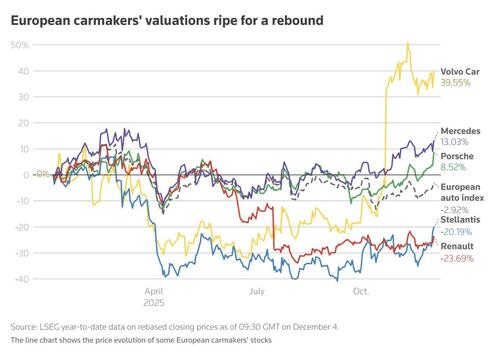
By mid-morning, Porsche shares were up more than 5%, Mercedes-Benz and Volvo Car gained nearly 4%, Renault rose 3.3%, and Stellantis climbed around 2.7% after an 8% rally the previous day.
Speaking from the Oval Office alongside industry executives and lawmakers, Trump announced the reversal of the Biden-era rules, saying, “We’re officially terminating Joe Biden’s ridiculously burdensome, horrible, actually, CAFE standards that impose expensive restrictions and all sorts of problems — gave all sorts of problems to automakers. And we’re not only talking about here, we’re talking about outside of our country.”
He also said his administration would revoke California’s emission waivers, following a Senate vote earlier this year to overturn them. A White House official said the reset could save Americans up to $109 billion.
Reuters writes that automakers responded favorably. Ford CEO Jim Farley said the move aligns regulations with market conditions, adding, “We can make real progress on carbon emissions and energy efficiency while still giving customers choice and affordability.”
Stellantis CEO Antonio Filosa said the company supports policies that are “environmentally responsible” but also allow consumers “the freedom to choose the vehicles they want at prices they can afford.” General Motors backed the idea of a single national standard and said it remains committed to offering both electric and gasoline-powered models.
Volvo Cars said it is too early to assess the effects of the regulatory shift. Although aiming to reach net-zero emissions by 2040, the company has already announced plans to expand hybrid production in the United States, with new models scheduled as late as 2029.
Market analysts said the rollback had been widely anticipated. Martino De Ambroggi of Equita noted that the change should benefit the industry and pointed to reports that the European Union may loosen or revise its planned 2035 ban on combustion-engine car sales. Industry sources said this week that the European Commission could delay announcing its support package for the region’s carmakers.
The move is expected to intensify debate over whether weaker standards actually reduce costs for drivers. Consumer Reports found “no systemic, statistically significant increase” in inflation-adjusted vehicle prices from 2003 to 2021, while fuel economy improved 30% over the same period.
The organization estimated that consumers saved “$7,000 in per-vehicle lifetime fuel savings for model year 2021 vehicles compared with model year 2003.”
Environmental groups criticized the policy shift, arguing it will raise long-term fuel expenses and emissions. Dan Becker, director of the Center for Biological Diversity’s Safe Climate Transport Campaign, said, “In one stroke Trump is worsening three of our nation’s most vexing problems: the thirst for oil, high gas pump costs and global warming.” He said stronger standards are essential to U.S. competitiveness, warning that Trump’s action “will feed America’s destructive use of oil, while hamstringing us in the green tech race.”
Tyler Durden
Thu, 12/04/2025 – 06:55ZeroHedge NewsRead More






 T1
T1