Hawkish Baltic States Lead Europe’s Race Back To The Draft
We’ve been documenting new efforts of European countries to drastically ramp up their defense readiness as the proxy war in Ukraine persists with no end in sight. For example, French President Emmanuel Macron last week announced a new avenue of voluntary military service for 18- and 19-year olds with the goal of gradually bolstering both active duty and reserve strength. This is part of a trend of the return of military conscription across the continent.
And this week Lithuania announced it will call up 5,000 conscripts in 2026, a significant increase from previous years. Years ago, Lithuania was the first EU country to restore mandatory military service in the wake of the Ukraine crisis centered on Crimea in 2014. The small Baltic country has also committed 5-6% of GDP to defense through 2030, more than double the existing NATO 2% guideline. It is now expected to expand its conscription plan to run year-round from 2026. Latvia too had been among the first to restore mandatory service based on concerns Russia could expand action beyond Ukraine.
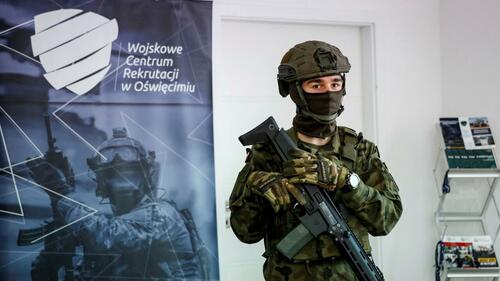
A regional publication reviews the recent history as follows:
Lithuania reinstated conscription in March 2015 after suspending it in 2008, becoming the first EU country to reverse course following Russia’s seizure of Crimea, according to the US Library of Congress. Sweden followed in March 2017 with a gender-neutral conscription system.
Russia’s full-scale invasion of Ukraine in February 2022 prompted Latvia to restore mandatory service in 2023, with mandatory service beginning January 2024. Croatia followed suit in October 2025, with the first conscripts expected in January 2026.
This is also consistent with a pattern of smaller Baltic and northern European states being some of the most outspoken hawks when it comes to Russia.
But broadly, more and more European governments racing to find the quickest and least expensive ways to expand their forces to face down the ‘Russian menace’. One European source says bolstering military personnel – whether active or reserve – is increasingly being seen as an “emergency back-up plan”.
“As defense budgets swell, governments are quietly rebuilding the human backbone of their militaries. It’s not just about guns and tanks. In 2024, EU member states collectively spent a record €343 billion on defence (1.9% of GDP), and much of that went to personnel and readiness,” Euractiv writes in a fresh report.
The report suggests that at a moment Washington seems to be taking more of a wait on the sidelines approach to militarily supporting Ukraine, the Europeans are scrambling to make up for a potential future major lack of NATO manpower.
“NATO currently has 3.44 million military personnel, according to the latest data. But if you take the US out of the equation, the Western military alliance is left with roughly 2.11 million active troops, only 1.5 million of which belong to EU countries,” Euractiv continues.
The report breaks things down as follows:
Across the bloc, 9 EU countries have mandatory military service: Austria, Cyprus, Denmark, Estonia, Finland, Greece, Latvia, Lithuania, and Sweden.
France and Germany have recently followed suit in a bid to bulk up their reserves without reverting to full-blown conscription. Paris has moved to roll out a 10-month voluntary national service program by 2026, and Berlin is openly weighing a return to mandatory service, after years of ruling it out.
The models, however, are anything but uniform. In the Nordics, Sweden and Norway use selective, gender-neutral drafts. They screen entire age groups but call up only the numbers they need, roughly 6,000-8,000 people a year, to avoid draining reserves. Denmark relies on a hybrid lottery. Militarily neutral Austria maintains traditional male conscription but provides conscripts with the option to participate in civilian volunteer activities instead of traditional military ones.
The report further provides the following helpful infographic map:
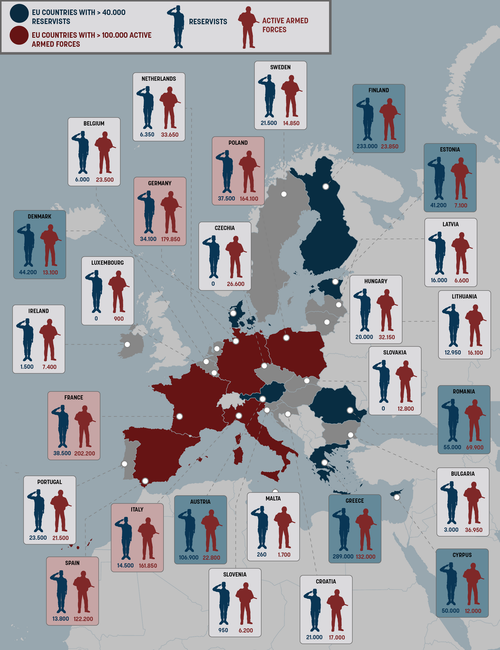
As for reserve programs, a system of part-time service members who are civilians which can be mobilized quickly if called upon helps countries keep defense spending down during times of peace. European nations are trying to bolster these numbers of trained personnel as well.
Tyler Durden
Fri, 12/05/2025 – 02:45ZeroHedge NewsRead More






 T1
T1