Alain de Benoist, The Populist Moment: The End of Right vs. Left, Middle Europe Books, 2025, 373 pages, $35.00 (softcover)
This is an abridged version of Michael Walker’s review.
Alain de Benoist’s The Populist Moment, subtitled The End of Right vs. Left, is the English translation of a book first published in French in 2017 as Le Moment Populiste, subtitled Droite-Gauche c’est fini! A note on the last page says Mr. de Benoist is “a political philosopher and historian of ideas” and “the author of a hundred books and thousands of articles.” He also edits Krisis and Nouvelle Ecole (Issue 29 of Krisis was devoted to populism), and for decades, he has been the best known representative of the so-called “French New Right,” a term he presumably shuns, judging by the subtitle of this book.
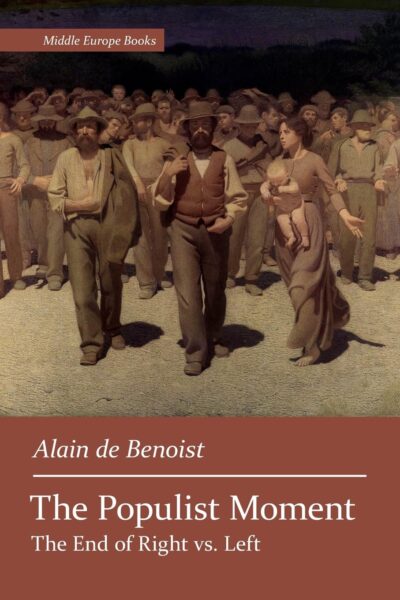
The book is a compilation of essays by Mr. de Benoist to a greater or lesser extent relating to populism — a baker’s dozen if we include the author’s introduction. The chapters are discrete essays, so they can be read as complete essays in their own right. Some, such as “What is Populism?”, discuss populism directly; others, such as “The Ambiguity of Communitarianism and Liberalism & Morality,” only indirectly.
Middle Europe Books is to be congratulated on having brought out an edition in English much more “user friendly” than the original French. The layout is more attractive and elegant. Middle Europe Books has also provided an index of proper names, especially important in any work by Mr. de Benoist.
The Populist Moment is not polemical, but analytic and academic. Less emphatic than the original subtitle (Droite-Gauche C’est Fini!), the English subtitle better reflects the book’s contents. The exclamation mark is missing, and whereas the original French means “it’s over!”, the English The End of Right vs. Left, like Mr. de Benoist’s thesis, can be read to mean that the end of the Right/Left divide has taken place, or will take place or is in the process of taking place. Which is correct? Mr. de Benoist himself seems undecided. In the chapter titled “The Erasure of the Right Left Divide,” he writes that “the Left-Right wing divide is in the process of losing a great deal of its significance,” which is a more cautious statement than “it’s over!” However, in the same chapter Mr. de Benoist writes as though he believes that process has indeed already been completed: “deep social transformations induced by changes in the capitalist system are most responsible for rendering the Left/Right distinction obsolete.” (p. 83)
The Populist Moment is principally focused on France. A disproportionate number of the writers and public figures cited and mentioned are also French. Very occasionally the English edition provides a footnote to explain who or what something was, but readers will probably still need to consult the internet frequently if they are curious about the many persons and groups to whom Mr. de Benoist refers.
The term “populism” is not new, but only in the last 20 years or so has it become widely used, and mostly in a negative sense. The online Encyclopedia Britannica provides a good example:
A political program or movement that champions, or claims to champion, the common person, usually by favorable contrast with a real or perceived elite or establishment. Populism usually combines elements of the left and the right, opposing large business and financial interests but also frequently being hostile to established liberal, socialist, and labour parties.
Later, the Britannica changes tone:
In its contemporary understanding, however, populism is most often associated with an authoritarian form of politics. Populist politics, following this definition, revolve around charismatic leaders who appeal to and claim to embody the will of the people in order to consolidate their own power. In this personalized form of politics, political parties lose their importance, and elections serve to confirm the leader’s authority rather than reflect the different allegiances of the people. Some forms of authoritarian populism have been characterized by extreme nationalism, racism, conspiracy mongering, and scapegoating of marginalized groups, each of which served to consolidate the leader’s power, to distract public attention from the leader’s failures, or to conceal from the people the nature of the leader’s rule or the real causes of economic or social problems.
Mr. de Benoist offers a short assessment of populism, which he takes from the Argentinian political theorist Ernesto Laclau:
Populism is not an ideology. It is a form of political construction that appeals to those below against those in power while passing over all established channels. (p. 216)
Mr. de Benoist interprets populism as a mass expression of political discontent with a globalist capitalist system — a system under which economics takes precedence over politics. In an interview to discuss his book with the French independent television channel TVL, he said that populism was “not an ideology but a style.” He went on to say that far from abandoning the rules of democratic politics, as its critics claim, populism represents a return to genuine political engagement.
In both the interview and this book, Mr. de Benoist stresses that populism cannot be identified in terms of any specific political plan or program, because it is not an ideology: “The first mistake to avoid when speaking of populism is therefore to seek in it an ideology or to identify it with a definite doctrine.” (p. 122)
The Populist Moment interprets populism as a democratic challenge to liberalism, principally understood as the doctrine of an economically unregulated society. According to that interpretation, liberalism and democracy are hard, if not impossible, to reconcile. So, for Mr. de Benoist, populism is the voice of true democracy. He makes the important point that populist rebellion demands courage and engagement. Acquiescence to the elitist system of so-called democracy requires neither:
Populism basically wants nothing but to put the people back into democracy. This is why Christopher Lasch saw in it ‘the authentic voice of democracy’ as well as a resurgence of the republicanism of Antiquity and the Renaissance, which wanted virtue (in the ancient sense of virtus, manly courage) to be the foundation of citizenship conceived not merely as a legal status but as a principle of collective action. (p. 131)
Mr. de Benoist distinguishes between democratic (political) equality and natural (biological) equality. Democratic equality is a political concept that includes all those who belong to the demos, the citizenry, and excludes all those who do not. By contrast, natural equality (which people share in common and what characterizes them as human beings) and natural inequality (which distinguishes one individual from another) are not political constructs.
Mr. de Benoist reproaches liberalism for failing to distinguish between natural and political equality. All people belonging to a specific democratic union should enjoy equal political rights in a clearly defined and exclusive system; but such rights are distinct from global individual human rights: “Under the influence of the rights-of-man ideology, the principle of democracy is no longer ‘one citizen one vote’ but ‘one man one vote.’ ” (p. 42)
According to Mr. de Benoist, global individual human rights justify a system of global competition among individuals who are said to enjoy “equal human rights” but who paradoxically lose the democratic rights they enjoyed as privileged members of a specific exclusive entity (for example, a nation state).
Mr. de Benoist argues that people under a liberal democratic system are increasingly left to fend for themselves economically and culturally in a kind of global bazaar, putting their individual abilities and personal connections to good effect or failing to do so. Each individual is responsible for his or her own personal fate. Such a system “naturally” creates inequalities and runs into conflict with the demos — the people as a political body. Mr. de Benoist quotes the German jurist Carl Schmitt:
. . . the essential concept of democracy is the people and not humanity. If democracy is to remain a political form, there are only democracies of the people, and no democracy of humanity. . . . The equality that is part of the very essence of democracy thus applies only within a state and not outside it . . . . If a democratic state recognized universal human equality in the domain of public life and law down to its ultimate consequences, it would rid itself of its own substance. (pp 338–339)
This shows how a discussion about liberalism and democracy is very relevant to a discussion about populism. Populism as understood in The Populist Moment is the expression of a militant demand that the will of the people be the ultimate political decision maker and the final court of appeal. The fundamental democratic rights of peoples are different from the rights of individuals, even when, or especially when, the need to defend human rights is presented by the advocates of liberal democracy as “defending our democracy.”
Mr. de Benoist argues that the liberalism of an unregulated economy and democracy (in the sense of rule of the people), are innately incompatible. Liberalism in the sense of the belief that the individual should “pursue happiness” free of arbitrary compulsion and restriction is acknowledged in The Populist Moment, but only as a negative accessory to economic liberalism.
The belief that liberalism and democracy are radically different runs counter to a common perception that democracy and liberalism naturally belong together and create the system called “liberal democracy.” In the chapter titled “What is Populism?”, Mr. de Benoist acknowledges that liberal democracy exists — or what he calls a “liberal conception of democracy” — but his opinion of it is very negative. “The liberal conception of democracy,” he writes:
consists of substituting parliamentary sovereignty for popular sovereignty. Liberal democracy is, moreover, an aggregative form of democracy that sees in the political field merely a conglomeration of interests where individuals and groups are supposed to try to maximize their best interest politically without any concern for the common good. Its partisans are clearly hostile . . . to all forms of direct democracy. (p. 113).
Historically, liberal democracy and social democracy are distinct, but bound by a consensus about democratic procedures. Liberal and social democracy nominally acknowledge and uphold institutions, procedures, protocols, and privileges deemed to be democratic. The politics of the first leans towards laissez-faire solutions to economic challenges, those of the second towards socialist ones. A mix of free-market economy and state support of the needy is widely understood as a liberal democratic compromise. That compromise enjoyed broad political consensus in Britain and many other Western countries after 1945. Elections would decide whether the people had swung to the Left or to the Right within the broad democratic consensus.
However, the welfare state was not new for liberal democracy in 1945, nor for any other political ideology. While it is true that European governments introduced or extended protective social legislation soon after 1945 — the establishment of a National Health Service in Britain comes to mind — the history of protective social legislation in the West predates the Second World War and was introduced by governments of very diverse political ideologies. Otto von Bismarck set up a National Health Service in Germany in 1883. Britain’s Liberal government introduced old-age pensions in 1909. Roosevelt’s New Deal legislation was enacted in the 1930s. Leon Blum’s socialist government introduced paid holidays in France in 1936. The Italian employment law obligating employers to pay employees a thirteenth month’s wage for each consecutive year of employment was enacted by the fascist government in 1937.
Mr. de Benoist writes that the populist moment arrives when enough citizens perceive themselves to be effectively disenfranchised by established parliamentary representative systems. Differences between Right and Left shrink as both submit to the growing hegemony of global economics and the rule of experts and globalist organizations. To maintain hegemony, the masses are to be discouraged from participating in public affairs. They are regarded by the professional classes as unqualified to make mature judgments on complex issues. Hilary Clinton’s “basket of deplorables” or “the beer-drinking, chip-eating, council house-dwelling, old Labour-voting masses” as Scottish businessman Brian Souter described traditional Northern Labor voters, are candid expressions of disdain on the part of wealthy, nominally Left or liberal professionals towards the very kind of people whom the Left is supposed to care about.
Political affairs are to be conducted by a professional elite or “New Class” of career politicians and civil servants who are themselves guided by experts. The professional political class regards democratic discourse with the citizenry not as a dialogue to learn what citizens want, but as a public relations challenge and an unwelcome distraction from running the affairs of state professionally:
So a chasm continues to be dug between the people and an autistic, incestuous and narcissistic New Class. Contrary to what gets repeated in reactionary milieus, modern democracy did not issue in ochlocracy, the power of the populace or multitude denounced by Plato, but in a new form of political, media and financial oligarchy. To criticize liberal democracy is thus not to denounce the people, but to denounce the elites. (p. 46)
Mr. de Benoist also writes of what he perceives to be the ambiguity of social democracy. Here his critique is remarkably similar to critiques by Marxists of those whom they call “revisionists,” that is to say, socialists who have turned their backs on revolutionary Marxism and Hegelian dialectics, believing that capitalism can be “reformed” and one day peacefully replaced by socialism. Such revisionist “betrayal” is exemplified for Marxists by the historical case of the 19th century reformist socialist Eduard Bernstein.
Historically, the Marxist critique of social democracy was that the revisionist politics of moderation consisted in bribing the proletariat with small material gains in order to dampen revolutionary ardor. The moderate Left would ingratiate itself with the capitalist system and be accepted as part of what Marxists call “bourgeois democracy” as a reward for helping to stymy revolution. Mr. de Benoist appears to hold similar views by arguing that the welfare state was obtained at the expense of true democracy. To this, he adds what is a common argument from the Right that the welfare state creates addictive dependence:
“Social democracy,” which goes hand-in-hand with the welfare state, has its European origins in the reforms of Napoleon III and Bismarck. From the beginning it involved an ambiguity. Responding to incontestably justified demands, it also made it possible to disarm the workers’ revolutionary challenge even as it convinced them that “democracy” consists essentially in the granting and apportionment of quantitative benefits. It thereby erased democracy’s political character and caused it to slip towards “expert” administration and pure management. Social democracy consists in “buying off the people” with increasing material benefits from one election to the other, making its practical legitimacy reside in its capacity to dispense benefits . . . . [I]t transforms the members of society into objects of assistance with dreams of nothing but receiving ever more assistance. (p. 45–46)
Mr. de Benoist distinguishes between two perceptions of what democratic representation should mean. One is that a democracy allows voters to chose professional representatives who know better than the voters do what decisions should be made for the common good. The other interprets democracy as literally the rule of the people, a system in which those elected are delegated simply to act as the mouthpiece of their voters. Mr. de Benoist believes that only the second is genuine democracy:
Democracy is a regime founded on the people’s sovereignty, which means that power, in order to be legitimate, must receive the citizens’ approval or consent. The democratic tradition is based not on the principle of the rule of law, but on popular equality and sovereignty. (p. 128)
A democracy that chooses expert representatives gives power not to the people, but to an elite:
Representation is by its very essence an oligarchic system, for it inevitably results in the formation of a dominant group whose members coopt one another into defending their own interests first and foremost. The entire “elitist” school of political science (Pareto, Michels, Mosca, Wright Mills) moreover, has demonstrated how the system of representative and parliamentary democracy unavoidably leads the representatives to constitute themselves as an elite or oligarchy that gradually becomes more autonomous from those who are represented. (p. 94)
As economic and commercial interests gain ascendancy over political divisions, the increasing similarity of views and aspirations of elected representatives and establishment parties creates cynicism and voter apathy. The Left and Right appear increasingly alike. Mr. de Benoist refers to opinion polls in France indicating that the terms Right and Left are becoming meaningless to most people:
In fact, for the past several years all opinion polling agrees in showing that in the eyes of a majority of Frenchmen, the Left/Right divide is increasingly devoid of meaning. In 1980 only 30% . . . . in 2011 58%. Three years after that, the figure was 73%, with over 60% saying they had no confidence in either the Left or the Right governing the country. (p. 54)
Mr. de Benoist writes that according to the doctrine of representative democracy, political involvement by the masses should be limited to choosing periodically from a list of candidates who are competing to sell similar political programs to the voter. Choosing among such candidates constitutes the democratic and acceptable limit of democratic duty in the eyes of what Mr. de Benoist dubs the “expertocracy.”
The expertocracy despises populism, not least because populism encourages the “average Joe” to care about political issues and be personally engaged in politics. The expertocracy works against political participation of the “average Joe,” by seeking to have democracy formalized, neutralized, made predictable, difficult of access and controlled:
Already in the 1970’s the leaders of the Trilateral Commission asked themselves how they could fight against the “excesses of democracy,” the general idea being that democracy is only “governable” when the people no longer have any means of making themselves heard. (p. 106)
All over the Western world, establishment politicians, loud in their advocacy of democracy, paradoxically do little to encourage widespread political engagement or interest. They may even discourage it.
Seymour Martin Lipset also encouraged abstention and even political apathy on the pretext that it was better to leave concern for public affairs to “those who know.” Cornelius Castoriadis for his part observed that “present-day institutions turn away, drive off, and dissuade people from participating in public affairs.” Everything is done to substitute the management of things, the sovereignty of financial markets, the authority of “experts” and the government of judges for popular decision making. (p 114)
The result is disillusionment with the traditional democratic electoral process, and general political apathy and cynicism. Mr. de Benoist notes that an opinion poll in France in September 2016 revealed that 85 percent of those polled expected to be disappointed by the results of the forthcoming presidential election in France regardless of the result.
Cynicism about democracy is not unique to France. In Peru, according to poll findings for September 2025 from the Instituto de Estudios Peruanos, 70 percent expressed little or no interest in any kind of politics. Another measure of growing disillusionment with existing parliamentary democracy is the falling number of card-carrying members of traditional parties.
Mr. de Benoist points to the Brexit vote, Trump’s election victory, and the election of a Five Star Movement mayor of Rome as instances of successful populist surges in reaction to the rule of the expertocracy. Those events took place shortly before the French edition of this book first appeared, and they may even have motivated Mr. de Benoist to have it published. He offers the American presidential election of 2016 as an example of an event signaling the collapse of Right versus Left and the success of populist campaigning:
The great event of the American presidential election that year, 2016, was the collapse of the old-style Republican Party, forced, beneath the blows of populist protest, to abandon its political philosophy in harmony with the business world; its most emblematic candidates, Jeb Bush, Marco Rubio, and Scott Walker, all went under. It is not the personality of Donald Trump which should occupy our attention here, but the Trump phenomenon, which must be compared to the Bernie Sanders phenomenon among Democrats. Trump (who is anti-Reagan as much as anti-Clinton) capitalized throughout his campaign on what neither his competitors nor the Republican strategists were able to see: the rise of a powerful anti-elite popular protest movement, a rejection of the establishment. (p. 3)
Is Mr. Trump as much anti-Reagan as he is anti-Clinton? Must the Trump phenomenon be compared to the “Bernie Sanders phenomenon among Democrats”? Is the rise of Donald Trump all about a “phenomenon” and not about his personality? (The dismissal of the importance of Trump’s personality is revealing: Mr. de Benoist ignores the importance of populist leadership throughout his entire book.) However contestable such statements may be, they are in line with the book’s claim that the Right-Left polarity is making way for a new polarity of expertocracy versus populist protest; and who can deny that Mr. Trump’s success owes much to a “rejection of the establishment”?
The new polarity of elite versus the people had already been examined in a successful book on the British EU membership referendum of 2016 by David Goodhart called The Road to Somewhere. Goodhart noted that the Leave versus Remain sides could not be accurately categorized in terms of Right and Left. Goodhart called most Leave voters “somewhere” citizens and most Remain voters “anywhere” citizens.
By “somewhere,” he meant people, usually not college educated, who possessed what the American sociologist Talcott Parsons called an ascribed identity, in contrast to the “anywheres,” mostly college educated people, whose identity is chosen, not confining them to a location or ethnos. Mr. de Benoist writes in the same vein as Goodhart, albeit with considerably more intellectual muscle, but in addition he associates liberalism with the interests of “anywheres” and democracy with the interests of “somewhere.”
Vox populi, vox dei — the voice of the people, the voice of God — was widely understood until recently as a slogan of the Left, signifying the demand for the emancipation of the wage earner, equality of the sexes, precedence of majorities over acquired privilege, and natural rights over contractual rights. The political Right was broadly understood to reflect the interests of established order and traditional, inherited rights over what was regarded as the presumptuous demands of the social or even racial inferior. The word populism is itself derived from populus, the Latin for people or population, which is associated with a mass and not an elite.
Vox populi, vox Rindvieh — the voice of the people, the voice of cattle — is a parody attributed to Elard Kurt Maria Fürchtegott von Oldenburg-Januschau (1855–1937) a Prussian Junker of the old school, as his droll name suggests. Two hundred years ago, “the voice of the people, the voice of cattle” or “the voice of the castle, the voice of reason” was the voice of the Right — a Right opposed to a rising tide of popular Left demands. Mr. de Benoist notes:
[H]istorically, the Right has not been especially fond of the common man. Above all, it does not like the idea that power can be exercised by the people, which it considers lacking in “competence” (an argument that will later nourish expertocracy). Basically, that is its main criticism of democracy: making the legitimacy of power reside in popular sovereignty (the “government of the crowd” as opposed to that of “elites”). Whence its frequent mistrust of the people. (p. 193)
Today, however, many people feel that “the voice of the people, the voice of the cattle” exhibits the true sentiments not of the Right, but of a new elite. Many would call that elite a progressive and privileged Left, although it may consider itself “middle-of-the road.” Its voice is perceived as that of a professional and successful, largely metropolitan class that is vehemently anti-Right and anti-populist. Populist movements, whatever their aims and whatever the cause of popular revolt, bear the mark of being opposed to that class — to a perceived establishment of vested interests and privileges that lives in a “state of disconnect” or “bubble,” unaware of “how real people live,” even though some members of that class may themselves use populist methods in politics to secure their power base.
Mr. de Benoist believes that the social class that deplores populism is inherently neither Left nor Right. He states that a “vertical polarity” of elite versus mass is replacing the old “horizontal polarity” of Left versus Right. However true this may be, it remains the case that “Left” and “Right” are still common terms. For example, the presidential candidate in the elections in Chile in 2025, Johannes Kaiser, was widely acknowledged to be “populist.” Nevertheless, in the media, he was most often called the “far-right candidate.”
What brings about a populist revolt or moment? Causes include the severing of the link between the ruling class and the electorate; the betrayal by the establishment Right of the notion of the nation and betrayal by the establishment Left of the notion of the people; a growing sense that true democracy is by its nature confrontational (but real confrontation is avoided); and a confrontation between those who feel excluded and those who feel included by establishment appeals to “our democracy.”
Mr. de Benoist also mentions the shift on the part those who identify as “progressive,” from combating financial inequality to accepting, even embracing, capitalism and globalism, and focusing instead on the individual’s “right to be different.” By contrast, the populist appeal is to those within a community (Goodhart’s “somewheres”) who feel that they have been left behind by the march of progress and the disruptive force of global capitalism.
A confrontation between “the people” and a capitalist hegemony, the notion of a tendency towards a two-class society of elite and mass, and class struggle culminating in a confrontation between two contenting social groups are all hypotheses of classical Marxism, and Mr. de Benoist’s critique of capitalism often calls Marx to mind:
[Globalization] has put into competition not merely businesses and products but social systems and entire nations, putting an end to the slow rise of the middle classes and rendering untenable the social gains conceded to the world of work during the era of the Thirty Glorious Years [1945 to 1975, during which the French economy grew rapidly]. Through delocalization and by putting Europeans into competition with the underpaid masses of the Third World in a context analogous to dumping, globalization has destroyed the collective bargaining power of workers while damaging the sovereignty of states, putting them on notice not to make use of their political decision-making power. (p. 6)
A populist moment is not invariably a challenge to global capitalism or to liberal democracy, however, a fact which Mr. de Benoist does not care to dwell on, although it is fully in accord with his argument that populism cannot be defined according to ideological criteria, because populism is not an ideology at all. Some successful pro-globalist liberal politicians have manifested populist characteristics, and have themselves overturned, replaced, or radically changed old political parties and structures, initiating a “fresh start” by creating a more personalized campaigning style, a more presidential style of government, undermining the civil service, and relying more on friends and personal advisors to decide on policy.
Populist in style, they are nevertheless loyal advocates of liberal democracy and are keen exponents of globalization. Tony Blair in Britain and Emanuel Macron in France are two examples of liberal democrat globalist heads of state acting in a way that many would describe as typically populist. It is also highly contestable whether populism as a movement is necessarily anti-capitalist or anti-globalist. Donald Trump, Nigel Farage, and Javier Milei — all widely described as “populist” politicians — can hardly be called sworn enemies of global capitalism, and Javier Milei claims that his own political thought is influenced by such pro-capitalist, free trade economic thinkers as Murray Rothbard, Friedrich von Hayek, and Ludwig von Mises.
Mr. de Benoist draws the reader’s attention to a distinction between personal gain or loss from political measures perceived idealistically or theoretically on the one hand, and gain or loss judged on the basis of personal experience on the other. Mass immigration can be perceived theoretically as a cultural enrichment, and its encouragement explained as economic pragmatism by rulers who promote it, and be historically justified by academics. However, personal accounts of what mass immigration means in practice may tell a very different story. The elite speaks optimistically in the name of theory, the populist opposition speaks bitterly in the name of experience:
In this regard, populism is also a sociological phenomenon. It is tied to the people’s situation, where the predominant feeling is one of triple exclusion: political, social, and cultural. Cultural insecurity . . . begins when you start feeling, rightly or wrongly, like a foreigner in your own land, when you start perceiving, rightly or wrongly, your neighbor as a threat because of their ethnocentric origin or religion. (p. 25)
A key argument in The Populist Moment is that by prioritizing individual rights and ambitions, liberalism conflicts with democracy, because democracy represents the general will of the people and does not speak just for individuals. Like Rousseau, whom he admires and about whom he has written a book, Mr. de Benoist’s pleads for democracy as the will of the people. He quotes the writer Jean-Claude Michéa approvingly:
In the world of the official media (whether Right or Left), celebrating the ordinary people’s decency or their ability to govern themselves directly is regarded very badly. At best it is held to be a ‘Rousseauist’ illusion, at worst populist ideas. (p. 125)
Populism is a demand to restore power to the “somewhere.” Mr. de Benoist quotes Chantal Mouffe (The Democratic Paradox):
On the one hand, we have the liberal tradition constituted by the sovereignty of law, defense of the rights of man, and respect for individual freedom, on the other, the democratic tradition whose principle ideas are those of equality, identity between governors and governed, and popular sovereignty. There is no necessary relation between these two different traditions, but only a contingent historical connection. (p 37)
The right of the citizen to be an active part of government decision-making is echoed in the American revolutionary cry “No taxation without representation!” Not only does a citizen expect to be represented, a citizen expects to participate. Mr. de Benoist argues that a representative democracy in which the citizen is empowered only to vote and nothing more, may not be democracy. Voters are bribed and flattered for electoral and public relations purposes, but their demands are not regarded as obligations to be taken up and acted upon. Mr. de Benoist notes that a sense by voters of being ignored in Western democracy has recently gained ground as a result of two major developments: the weakening of political power in the face of global capitalism, and the erosion of the distinction between Left and Right.
Mr. de Benoist draws the reader’s attention to the historical and ideological links between liberal democracy and the prioritization of progress, pointing out that global capitalism is obliged by its nature to believe in and invest in perpetual material progress as the only measure of good and bad governance. Collective identities that enjoy degrees of cultural, social or political autonomy, are regarded as remnants of an ignorant past. Those who defend them are viewed as enemies of progress.
If the choice of belonging to one group and thereby excluding others is political, this must conflict with the ideology of progress, because that ideology, according to Mr. de Benoist, is hostile to politics in principle. In politics, there is always conflict and always an alternative. The ideology of progress seeks to attenuate politics in the name of economic efficiency, an ideology of unending economic growth that allows for no alternative to choosing solutions that are the most economically rational, whatever the environmental or social cost. Without the political debate and conflict of politics, there can be a global managerial scientific order, as portrayed by Aldous Huxley in Brave New World.
Is populism a moment of protest only — a popular demand given voice by a charismatic leader? If a demand is satisfied, has the populist movement served its purpose (a widespread view in Britain after the Brexit referendum)? Or is populism something radical and permanent, and seeks to refashion the democratic process and replace liberal democracy? Are populists reformers or revolutionaries? If the struggle is indeed global and long lasting, which side, if either, is likely to emerge victorious? The Populist Moment indirectly raises those questions but does not answer them.
To be continued.
The post Different Directions, Part I appeared first on American Renaissance.
American RenaissanceRead More








 T1
T1