Credit Image: © Annabelle Gordon/CNP via ZUMA Press Wire
Vivek Ramaswamy is a salesman. He made his money promoting a drug that failed a clinical trial. It was legal, but did not help anyone. He then moved on to politics, with tough talk about the ways Americans need to shape up. This is hypocritical. While “scam” would be too strong a word, investors in Mr. Ramaswamy cannot claim to have made the same kind of profits he did.
However, “scam” is exactly the right word for Mr. Ramaswamy’s politics. He has written a column in The New York Times presuming to tell us about our national identity. It is a strange choice of publisher for a Republican gubernatorial candidate who is trailing in the working-class red state of Ohio. His topic has little to do with his campaign. Instead, he seems to be settling scores with Nick Fuentes’s supporters.
The article, “What Is An American,” starts with this:
There are two competing visions now emerging on the American right, and they are incompatible. One vision of American identity is based on lineage, blood and soil: Inherited attributes matter most. The purest form of an American is a so-called heritage American — one whose ancestry traces back to the founding of the United States or earlier.
This view is now popularized by the Groyper right, a rapidly ascendant online movement that argues for the creation of a white-centric identity.
This is not really true. Groypers, who support Nick Fuentes, generally believe that Jewish influence and Israel’s impact on foreign policy are the most important issues. Their insistence on Roman Catholicism hardly fits with veneration of America’s Anglo-Protestant founding stock. And why is a Republican running for governor of Ohio so concerned about winning over the New York Times and its readers?
Mr. Ramaswamy may be thinking about a meme that sometimes appears online:
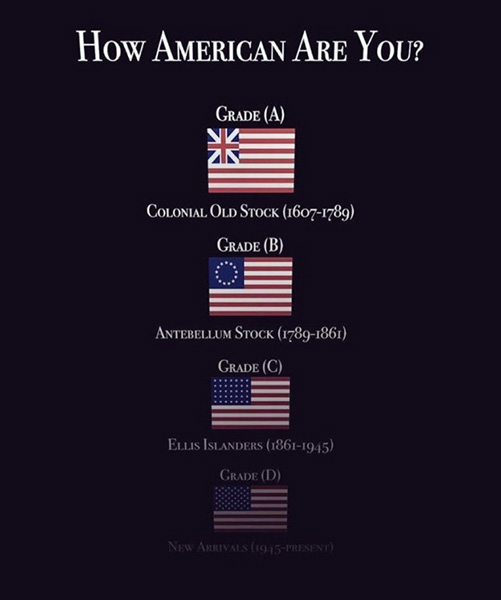
John Jay, in Federalist No. 2, praised Americans’ common ethnic, religious, and political roots as a vital national strength. Thomas Jefferson, the man who wrote “all men are created equal,” also wrote that blacks and whites could not co-exist under the same government. The nation’s earliest immigration act explicitly limited naturalization to “free white persons of good character.” Alexander Hamilton, often claimed as an “immigrant” despite being a white British subject like all the other Founders, also warned about the dangers of foreign populations dividing American opinion. Clearly, the Founders thought American identity was not infinitely elastic.
However, even if they had thought all sorts could be American, Mr. Ramaswamy’s ideas of how to how to make the transformation are incoherent:
Americanness isn’t a scalar quality that varies based on your ancestry. It’s binary: Either you’re an American or you’re not. You are an American if you believe in the rule of law, in freedom of conscience and freedom of expression, in colorblind meritocracy, in the U.S. Constitution, in the American dream, and if you are a citizen who swears exclusive allegiance to our nation.
This would mean the Founders, as well as almost all white Americans until very recently, were not American because they weren’t “colorblind.” It would mean anti-Federalists (including Patrick Henry) were not American because they opposed the Constitution. Presumably, those who knowingly violated the Constitution because of an emergency, as Abraham Lincoln did, were also not American. Socialists (who do not believe in “the American dream”) and supporters of the Alien and Sedition Acts (such as John Adams) are also excluded. So, too, are those who have primary or residual loyalty towards other nations, including Ilhan Omar and Ben Shapiro.
Mr. Shapiro himself recently expressed support for an ideologically driven definition of American identity, at least when it comes to immigration. He suggested we could exclude those who do not believe in core American ideals, as he defines them.
Is he serious? Potential immigrants are not screened for their belief in “colorblind meritocracy,” or capitalism, or whatever else “conservatives” claim to care about. Some may think we should screen them, but what about their children? We should expel those who violate their naturalization oath by expressing loyalty to a foreign state, but we do not do that to naturalized citizens, much less to the native born. Furthermore, if we take Vivek Ramaswamy’s conception of American identity seriously, there would be constant ideological tests to ensure that Americans are remaining true to “ideals,” presumably stripping them of citizenship if they fail. The supposedly tolerant “credal nation” would require screening for un-American thoughtcrime, and would disqualify nearly every white American who lived before 1965.
Mr. Ramaswamy invokes Ronald Reagan:
As Ronald Reagan quipped, you can go to live in France, but you can’t become a Frenchman; but anyone from any corner of the world can come to live in the United States and become an American. No matter your ancestry, if you wait your turn and obtain citizenship, you are every bit as American as a Mayflower descendant, as long as you subscribe to the creed of the American founding and the culture that was born of it. This is what makes American exceptionalism possible.
But there is nothing “exceptional” about America’s supposedly universal identity. France today insists that its nation has nothing to do with ethnicity and that Africans and Muslims can become “French.” Almost every Western country, including Ireland, Germany, and England, does the same. There’s nothing special about it if every Western country is eager to deconstruct its identity and hand citizenship out to anyone.
How can you say that American identity is defined by certain ideals but not take the next step and say those who do not believe in them aren’t American? If Mr. Ramaswamy were serious, it would not only mean that those who cling to white identity are not American, but practically every Democrat is also excluded, because they tend to support racial preferences for non-whites, question capitalism and free markets, and challenge parts of the Constitution, such as the Second Amendment. What is Mr. Ramaswamy trying to accomplish with this article? Follow in the long conservative tradition of trying to purge those to his right?
He explicitly calls for this. “First, conservative leaders should condemn — without hedging — Groyper transgressions.” He warns Republicans that they they risk duplicating the Democrats’ embrace of identity politics that supposedly doomed them in 2024. It’s not clear “identity politics” cost the Democrats anything. Kamala Harris lost because she did not break from Joe Biden’s dismal record on inflation and affordability, a crisis that is now tormenting President Trump’s Administration. Democrats are winning or coming close in special elections and are projected to sweep the midterms. One reason is they can count on almost monolithic support from non-whites, especially blacks.
Mr. Ramaswamy is right to say that many young Americans feel the loss of their national identity, but he warns against “tribalism.” National identity is tribalism. It is exclusive. An identity that can be chosen by anyone in the world means nothing. In recent months we have seen countless “Americans” carrying foreign flags in anti-ICE protests, calling for America to serve their ethnic homeland’s interests, or even openly declaring that they are part of a foreign community. Clearly, it is not “tribalism” that has no place in America, but exclusive loyalty to America. If Mr. Ramaswamy’s is writing in good faith, he may think this behavior is unacceptable. However, if there is no way to expel such people from the national community, his column is just talk. Certainly, vague denunciations of people who like Nick Fuentes are not going to do anything to restore an identity to entire regions of the country that have ceased to be culturally American.
Mr. Ramaswamy proposes a grab bag of policies to transcend ethnic identity and bind Americans together, including making government more efficient, reducing property taxes, and giving young Americans a grant to be invested in the stock market. Some of these policies may be good or bad, but they all miss the point. Mr. Ramaswamy’s call for a vague national mission, which goes undefined, is almost a parody. America’s past accomplishments, such as the Apollo program or defeating the Japanese, were rooted in a white racial majority, a united national culture, and a strong identity. The irony of a conservative proposing a big government program to forge national unity, with almost total indifference to what it will actually do, seems lost on Mr. Ramaswamy and his movement-conservative supporters.
The fundamental problem is that identity is not freely chosen. Mr. Ramaswamy is right about one thing: You are American or you’re not. But you don’t become American with a job interview, a piece of paper, or an ideological test. It is a question of blood, history, and culture. Mr. Ramaswamy’s attempt to break America’s identity away from these fundamental realities is itself an exercise in identity politics. He’s trying to shoehorn himself and his subcontinental brethren into an American identity that he conveniently defines.
Pat Buchanan warned that:
Every true nation is the creation of a unique people. Indeed, if America is an ideological nation grounded no deeper than the sandy soil of abstract ideas, she will not survive the storms of this century any more that the Soviet Union survived the last. When the regime, party, army, and police that held that ideological nation together lost the will to keep it together, the USSR broke down along the fault lines of nationality, faith, and culture. True nations, held together not by any political creed but by patriotism, emerged from the rubble.
Nation precedes government, transcends politics, and outlasts any ideology. Like family, belonging is through blood, not abstractions. Mr. Ramaswamy is trying to talk us out of our birthright. It’s not up for debate. We do not need to engage with an outsider trying to deconstruct us. Mr. Ramaswamy may have good or bad ideas about policies. Sometimes he may even say things of which white advocates might approve. But he has nothing to say about American identity. It does not involve him. If you have to ask if you are American, you aren’t.
The post Vivek Is Scamming Us appeared first on American Renaissance.
American RenaissanceRead More








 T1
T1