Largest Acquisition In Nvidia History: Jensen Pays $20BN For AI Chip Startup In Bid For Google’s TPU Tech
Just before the market close on Friday, Nvidia unveiled its largest ever acquisition (which however was structured as a licensing deal to avoid anti-trust concerns) when it agreed to buy Groq – pardon license all of Grok’s assets and acquire its entire executive team – a designer of high-performance artificial intelligence accelerator chips, for $20 billion in cash. In reality what the deal is really about is Grok’s TPU expertise, and specifically the knowledge inside CEO Jonathan Ross’ head, who helped launch Google’s TPU, the search giant’s custom Application-Specific Integrated Circuit.

The news was first reported by CNBC, citing Alex Davis, CEO of Disruptive, which led the startup’s latest financing round in September. Davis, whose firm has invested more than half a billion dollars in Groq since the company was founded in 2016, said the deal came together quickly (that part is true: the deal likely came together in the days following the recent dramatic ascent of Google’s Gemini and TPU architecture, not to mention stock price, as explained below).
Groq raised $750 million at a valuation of about $6.9 billion in September. Investors in the round included Blackrock and Neuberger Berman, as well as Samsung, Cisco, Altimeter and 1789 Capital (where Donald Trump Jr. is a partner). Groq said at the time it would use the funds to expand its data center capacity. Instead, the participating funds are about to 3x their money in 3 months, an unprecedented venture return, thanks to Nvidia’s massive cash hoard.
Groq said in a blog post on Wednesday that it’s “entered into a non-exclusive licensing agreement with Nvidia for Groq’s inference technology,” without disclosing a price. Clearly, however, this is much more than just a licensing agreement since Groq founder and CEO Jonathan Ross along with Sunny Madra, the company’s president, and other senior leaders “will join Nvidia to help advance and scale the licensed technology,” the post said.
As Bloomberg explains, sharing a slightly different perspective on how the deal is structured or rather wants to be structured, the world’s largest publicly traded company paid for the right to use Groq’s technology and will integrate its chip design into future products. Some of the startup’s executives are leaving to join Nvidia to help with that effort, the companies said.
Groq will continue as an independent company with a new chief executive, existing finance chief Simon Edwards as CEO, it said Wednesday in a post on its website, which of course it will only pretend to be for regulatory and anti-trust reasons: Nvidia will have stripped all the good stuff, i.e., the TPU IP. It’s data center business, which offers outsourced computing, will continue, the company said in the post.
Davis told CNBC that Nvidia is getting all of Groq’s assets, though its nascent Groq cloud business is not part of the transaction. Groq said “GroqCloud will continue to operate without interruption.”
The deal represents by far Nvidia’s largest purchase ever. The chipmaker’s biggest acquisition to date came in 2019, when it bought Israeli chip designer Mellanox for close to $7 billion. At the end of October, Nvidia had $60.6 billion in cash and short-term investments, up from $13.3 billion in early 2023.
In an email to employees that was obtained by CNBC, Nvidia CEO Jensen Huang said the agreement will expand Nvidia’s capabilities.
“We plan to integrate Groq’s low-latency processors into the NVIDIA AI factory architecture, extending the platform to serve an even broader range of AI inference and real-time workloads,” Huang wrote, revealing the deal rationale.
Groq has been targeting revenue of $500 million this year amid booming demand for AI accelerator chips used in speeding up the process for large language models to complete inference-related tasks. The company was not pursuing a sale when it was approached by Nvidia, Davis said. While it is unclear what is the actual LTM revenue, the acquisition represents a 40x multiple of its “targeted” sales… so do the math.
So what is the reason for the deal? Well, as we explained in “The Google TPU: The Chip Made For The AI Inference Era“, in recent months Nvidia and its GPU architecture has lost momentum to Google and its TPU, which as noted above, is the “chip made for the inference era.” And so, instead of developing its own Tensor architecture, Nvidia decided to just buy it. Or rather, it pretends not to buy it as regulators may just kill the deal, which instead was structured as an asset-purchase/licensing deal.
And the punchline: Groq was founded in 2016 by a group of former engineers, including CEO Ross. Ross is a former Google chip executive who helped start that company’s Tensor Processing Unit, or TPU, the search giant’s custom chip that’s being used by some companies as an alternative to Nvidia’s graphics processing units. As part of the deal, he and other top executives will join Nvidia “to help advance and scale the licensed technology,” Groq said in the statement.
In its initial filing with the SEC, announcing a $10.3 million fundraising in late 2016, Groq listed as principals Ross and Douglas Wightman, an entrepreneur and former engineer at the Google X “moonshot factory.” Wightman left Groq in 2019, according to his LinkedIn profile.
Huang added that, “While we are adding talented employees to our ranks and licensing Groq’s IP, we are not acquiring Groq as a company.” Narrator: you are.
Nvidia has ramped up its investments in chip startups and the broader ecosystem as its cash pile has mounted. The company has backed AI and energy infrastructure company Crusoe, AI model developer Cohere, and boosted its investment in CoreWeave as the AI-centric cloud provider was getting ready to go public this year.
In September, Nvidia said it intended to invest up to $100 billion in OpenAI, with the startup committed to deploying at least 10 gigawatts of Nvidia products. The companies have yet to announce a formal deal. That same month, Nvidia said it would invest $5 billion in Intel as part of a partnership.
Nvidia has been making investments in companies across the AI infrastructure ecosystem and is trying to keep a large lead in the market for inference — running models once they have been developed. The company’s leadership has already pledged billions to a wide variety of projects that it believes will further the overall AI industry. Nvidia agreed to invest as much as $100 billion in OpenAI and has even bought a stake in erstwhile nemesis Intel Corp.
By incorporating a new type of design into what it sells, Nvidia is showing willingness to be flexible and add novel capabilities. That approach is likely aimed at keeping its biggest customers and new adopters focused on its technology at a time when in-house efforts from Google, Microsoft Corp. and Amazon.com Inc. are gaining momentum as the industry rushes to install as much computing capacity as quickly as it can.
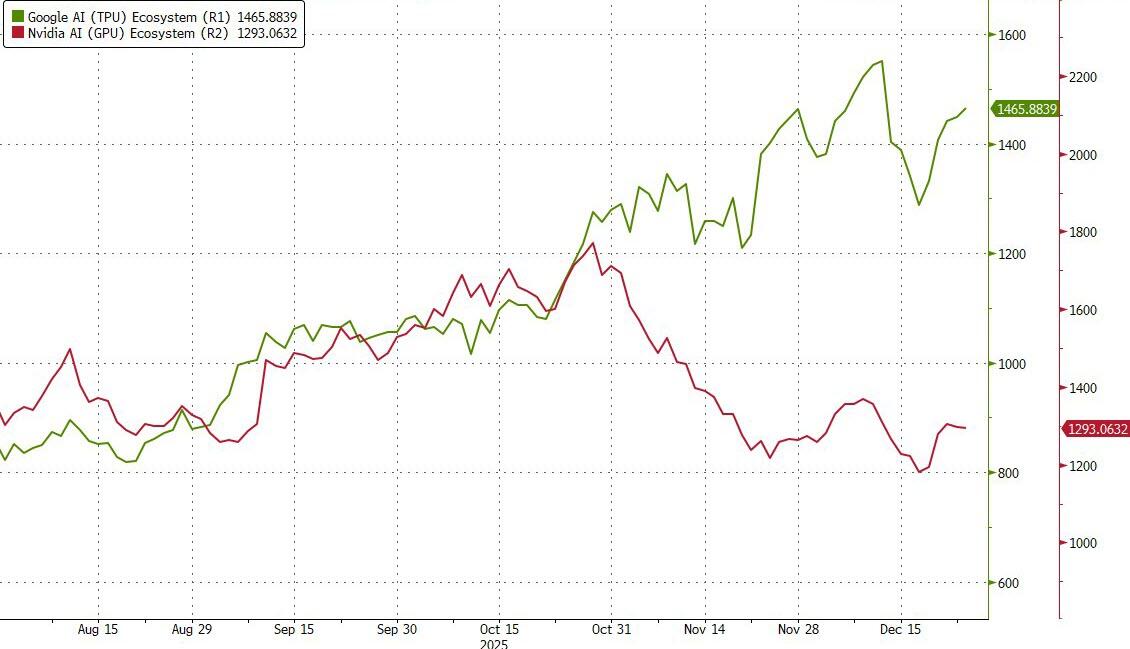
With today’s purchase, pardon, “licensing deal”, Nvidia has formally lobbed its response to Google’s recent ascent with its Ironwood TPU and Gemini AI, which saw a dramatic divergence in the Google vs Nvidia ecosystems (chart below). The question now is will Google issue its own “code red” and pull every string in its power to kill the deal, or will it respond even more forcefully. One thing is certain: if Nvidia has now successfully caught up to Google and its TPU technology, the alligator jaws of the Google vs OpenAI/Nvidia chart are about to slam shut.
Tyler Durden
Wed, 12/24/2025 – 21:09ZeroHedge NewsRead More







 T1
T1