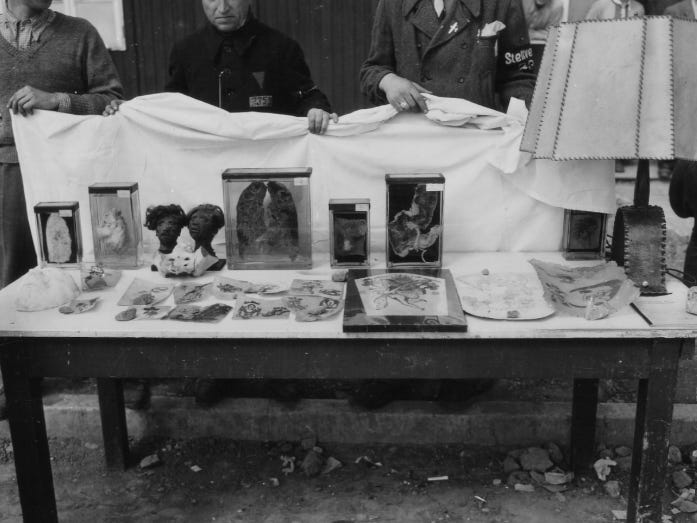
We’ve recently covered two of the five elements of the ‘table of horrors’ presented at Buchenwald by the US army in April 1945 and which was presented at Nuremberg Trials in the form of document 2340-PS. These have been the myths of the ‘tattooed human skin art’ – (1) for lack of a better way of putting it – and the shrunken heads (2) of Buchenwald.
Our next bit of ‘Remarkable Holocaust Nonsense’ is the myth of the ‘human-skin lampshades’ and unlike the ‘tattooed human skin art’ we have a lot more to go on as well as a modern analysis to address.
Document 2340-PS states:
‘On a table for all to gaze upon is a lampshade made of human skin, made at the request of an SS officer’s wife.’ (3)
Firstly, let’s remember that document 2340-PS is actually a transcript of an Allied propaganda film titled ‘Nazi Concentration Camps’ by the American film director George Stevens – who also figures significantly in the popularization of the so-called ‘Diary of Anne Frank’ in the 1950s – so we can actually see footage of this alleged ‘human skin lampshade’. (4)
Secondly, you might have noticed I’ve used ‘lampshades’ in the plural not ‘lampshade’ in the singular but document 2340-PS says ‘lampshade’ not ‘lampshades’. The reason for this is that there are two alleged human-skin lampshades from Dachau but yet only one was known in mid-April 1945 when Stevens’ ‘Nazi Concentration Camps’ was filmed – specifically reel 5 which covers Buchenwald – and the claims made about it.
This distinction will become important later when we see how those seeking to rehabilitate the myth of the ‘human-skin lampshades’ have used the second ‘human-skin lampshade’ of Buchenwald that was not known to the US army in mid-1945 and conflated it with the first ‘human-skin lampshade’ of Buchenwald.
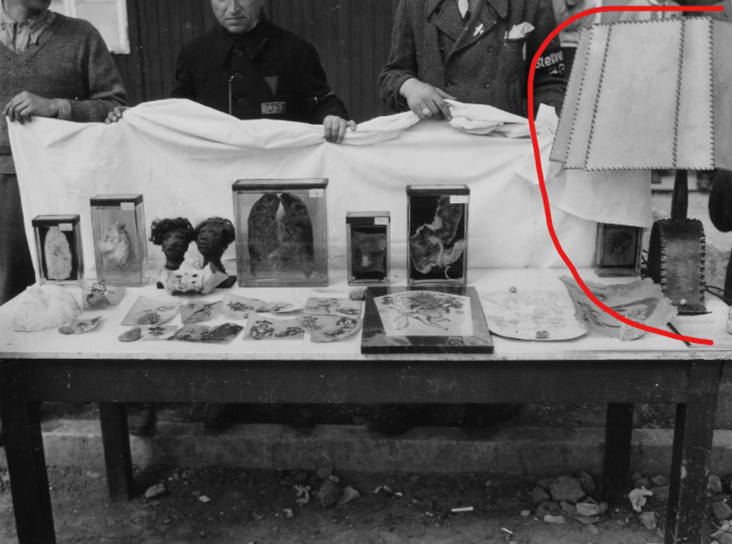
Now this is the ‘table of horrors’ at Buchenwald as referenced in document 2340-PS and Stevens’ ‘documentary’ ‘Nazi Concentration Camps’ from which it derives:
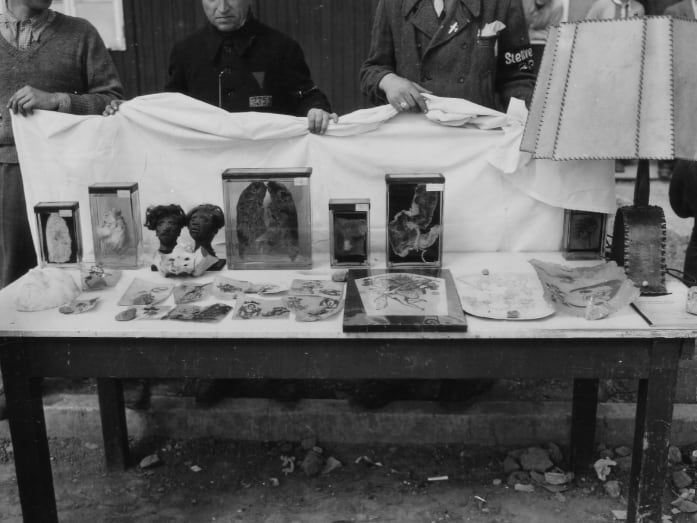
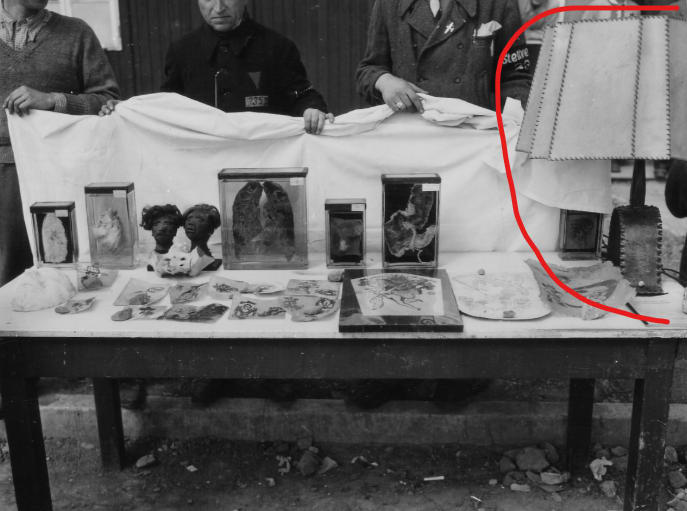
We can see that the ‘human-skin lamp’ concerned is this:
Now this lamp actually has decent provenance in terms of evidence, because we have a photo of it in the camp commandant’s office at Buchenwald from 1943 during the tenure of Buchenwald’s second (and last) commandant Hermann Pister (1942 to 1945), which is as follows: (5)
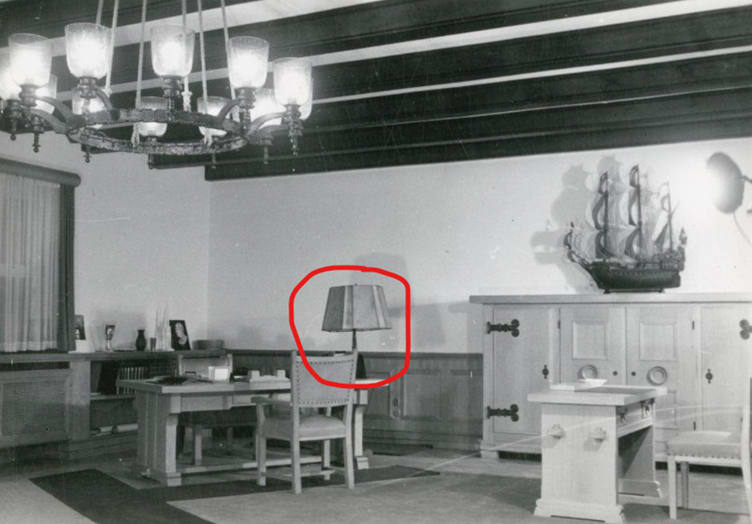
This lampshade has also been dated by Buchenwald Memorial Museum to the time of the first (and most famous) commandant of Buchenwald Karl-Otto Koch (1937 to July 1941) (6) which puts its creation early (not late) in Buchenwald’s history.
The problem with this is that while it might be plausible that Koch desired to have a human-skin lampshade; it would be decidedly odd if Pister desired to have one as well.
This chronological problem is simply ignored by most authors when discussing the alleged ‘human-skin lampshades’ in that it seems simply implausible that Pister would have missed that this was a ‘human-skin lampshade’ – remember there were also numerous German doctors attached to Buchenwald who would have also quickly recognised it as a ‘human-skin lampshade’ as we are told the American G.I.’s and their medical personnel did – so it assumes that every single German doctor and officer in Buchenwald (not to mention visiting SS and German personnel) either didn’t recognize it as a ‘human-skin lampshade’ or didn’t care – neither are likely given that Buchenwald was the centre of at least one major SS corruption and ‘maltreatment of inmates’ investigation (largely 1943/1944 but had in fact begun as early as 1941) that ended up with Koch being shot by an SS firing squad in April 1945 just before Buchenwald was occupied by the US 6th Army – and had this been a ‘human-skin lampshade’ it would have likely been used a principal exhibit by the SS against Koch and those tried with him (like his wife Ilse Koch).
We can thus see that this stretches credibility beyond breaking point and which we must assume that those writing about the ‘human-skin lampshades’ are at least somewhat aware given that they obfuscate the timeline of the creation of the ‘human-skin lampshades’ as well as who was Buchenwald camp commandant when (these ‘human-skin lampshades’ are often implied to be a mid-to-late war creation and are explicitly linked to Ilse Koch – ‘the Bitch of Buchenwald’ in Allied propaganda – when in fact Koch hadn’t been in charge of Buchenwald since July 1941 and Pister had been in charge since 1942).
Basically – like most ‘Holocaust’ ‘facts’ – the claim is stated very generally without its context and relies on the credulity of its readers as well as the authority of the Nuremberg Trials – i.e., surely the Western Allies wouldn’t just outright lie to the world? – to smuggle it through the ‘sniff test’ that we all perform when we read about ‘facts’ – does it sound plausible based on my current knowledge? etc – when in fact that even without any additional information: it is obviously highly suspect and/or hilariously bad anti-German wartime propaganda (rather like the ‘bayonetting babies’ propaganda myth from the First World War that also makes an appearance in Second World War anti-German wartime propaganda). (7)
However, there is further information to consider here in that the Buchenwald Memorial Museum explains that:
‘The lampshade, which was also intended as evidence, was literally plundered within days. In a photo from 24 April 1945, only the frame of the lampshade remains.’ (8)
So – rather conveniently – the ‘human-skin lampshade’ of Buchenwald’s ‘Table of Horrors’ had none of its ‘human-skin’ panels left and ‘only the frame remained’ as late as 24th April 1945 or put another way: the ‘evidence’ simply disappeared.
However, thanks to the work of Myfanwy Lloyd – who is a ‘Freelance Museum Consultant’ – (9) one of the ‘human-skin panels’ was tracked down in the collection of a ‘British M.P.’ and as a result:
‘The family expressed the wish to hand over the object to the Buchenwald Memorial. The handover took place on 11 April 2023.
An expert report on the property was commissioned by the Buchenwald Memorial on 19 February 2024. The result is still pending.’ (10)
The problem here is fairly obvious in that if the Buchenwald Memorial Museum have had this sole ‘human-skin lampshade panel’ since 11th April 2023 and ‘sent it for testing on 19th February 2024’ and ‘haven’t had a result yet’. Then because these tests take a matter of days, weeks and months not years; especially since German criminologist Mark Beneke had literally just done the same to the second ‘human-skin lampshade’ of Buchenwald – more on that in a minute – and shown how this could be achieved and by whom. (11)
It therefore strongly suggests that the results were not what the Buchenwald Memorial Museum wanted and they are desperately trying to find someone – or some institution – that is willing to stick their neck on the line for them and to claim that the ‘human-skin lampshade’ of Buchenwald is actually made of human skin rather than the more obvious solution being that of tanned animal leather (which isn’t an uncommon thing (12) and would explain why the American occupiers of Buchenwald mistook – deliberately or otherwise – it for ‘human-skin’ aka ‘human leather’).
This is also strongly suggested by the largely suppressed fact – which I owe to the X/Twitter user @Le_Blanc_Pat for pointing it out to me – that General Lucius Clay – one of the senior US officers in charge of the Allied administration of post-war Germany – explained that this first ‘human-skin lampshade’ had been tested by American authorities and discovered to actually have been made of goatskin.
To quote Jean Edward Smith’s 1990 biography of Clay where Clay is explaining why he commuted Ilse Koch’s death sentence in 1948:
‘That was one of the reasons I revoked the death sentence of Ilse Koch. There was absolutely no evidence in the trial transcript, other than she was a rather loathsome creature, that would support the death sentence. I suppose I received more abuse for that than for anything else I did in Germany. Some reporter had called her the ‘Bitch of Buchenwald,’ and had written hat she had lampshades made out of human skin in her house. And that was introduced in court, where it was absolutely proven that the lampshades were made out of goatskin.’ (13)
Further evidence is also (accidentally) provided by the testimony of the major Buchenwald ‘eyewitness’ Franz Blaha – who was a communist Czech doctor imprisoned in Buchenwald and who figures prominently in most of the atrocity and mass killing claims in relation to the camp (including the ‘shrunken heads’) – (14) where we read how:
‘It was common practice to remove the skin from dead prisoners. I was commanded to do this on many occasions. Dr. Rascher and Dr. Wolter in particular asked for ‘this human skin from human backs and chests. It was chemically treated and placed in the sun to dry. After that it was cut into various sizes for use as saddles, riding breeches, gloves, house slippers, and ladies’ handbags. Tattooed skin was especially valued by SS men. Russians, Poles, and other inmates were used in this way, but it was forbidden to cut out the skin of a German. This skin had to be from healthy prisoners and free from defects. Sometimes we did not have enough bodies with good skin and Rascher would say, ‘All right, you will get the bodies.’ The next day we would receive 20 or 30 bodies of young people. They would have been shot in the neck or struck on the head so that the skin would be uninjured.’ (15)
Now you’ll noticed that Blaha while testifying – without any real supporting evidence mind you – that the German doctors at Buchenwald concentration camp were basically skinning dead inmates – Blaha implies this was done to hundreds if not thousands of inmates who were killed in special ways to facilitate this skinning by not damaging the skin – and then turning the skin into numerous household and personal items such as ‘saddles, riding breeches, gloves, house slippers, and ladies’ handbags’.
The point here is simple: Blaha doesn’t mention – nor seem to know about – the far more obvious alleged use of tanned human-skin in Buchenwald: the ‘human-skin lampshade’.
This suggests that Clay is correct here and that while Stevens’ ‘Table of Horrors’ and ‘Nazi Concentration Camps’ claimed this was a ‘human-skin lampshade’: it was in fact nothing of the kind and – as Clay later asserted – was in fact discovered to have been made of goatskin all along.
But what of the recent claims that the ‘human-skin lampshades’ have been ‘proven to be real’ by scientists?
Well, this refers to the work of a German criminologist named Mark Beneke who claimed in 2024 that he’d proved this to be true with the Russian newspaper ‘Izvestiya’ writing on 11th April 2024 that:
‘German forensic scientists examined some everyday objects in the Buchenwald concentration camp and found that a lampshade from the camp was made of human skin. Mark Beneke, a forensic biologist who took part in it, told Izvestia more about the forensic and microscopic examination carried out.
He noted that many laboratories could not recognize the biomaterial, but experts found one that was able to distinguish human skin from other types of skin, in particular pigs and sheep.
“We found out that lamp shades are made entirely of human skin. The sheath is also made of human skin. However, the shrunken head is made from horse skin and hair,” Beneke said.’ (16)
Beneke is honest as far as I can work out – such is indicated by the fact that he stated that a ‘shrunken head’ from the Buchenwald Memorial Museum was actually a fake made of horse skin and hair – but Beneke’s findings have been dishonestly portrayed by media outlets and even to an extent by himself.
The problem you see is that because – as pointed out above – there are two alleged ‘human-skin lampshades’ of Buchenwald and while – as we have seen – the first one has proper provenance and has been dated to having been created sometime before July 1941 by the Buchenwald Memorial Museum; the second ‘human-skin lampshade’ has no link to Buchenwald whatsoever.
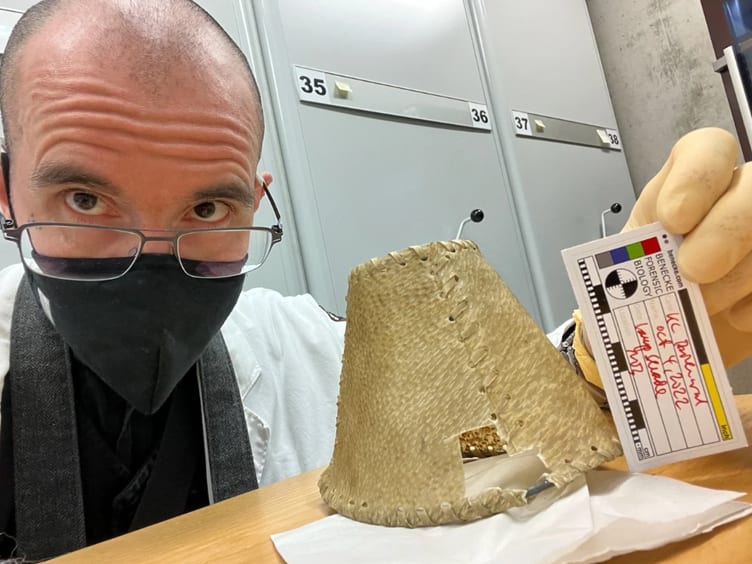
The problem you see is that Beneke tested the second ‘human-skin lampshade’ (aka ‘the small lampshade’) and ruled it to be genuine. Beneke is not referring to the alleged ‘human-skin lampshade’ that was found by the US Army in April 1945, and which Clay had tested between 1946 and 1948 and found to be made of goatskin.
We can see this very quickly by reminding ourselves of what the alleged ‘human-skin lampshade’ of Buchenwald of April 1945 and the Nuremberg Trials looks like:
While what Beneke tested is this: (17)
And for good measure this is the same ‘human-skin lampshade’ photographed for the Buchenwald Memorial Museum’s archives: (18)
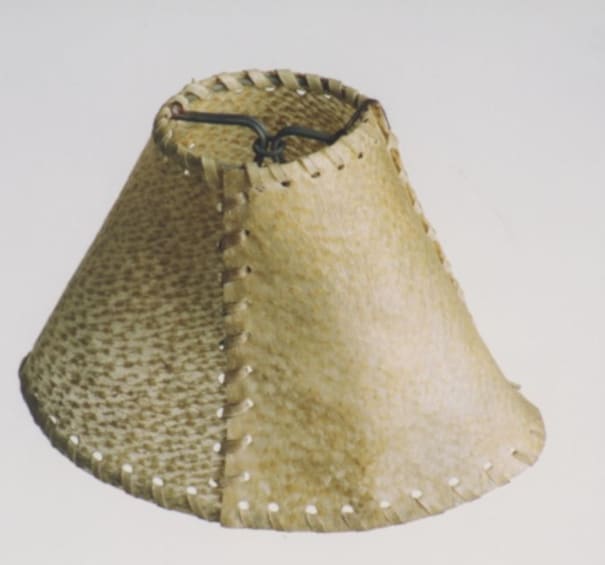
Now clearly they are not the same thing and those who claim that the ‘human-skin lampshades’ have been ‘proven true’ by Beneke are simply lying because Beneke’s work doesn’t reference the alleged ‘human-skin lampshade’ that was found by the US Army in April 1945 but rather a much later different ‘human-skin lampshade’ that is alleged to have been ‘from Buchenwald’.
The problem is well-illustrated by quoting the Buchenwald Memorial Museum on the history of this exhibit:
‘The small shade of a bedside lamp, which apparently came from one of the houses in the SS villa settlement of the Buchenwald concentration camp, was taken by the former German political prisoner Karl Straub (1898-1966) immediately after the liberation in April 1945.
Via the General Secretariat of the Association of Persecutees of the Nazi Regime (VVN), to whom the lampshade had been handed over in the late 1940s, it ended up in the archives of the Marx-Engels-Lenin Institute of the GDR in Berlin together with other artefacts from Buchenwald. In August 1953, the lampshade and three pieces of tattooed human skin were reclaimed “for the establishment of a museum in Buchenwald”. These and other objects from the Buchenwald context were then returned a few weeks later.
In the “Resistance Museum” exhibition that opened in the former inmates’ canteen on 18 August 1954, the small shade of a bedside lamp was presented in “Desk 52” as a “lampshade made of human skin”. Without any verification of its authenticity, the lampshade was also shown as a “lampshade made of human skin” in all subsequent permanent exhibitions during the GDR era.
The lampshade was also examined for authenticity during the fundamental revision of the collection and exhibition holdings carried out after the end of the GDR. The expert opinion drawn up by the Institute of Forensic Medicine at the Erfurt Medical Academy on 6 July 1992 stated: “Specimen IV (lampshade), however, cannot be serologically identified as human. It is possible that it is a synthetic material that was produced for lampshades at a similar time. Ultimately, however, it cannot be completely ruled out that it is nevertheless biological material.”
The lampshade was removed from the historical exhibition on the basis of this expert opinion and stored in the collection depot.
Only an additional forensic report commissioned in 2023 came to the conclusion after microscopic and genetic examinations that the material of the lampshade – as originally assumed – was “certainly human skin”.’ (19)
So put another way: the ‘human-skin lampshade’ verified as ‘human-skin’ by Beneke in 2023/2024 – and remember it was just a microscopic analysis not a proper genetic test that would prove it one way or the other – first appears not in Buchenwald during the Third Reich but in the ‘late 1940s’ (i.e., the early Cold War era) when it is ‘given’ to the Marx-Engels-Lenin Institute of the German Democratic Republic (hereafter GDR) – Stalin’s puppet government of occupied Germany – by a former inmate at Buchenwald named Karl Straub. Who in turn gave it to the newly ‘Resistance Museum’ opened at Buchenwald in 1953.
Now Straub isn’t some innocent figure but rather a fanatical communist propagandist who – from December 1945 to 1953 – was the head of the ‘Victims of Fascism Department’ of the ‘Thuringian State Office for Labour and Social Welfare’ in the GDR that was based in the city of Weimar and was responsible for Buchenwald’s ‘Resistance Museum’. (20)
In other words: the second ‘human-skin lampshade’ actually comes from a senior communist propagandist several years after the Second World War – one wonders why didn’t he ‘donate’ it earlier and why there are no mentions of this second ‘human-skin lampshade’ until the late 1940s? – and is not mentioned in Nuremberg nor found at the camp by the US army in April 1945.
Thus, we can see the second ‘human-skin lampshade’ actually has no link to the Third Reich concentration camp at Buchenwald.
So where does it come from then?
Well as my friend J. Otto Pohl – an academic expert of Stalin’s prison camp system (the Gulags) – has rightly pointed out; Stalin’s NKVD took control of Buchenwald in August 1945 and turned it into a Soviet concentration camp which had a mortality rate 25 percent higher in peacetime than Buchenwald had at the height of its war-time privations and epidemics of disease. (21)
So the ‘human skin’ of the second lampshade could well in fact be the skin of a ‘Nazi’ who was interned at Buchenwald by the NKVD in the mid-to-late 1940s whose skin was used by Straub and/or NKVD doctors to make a ‘human-skin’ lampshade for propaganda purposes and claim it was ‘found in Buchenwald’ by Straub, which in turn suggests it was the skin of a ‘prisoner of the Nazis’ rather than a ‘Nazi prisoner’s skin’.
Thus, given that the second ‘human-skin lampshade’ comes not from the Third Reich but rather the early GDR era and our source is a communist propagandist – who had been in Buchenwald but hadn’t mentioned he’d apparently stolen dozens of large exhibits (for example he’s also the origin of the ‘Bulleted Heart’ exhibit among others) – (22) it informs us that the second ‘human-skin lampshade’ verified as human skin by Beneke – although verified as not human skin thirty years earlier in July 1992 by the Institute of Forensic Medicine in Erfurt (so there is mixed scientific evidence) – (23) is almost certainly a fake ‘Nazi human-skin lampshade’ – whether it is made of human skin, another animal’s skin and/or some other material – created by the Stalinist GDR to impugn the memory of the Third Reich, but in turn was probably motivated by the fact that all the panels for the first ‘human-skin lampshade’ – that remember was actually goatskin – discovered by the US army in April 1945 had been stripped from it by 24th April 1945 resulting in the GDR having to manufacture their own ‘human-skin lampshade’ to exhibit in the ‘Resistance Museum’ in Buchenwald that opened in 1953/1954 and was almost certainly Straub’s idea and pet project.
The truth is then we can see that both the ‘human-skin lampshades’ of Buchenwald are both propaganda frauds – one conducted by the Americans and the other by the Stalinist GDR – and are thus truly ‘Remarkable Holocaust Nonsense’.
References
(1) On this please see my article: https://karlradl14.substack.com/p/remarkable-holocaust-nonsense-74
(2) On this please see my article: https://karlradl14.substack.com/p/remarkable-holocaust-nonsense-75
(3) Trial of the Major War Criminals Before the International Military Tribunal, Nuremberg, 14 November 1945 – 1 October 1946, Vol. 30, p. 469
(4) You can see this for yourself here: https://en.wikipedia.org/wiki/Nazi_Concentration_Camps_(film); it starts at 32 minutes: 30 seconds
(5) https://www.buchenwald.de/en/geschichte/themen/dossiers/menschliche-ueberreste/teil-eines-lampenschirms
(6) Idem.
(7) On this please see my article: https://karlradl14.substack.com/p/remarkable-holocaust-nonsense-7-german; there is a variant of this with German soldiers bayonetting pregnant Russian women as well: https://karlradl14.substack.com/p/remarkable-holocaust-nonsense-8-german
(8) https://www.buchenwald.de/en/geschichte/themen/dossiers/menschliche-ueberreste/teil-eines-lampenschirms
(9) https://www.linkedin.com/in/myfanwy-lloyd-71ab7a1b?originalSubdomain=uk
(10) https://www.buchenwald.de/en/geschichte/themen/dossiers/menschliche-ueberreste/teil-eines-lampenschirms
(11) https://home.benecke.com/publications/forensic-biologist-mark-benecke-buchenwald-lampshade-is-made-of-human-skin
(12) For example: https://www.1stdibs.com/buy/leather-lampshade/ and https://en.wikipedia.org/wiki/Leather_wallpaper
(13) Jean Edward Smith, 1990, ‘Lucius D. Clay: An American Life’, 1st Edition, Henry Holt: New York, p. 301
(14) On Blaha please see my article: https://karlradl14.substack.com/p/remarkable-holocaust-nonsense-31
(15) Trial of the Major War Criminals Before the International Military Tribunal, Nuremberg, 14 November 1945 – 1 October 1946, Vol. 5, p. 170
(16) https://home.benecke.com/publications/forensic-biologist-mark-benecke-buchenwald-lampshade-is-made-of-human-skin
(17) https://home.benecke.com/publications/biologische-spuren-kl-buchenwald-/-biological-stains-kz-buchenwald
(18) https://www.buchenwald.de/en/geschichte/themen/dossiers/menschliche-ueberreste/kleiner-lampenschirm
(19) Idem.
(20) https://www.buchenwald.de/en/geschichte/themen/dossiers/menschliche-ueberreste/praepariertes-herz
(21) https://x.com/JOttoPohl1/status/2004216267390308570
(22) https://www.buchenwald.de/en/geschichte/themen/dossiers/menschliche-ueberreste/praepariertes-herz
(23) https://www.buchenwald.de/en/geschichte/themen/dossiers/menschliche-ueberreste/kleiner-lampenschirm
Karl’s SubstackRead More






 T1
T1