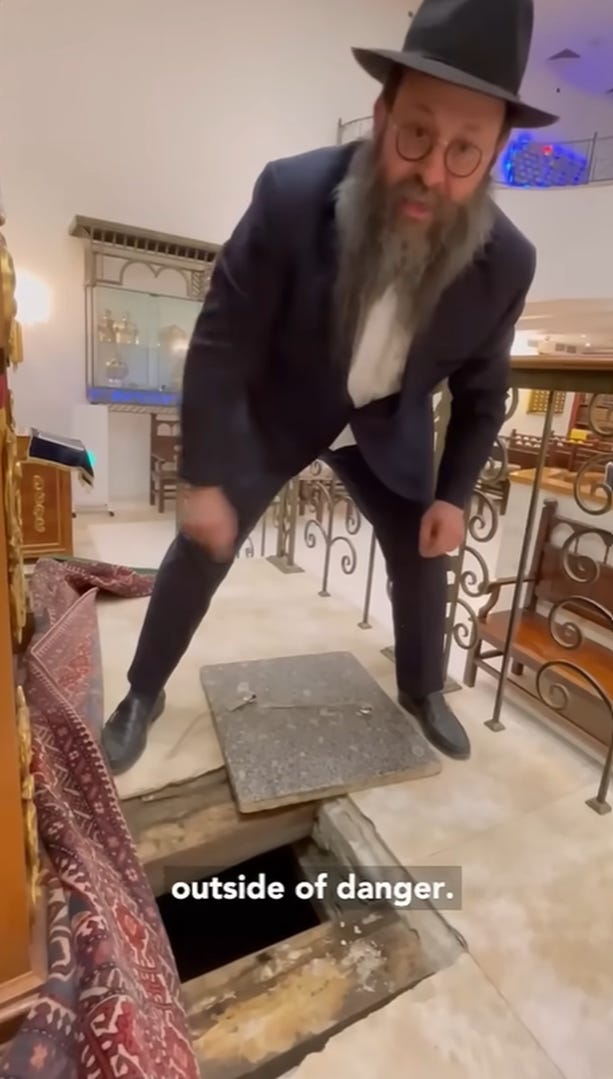
Back in 2018 a Lubavitch Chabad Facebook account called ‘Humans of Judaism’ published a video by Rabbi Chaim Danziger where they showcased the newly rebuilt Bolshaya Bronnaya Synagogue in central Moscow and the principal exhibit was the synagogue’s alleged ‘pogrom escape tunnel’. (1)
This naturally piqued my interest as ‘pogrom escape tunnels’ are apparently not a thing – well outside of odd examples like that of the Novogrudok Ghetto in Belarus and the ‘Burning Brigade’ in Ponar, Lithuania (both of which were dug by jews in 1943) – so I wondered whether this claim by Danziger and Kogan could be true or was invented nonsense by jews.
The first reference to a ‘pogrom escape tunnel’ only occurs on 10th September 2004 article by JTA on the renovations at the synagogue where they write how:
‘The 25-foot-long tunnel running beneath Moscow’s Bronnaya Street Synagogue is highly symbolic of the past — it was built in the 1880s amid fears of pogroms. But standing on the exposed top floor of the synagogue’s as-yet unfinished community center, Rabbi Yitzhak Kogan — his shoes covered in concrete dust — is still optimistic about the future.’ (2)
The interesting thing about this is that while it mentions the tunnel; JTA doesn’t actually tell us how the jews (presumably Rabbi Kogan) ‘knew’ that it was a ‘pogrom escape tunnel’ given that the synagogue had been closed down by Stalin’s Soviet government during the Purges in 1937 and turned into a trade union meeting hall until 1991 when ownership of the synagogue was transferred to the Lubavitch Chabad (3) after a two year fight with Moscow’s Reform jews over who would get the building. (4)
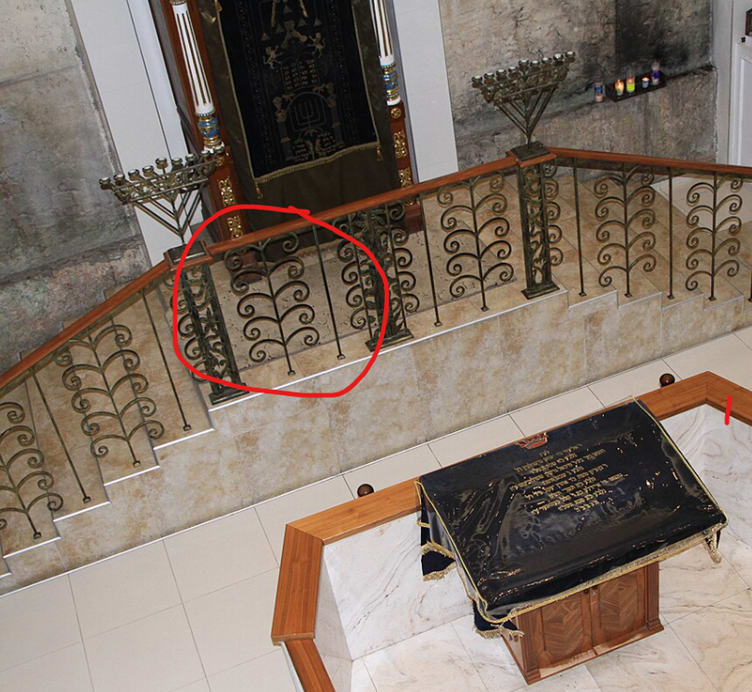
For the record the ‘pogrom escape tunnel’ is right next to the ‘Torah Ark’ in the synagogue: (5)
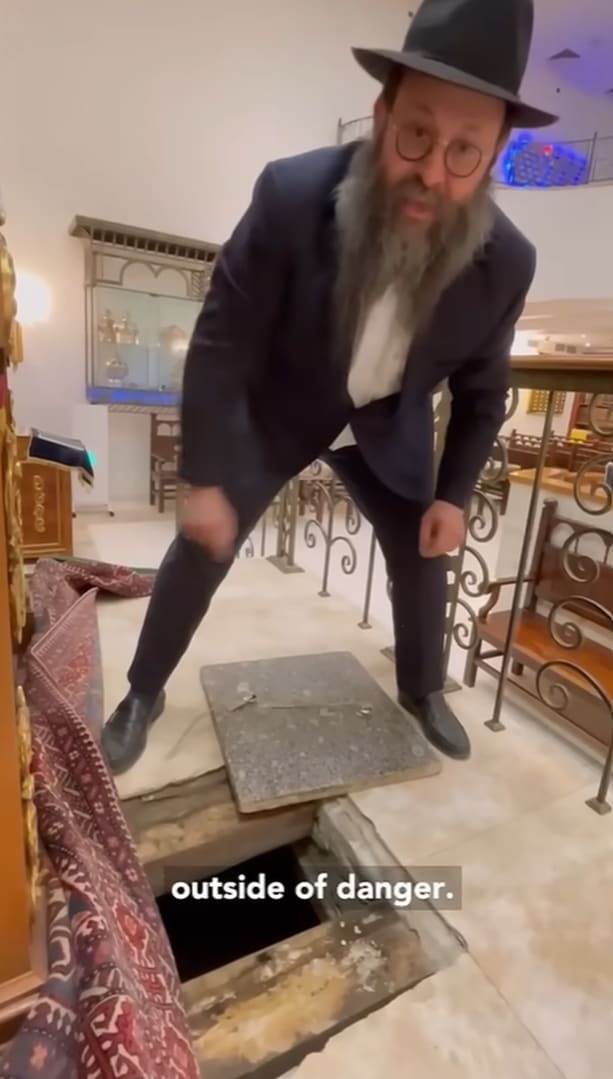
You can see the ‘pogrom escape tunnel’ clearly here in a still taken from Danziger’s video: (6)
Now the gigantic problem with Danziger and Kogan’s claims that this is a ‘pogrom escape tunnel’ is that there is no evidence about when this tunnel was first created since it spent 54 years as the property of the Soviet/Russian government and the tunnel may well have been created during this time for a variety of reasons such as adding in electricity (or plumbing) to the building or using the basement as a bomb shelter during the Second World War where the Germans reached the outer suburbs of Moscow in December 1941.
This already throws the structure’s status as a ‘pogrom escape tunnel’ into massive question since Danziger and Kogan would need to demonstrate it was there before 1937 and wasn’t just a later addition by the Soviet/Russian government between 1937 and 1991 that is now being misrepresented as a ‘pogrom escape tunnel’.
However, let’s assume for the sake of the argument it was there before 1937; another major problem quickly raises its head as the synagogue was never meant to be a public synagogue and was in fact built in 1883 – having been started in 1881 – by the multi-millionaire jewish banker Lazar Polyakov ‘the Rothschild of Moscow’; who had received special permission from Tsar Alexander III to create a private synagogue for him, his family and his staff outside of the Pale of Settlement.
Now this should already be setting off alarm bells given that this wasn’t a public synagogue at all, was situated right in the heart of Moscow which was the least likely place for pogroms in all of the Russian Empire (which almost always occurred away from Imperial power since while the Russian government was in theory anti-Semitic; in practice it cooperated extensively with jews) (7) and was created with the explicit permission of a ‘notoriously anti-Semitic Tsar’ (8) so was under the Tsar’s direct protection.
So why on earth would the synagogue have a ‘pogrom escape tunnel’ if there was almost no danger of pogroms to it – or its residents – and the answer to which may well lie in the fact that what Polyakov did was a convert an ordinary pre-existing house into his synagogue. (9) This would then mean that the ‘pogrom escape tunnel’ is likely just a bit of the original house – quite possibly its cellars – that was built over between 1881-1883 by Polyakov to create the synagogue with a trap door left to access the old cellars if necessary.
Therefore, we can see that it is almost certain that the so-called ‘pogrom escape tunnel’ of Moscow’s Bolshaya Bronnaya Synagogue is a complete and utter myth and was never anything of the kind apart from in the minds of modern jews.
References
(1) https://www.facebook.com/photo?fbid=2253532688207880&set=pcb.2253534294874386 also see https://www.youtube.com/shorts/9UL0lKvbJ2E
(2) https://www.jta.org/archive/across-the-former-soviet-union-moscow-rabbi-a-symbol-of-resistance-seeks-fusion-between-past-and-p
(3) https://bridgetomoscow.com/time-gap-the-synagogue-on-bolshaya-bronnaya
(4) https://www.jta.org/archive/across-the-former-soviet-union-moscow-rabbi-a-symbol-of-resistance-seeks-fusion-between-past-and-p
(5) https://commons.wikimedia.org/wiki/Category:Bolshaya_Bronnaya_Synagogue
(6) https://www.youtube.com/shorts/9UL0lKvbJ2E (0 Minutes; 35 Seconds)
(7) Cf. John Klier, Shlomo Lambroza (Eds.), 1992, ‘Pogroms: Anti-Jewish Violence in Modern Russian History’, 1st Edition, Cambridge University Press: New York and John Klier, 2011, ‘Russians, Jews, and the Pogroms of 1881–1882’, 1st Edition, Cambridge University Press: New York
(8) https://www.chabad.org/calendar/view/day_cdo/aid/509028/jewish/Anti-Jewish-Riots-in-Russia.htm
(9) https://bridgetomoscow.com/time-gap-the-synagogue-on-bolshaya-bronnaya
Karl’s SubstackRead More






 T1
T1