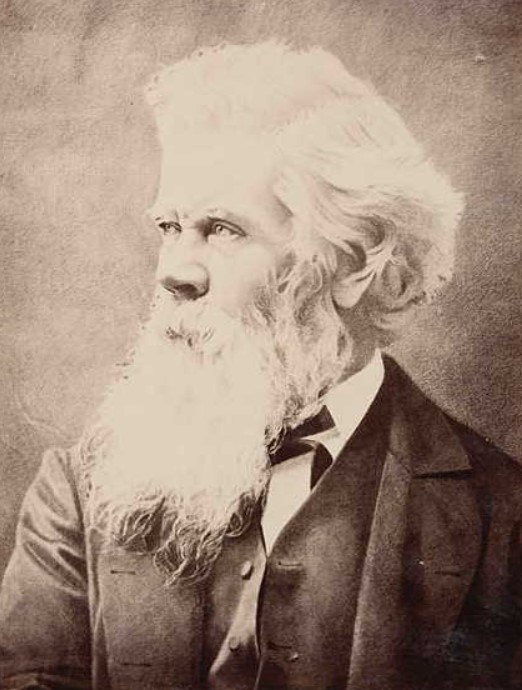
Sir Henry Parkes is one of the titans of early Australian history in that he was the premier of the Colony of New South Wales four times and gave the Tenterfield Oration in 1889 which directly led to the federation of Australian colonies that began two years later in 1891. So much so that Parkes is often referred to as the ‘Father of the Federation’ in Australian history.
What many Australians don’t know however is that Parkes had… shall we say… views about the jews which are expressed in his letters that were then published late in his life. Publicly Parkes supported freedom of religion and the general liberalism of the age, (1) but privately Parkes held stronger views which we can see in his letter of 25th March 1839 where he writes:
‘I hope you will enjoy health and unlooked for prosperity till you hear from me again, and till I hear from you, I have not much more time now. If any of you should ever have to come to London you cannot do better than to get lodging, if you can, at our house in Kirby-street, but I will give you another address, in case Irvines should be gone away: Mr. Stentake, tailor, Red Lion Court, Charter House Lane. This is where Hornblower lodges, and they seem to be very decent people—a sort by no means very common in London. Kirby-street, Hatton Garden, is a very respectable street, but London is such that the next street to it is full of thieves, Jews, and evil persons. The name of it is Field-lane. You will remember this if you should ever read ‘Oliver Twist.’’ (2)
Here we can see that Parkes refers to jews as being – in essence – ‘evil people’ and/or criminals because he refers to London being the kind of city where a nice street (Kirby Street) is next to an bad street filled with all sorts of evildoers such as thieves and jews.
Hardly the nicest commentary from Parkes and we can also see that he associates jews with a lack of masculinity and weak men in general since he writes on 31st March 1839 that:
‘Came to anchor, after tacking about all night, at Plymouth. There is a Mr. Walker, from Newbold, Warwickshire, a cabin passenger, and some men whom he has engaged in the steerage. There is also a Mr. Badham, from Birmingham. And there are many farm labourers from Sussex in the steerage—a very rude set. There are some Irishmen and some Scotchmen. Some of the steerage passengers, I believe, are going to leave us at Plymouth, among them a young foppish Jew from London, heartily tired of the journey already.’ (3)
We then read in Parkes’ letter from 7th April 1839 that:
‘We have nearly all our passengers on board now. A boat load of Irish ‘real emeralds,’ as the surgeon called them, came last night. A young Jew from London forfeited his passage money and left the ship the other day, heartily tired of it.’ (4)
So put another way: the ‘young foppish jew’ – meaning a young delicate feminine-acting jew – was regarded with disdain by Parkes – especially when compared to the bawdry and manly ‘farm labourers from Sussex’ and ‘Irish ‘real emeralds’’ – because he was too weak and delicate to undertake the voyage of Australia and ended up fleeing the boat after a few days on board.
In essence then we can see that Parkes really didn’t have much time for – nor like – jews who he considered to be ipso facto ‘evil people’.
References
(1) Sir Henry Parkes, 1892, ‘Fifty Years in the Making of Australian History’, 1st Edition, Longmans, Green & Company: London, p. 325
(2) Sir Henry Parkes, 1896, ‘An Emigrant’s Home Letters’, 1st Edition, Angus & Robertson: Sydney, p. 77
(3) Ibid., pp. 81-82
(4) Ibid., p. 85
Karl’s SubstackRead More








 T1
T1