US Trade Deficit Collapses In October: Structural Shifts In Global Trade Revealed
Submitted by Thomas Kolbe
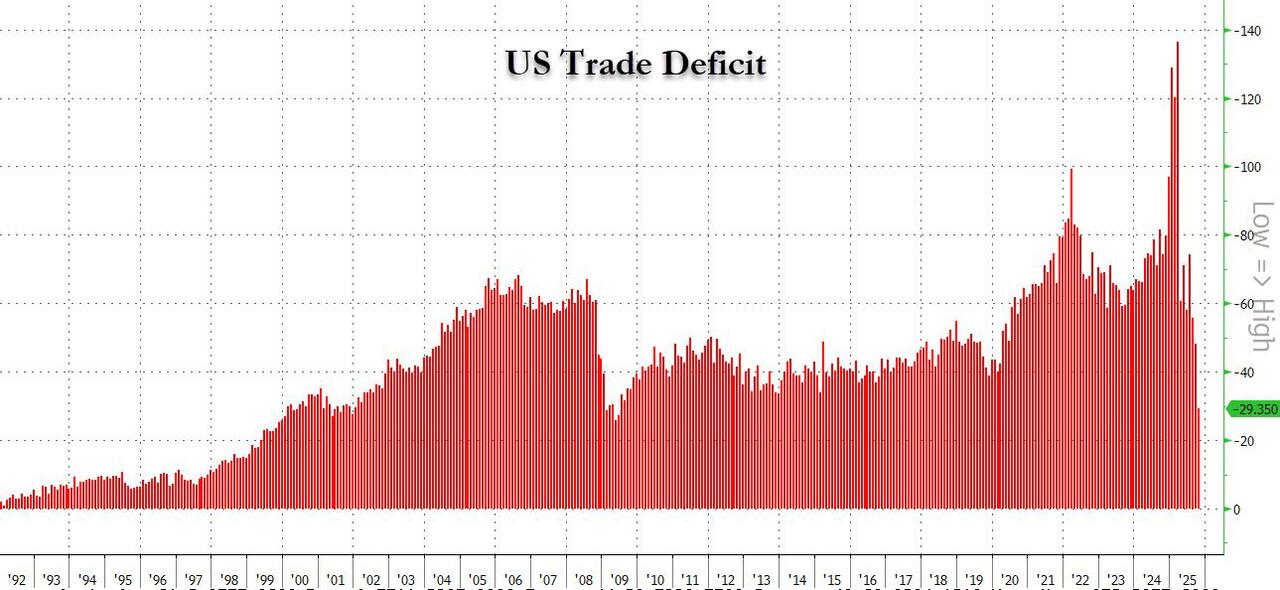
The US economy managed to drastically reduce its trade deficit in October of last year. Data delayed due to the government shutdown highlight structural shifts in the global trade landscape.
Reducing the massive trade deficit has been a primary goal of the US government’s economic agenda under President Donald Trump. This deficit is almost a mirror of the industrial weakness of the US economy in international comparison. It is also a consequence of the US dollar’s role as the global reserve currency. High demand for dollars facilitated imports and encouraged decades of outsourcing American industrial production to other locations.
In the year prior to his 2024 inauguration, the deficit reached a staggering $918 billion – roughly equivalent to China’s trade surplus.
The months-delayed surveys by the US Chamber of Commerce – a result of the prolonged government shutdown last year – now provide an insightful snapshot for October. During that period, the US trade deficit fell from $48.1 billion to just $29.4 billion, while markets had priced in a deficit of nearly $60 billion.
With the data lag now accounted for, several factors become clear.
Restrictive Trade Policy and Reindustrialization
One key driver is the US government’s restrictive trade policy. Tariffs make imports more expensive and have pushed down trade volumes with China, a topic heavily debated politically between Washington and Beijing. In this context, Trump’s trip to the Arab Gulf states is notable, culminating in investment pledges of hundreds of billions of dollars for American industrial production.
Trump is tackling the trade deficit on two fronts. US industry, which recently accounted for only about 10 percent of GDP, is being systematically rebuilt. This is particularly evident in massive investments in artificial intelligence and energy sectors.
At the same time, China, with its heavily subsidized export machine, is forced to pivot to other markets – increasingly putting pressure on the European Union.
The so-called inventory cycle effect is likely reflected in the Chamber of Commerce numbers. Due to US tariff policies, companies pulled imports forward along supply chains to hedge against potential price increases and supply risks. This effect is now reversing, showing up as declining import demand.
LNG Exports and Economic Warning Signals
Another obviously relevant factor is the export of liquefied natural gas (LNG), which the US government strategically uses as a geopolitical lever. LNG exports rose 25 percent last year to 116 million tons. Germany, in particular, has been involved in this trade since the halt of cheap Russian gas imports, facing a significantly higher price for US LNG.
Depending on market prices – estimated between $8.5 and $9.5 per MMBtu – the value of US LNG exports is likely well over $50 billion.
Another less-discussed factor potentially affecting the trade balance lies beneath the surface, in the middle- and lower-income brackets in the US. Private households may have curtailed demand due to persistently high prices, which could also influence the trade figures.
However, this effect is expected to moderate given the continued high growth momentum of the US economy. In the last two quarters of the previous year, GDP grew at an annualized rate of roughly 4.5 percent, while domestic energy prices continued to decline. Additionally, as part of the government’s deportation measures, property prices in some regions have reportedly started to ease. The US government recently reported the repatriation of roughly 2.6 million previously illegally residing immigrants. This could dampen rent and housing costs, easing the financial burden on households.
The International Monetary Fund (IMF) projects global economic growth of around 3 percent this year – well below the historical trend of 3.5–4 percent. Yet dynamic indicators, such as shipping indices, suggest a tentative recovery in global trade. The reference “Drewry World Container Index (WCI)” has shown early signs of improvement along main routes connecting China, the US, and European ports.
Apparently, companies along global supply chains have adapted to US tariffs and are gradually returning to normal operations.
German Exports Sluggish
Germany’s export sector performed modestly last year. Nominal exports rose 0.6 percent to roughly €1.6 trillion, while volume-adjusted exports lost about 2 percent.
The reasons are well known: the energy crisis and declining competitiveness weigh heavily on industrial core sectors. Structural pressure is most visible in the automotive and machinery industries. Consequently, Germany’s trade surplus with the US shrank by 7.3 percent.
Even sharper declines occurred in China, where German exporters lost around 10 percent of business volume. Meanwhile, Germany’s imports rose 4.4 percent year-on-year, notably driven by Chinese capital goods. This suggests a reversal in knowledge transfer: China is increasingly a technology exporter rather than merely the global “low-cost factory.”
For the full year 2025, pending final monthly data, Germany’s trade surplus is expected at roughly €195 billion – the lowest since 2012, excluding the exceptional Corona lockdown year.
* * *
About the author: Thomas Kolbe, born in 1978 in Neuss/ Germany, is a graduate economist. For over 25 years, he has worked as a journalist and media producer for clients from various industries and business associations. As a publicist, he focuses on economic processes and observes geopolitical events from the perspective of the capital markets. His publications follow a philosophy that focuses on the individual and their right to self-determination.
Tyler Durden
Sat, 01/10/2026 – 10:30ZeroHedge NewsRead More






 T1
T1