
In Some Minnesota Schools, The Focus Is Reading, Writing, And Resistance
Authored by Aaron Gifford via The Epoch Times,
In the Twin Cities, schools play a key role in fostering a culture where resistance and anti-authoritarianism thrive.
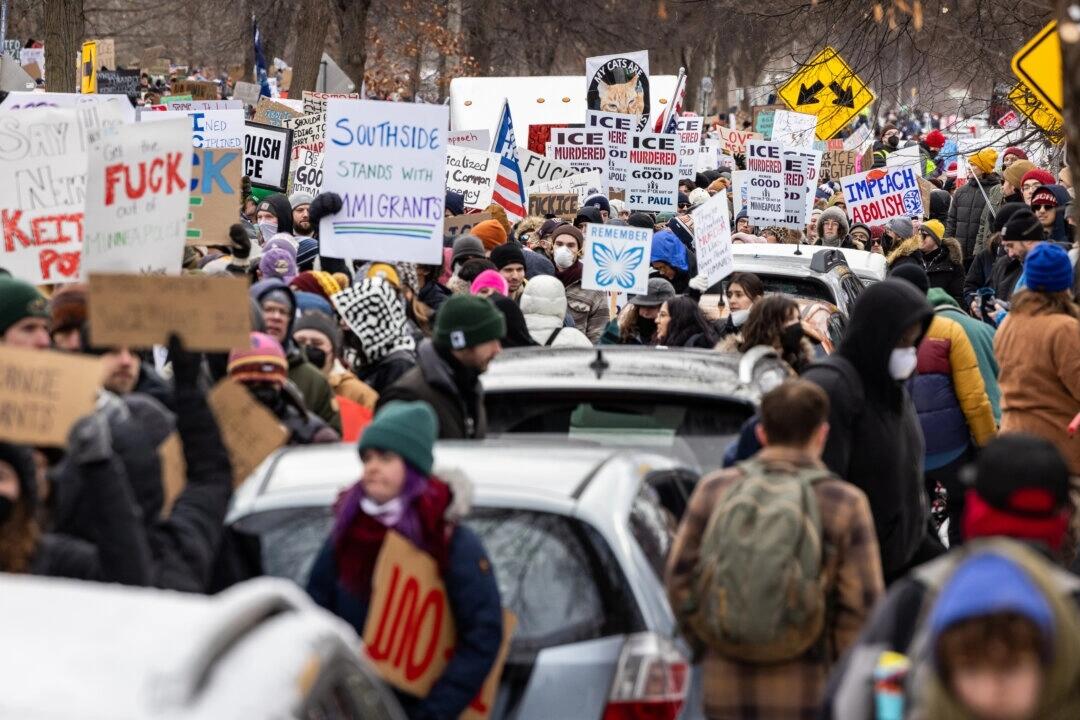
A Minneapolis charter school located near where 37-year-old Renee Nicole Good was shot and killed last week by an Immigration and Customs Enforcement (ICE) agent is centered on social justice and has a long history of left-wing political activism, according to its website.
“We integrate social justice into every grade level, telling the stories of the people, not the people in power, and helping students understand history and their role in making the world a better place,” says the website for Southside Family Charter School.
The ongoing ICE protests coincide with a new statewide mandate requiring ethnic studies, which the state Department of Education defines as analyzing ways in which “race and racism have been and continue to be social, cultural, and political forces, and the connection of race to the stratification of other groups.”
Around the time of the Black Lives Matter protests in 2020, several schools in Minneapolis and St. Paul took it upon themselves to require one high school semester of ethnic studies courses before it became a state mandate.
The ethnic studies offerings in the Minneapolis district currently include a course on race and identity, and “culturally sustaining” African American, Chicanx/Latinx, American Indian, Asian American, Hmong, and Somali studies, according to its website.
Moreover, private schools and taxpayer-funded charters like Southside attract families seeking more progressive social justice-related curriculum than the public schools offer.
“Activist-bent parents chose the school knowing what they’re going to get,” Katherine Kersten, a senior fellow at the Minnesota-based Center of the American Experiment think tank and policy center. “Kids are being told to study left-wing activism and view the activists as models to follow.”
Other Twin City area schools that prioritize social justice beyond the level of traditional public schools include the St. Paul School of Northern Lights, the Angela Day School for Liberation and Progressive Education, and the Prairie Creek Community School.
Kersten said “identity and resistance” are two main pillars of the ethnic studies mandate. Approved instruction for stand-alone high school ethnic studies courses that must be implemented ahead of the fall semester—in addition to the embedded requirement for all other subject areas in K–12, as they are reviewed and then updated periodically—most likely include definitions and examples of identity and resistance, she said.
University of Minnesota’s Center for Race, Indigeneity, Disability, Gender, and Sexuality Studies developed a free curriculum for the state mandate endorsed by teachers unions and state officials. Its middle school instructional materials, “Protest Art & the Movement for Black Life,” require students to learn about the 13 guiding principles of the Black Lives Matter movement, create protest art “for a cause of their choice,” and “describe how mural artists transformed the landscape of Minneapolis during the 2020 Uprising,” according to the center’s webpage.
This kind of classroom rhetoric only emboldens anti-authoritarian sentiment in the community, even if protesters don’t fully understand their cause, Kersten said.
“We’ve seen people crossing the line, and destruction of property, and our elected leaders are encouraging this—[saying] that authority figures are racist and that this resistance is noble,” she said. “To have the state working with and relying on some of the most extreme, self-interested activists to create standards is so egregious.”
Kersten’s organization is urging public school districts across Minnesota to consider less extreme instructional materials that are endorsed by nonpartisan academic institutions and will still meet the state requirements, including 1776 Unites and the Foundation Against Intolerance and Racism (FAIR), both of which oppose identity politics.
The Center for the American Experiment recently presented its suggested instructional materials to Anoka-Hennepin schools, the largest district in the state, and was greeted outside by a long line of protestors summoned from Minneapolis and St. Paul, Kersten said.
“Anyone who criticizes is automatically called a racist,” she said, adding that, beyond a few parents who took advantage of a state law that allows them to opt their child out of instructional materials they find objectionable, there has been very little pushback against Minnesota’s ideological education movement.
“It’s so damaging to celebrate these events as a great Civil Rights statement,” she said. “It’s important for schools to push back and make the case for reasonable academic learning.”
In social media posts last week, Rep. Buddy Carter (R-Ga.) called on the executive branch to revoke all federal funding to the Southside Family Charter School.
“This institution radicalizes students and pushes a left-wing agenda that demonizes ICE agents,” his Jan. 9 posts on Facebook and X said. “The federal government should not subsidize anti-American education.”
The Epoch Times reached out to the Southside Family Charter School, Gov. Tim Walz’s office, the Minnesota Department of Education, and the Minneapolis and St. Paul school districts. No responses were received in time for publication.
Tyler Durden
Wed, 01/14/2026 – 13:55ZeroHedge NewsRead More






 T1
T1