Auschwitz’s Crematorium I – and its first true alleged ‘gas chamber’ – that is in the Auschwitz I camp is equally famous to revisionists – it is the site of the famous ‘wooden gas chamber door’ as well as the just as famous unconnected chimney that was rebuild by the Soviet Union for propaganda purposes – and almost completely unfamiliar to the orthodox ‘Holocaust’ crowd.
This is because in the words of the great Carlo Mattogno in his study of Crematorium I:
‘Official historiography affirms that, because the basement of block 11 caused too much time to be lost in ventilation, the homicidal gassings were subsequently moved to the morgue (Leichenhalle) of crematorium I, the old crematorium (altes Krematorium) at Auschwitz, and that this space was then equipped with a ventilation device to make it suitable for such a purpose. There is, however, no trace in the documents of any such criminal use of this hall.
Initially at least, the homicidal activity, which allegedly went on in this morgue, is said to have been of an experimental nature aiming at a refinement of the method used. As in the case of the “first gassing,” this activity rests entirely on testimony. In view of the total absence of documentary confirmation, this alleged milestone of the official history of the camp was for decades relegated to the murky sidelines of historical research, generally dealt with in a few pages, if not a few lines of text.’ (1)
In essence Crematorium I was – according to the documentation anyway – exactly what it appeared to be: a morgue with an attached crematorium serving as the most expedient way for the German authorities to deal with the numerous deaths that occurred in the rapidly growing Auschwitz camp complex.
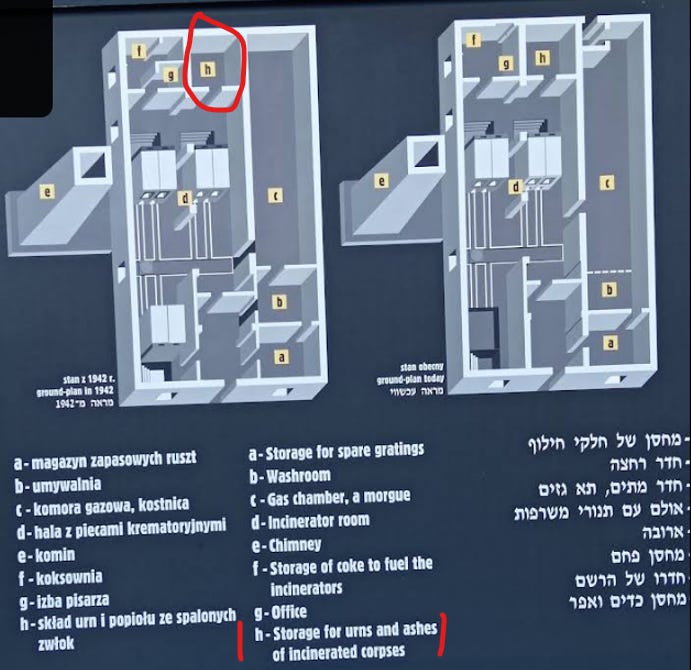
However, something odd is noticeable when you look at tourist photographs of the signage put up by the Auschwitz Memorial Museum at Crematorium I in Auschwitz I (the ‘Stammlager’) since the signs refer to a small room off the main crematorium area and next to Crematorium I’s office.
Namely they refer to it as:
‘Storage for urns and ashes of incinerated corpses’
We can see this in the below tourist photographs from Auschwitz I:
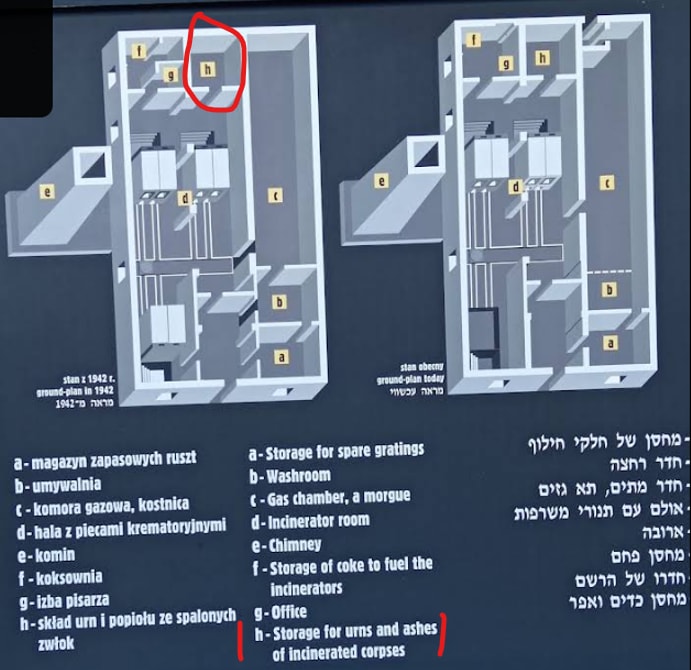
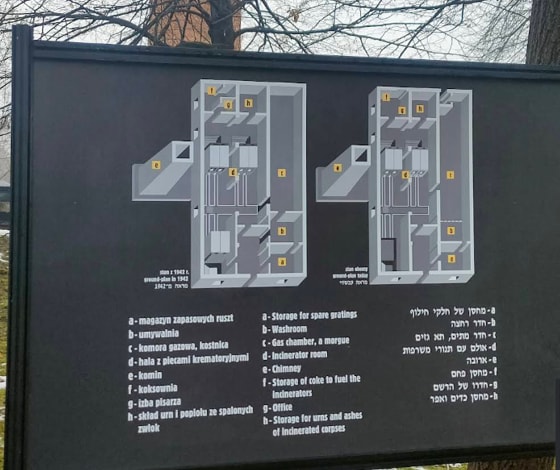
You can see the same informational sign in a different tourist’s photograph:
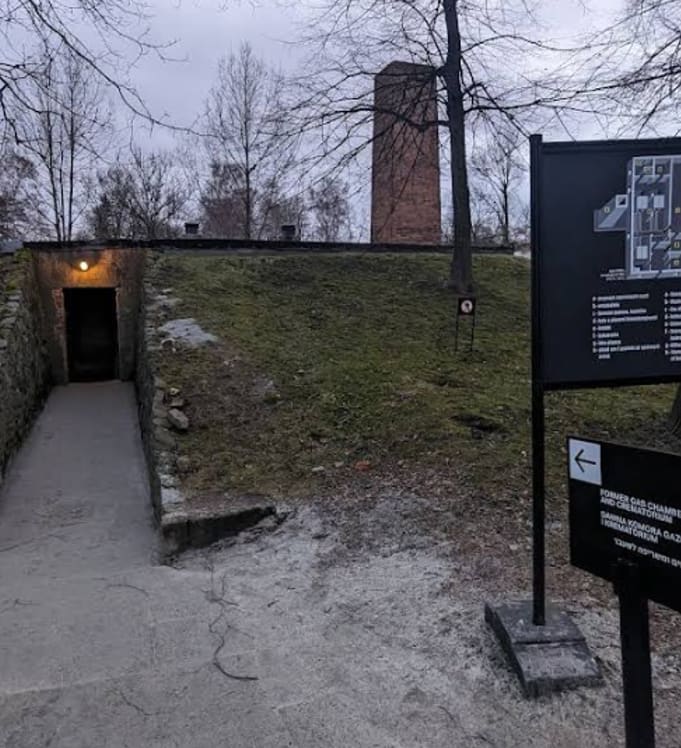
And just to be thorough this is where the sign is at Auschwitz I (right in front of the entrance to Crematorium I):
The ‘urn room’ presents a significant difficulty for conventional ‘Holocaust’ historiography for the obvious reason of… why have it? And more importantly: why keep it?
The conventional answer from the pro-‘Holocaust’ crowd is that the ‘urn room’ was designed and created in Crematoria 1 before the ‘Holocaust’ was contemplated in January 1941 when Crematoria 1’s ‘gas chamber’ was still intended – and used as – a morgue and thus was simply ‘unchanged’ when it was ‘re-purposed into a gas chamber’.
This is based on a communication from the head of construction at Auschwitz – August Schlachter – to the much vilified cremation oven designers and builders Topf and Sons, which reads:
‘On account of the creation of an urn storage room, the morgue changes its layout, as shown in blue in the drawing. The fan with its motor is to be placed in the urn room. The creation of the urn room leads to the change in the design of the air extraction equipment. Moreover, it is desired to attach the furnace hall to the ventilation system.’ (2)
Mattogno describes what happens next as follows:
‘On February 3, 1941, Topf drew up another cost estimate for “1 ventilation system for corpse and dissecting room, 1 ventilation system for furnace room” for a total cost of 2,486 RM. The equipment for the dissecting room and the morgue was the same as before. In addition, there was a blower No. 300 of 3,000 cubic meters per hour against a pressure of 15 mm of water column, driven by a 0.75 HP three-phase electric motor, for the furnace hall. The corresponding ducts started in the center of the hall and had a section increasing from 255 to 300 millimeters. The design probably corresponded to J.-C. Pressac’s drawing: the two blowers stood in the urn room and were connected to a brick chimney rising from this room.
On February 15, 1941, Schlachter informed Topf that he did not want a ventilation chimney. The design would have to be changed with the exhaust air now feeding into the existing chimney.’ (3)
The historical reality is simple enough: Topf wanted to use part of the top of the new ‘urn room’ as a duct to a new ventilation chimney for the morgue and dissecting room – which the ‘urn room’ is next to but Schlachter turned down their proposal and ensured the top of the ‘urn room’ was not used for this purpose and instead all the ventilation of the morgue and dissecting room was ducted out via the existing crematorium chimney.
So how do we know that the ‘urn room’ was used… for… well… urns for the ashes of cremated victims and wasn’t some elaborate blind by the ‘evil Nazis’?
Well one of the principal ‘witnesses and survivors’ of Auschwitz named Filip Muller tells us as much in his ‘witness testimony’ after the war.
He states that that’s:
‘Unterscharfuhrer Grabner was also guilty of sending out urns with the ashes of completely wrong victims, i.e., they filled 3000 urns with ordinary ash, which were then stored in the SS hospital in front of the crematorium, from where they would be sent out upon the orders of the Political Department. I saw Aumeier and Grabner shooting Russian prisoners in Block 11 and Polish political prisoners, too. When Aumeier and Grabner felt that this [shooting] was too slow, they used to beat them before they died and said faster[sic]. When the Polish political prisoners shouted ‘Long live free Poland’ before their execution, they took them aside and shot them in the stomach so that they would lie in agony for two or three hours.’ (4)
We also know from Muller that the multiple crematoria in Auschwitz II worked much the same way since he stated in his testimony that:
‘The work in the Auschwitz crematorium also entailed filling the urns. We filled them with the ash and the dirt from the great pile and closed them with metal lids, on which we embossed the names of the victims, their date of birth and date of death, in accordance with the list we received from the Political Department. The urns were placed into boxes, some 20 x 20 x 40 cm, and labelled with the address of the family. They had to pay 2000 crowns for such an urn. No urns, however, were sent to the families of Jews.
Many such urns were sent to Bohemia, Moravia, and to other countries. But none of them contains the ashes of the person whose name is indicated on the urn.
When I was moved from Auschwitz to Birkenau, there was a store of some 4,000 already filled urns.’ (5)
Mattogno also points out that a lot of the day-to-day function of the Political Department at Auschwitz – the camp’s Gestapo officers (remember Auschwitz contained a lot of political prisoners and the camp’s compliment of Gestapo officers was also concerned with running counter-intelligence against inmate conspiracies to escape and/or launch an uprising using paid informers among the inmates) – was actually policing the morgues and ensuring the bodies of those who had died were duly registered, not interfered with and also had their ashes placed into urns – which the Political Department ordered large numbers of and of which we have extensive records (the first order for urns we know of comes from 5th February 1941 and is for ‘boxes of 100 urns’) – (6) that were then – if we believe Muller – given back to the families of the deceased who had to pay for the urns and the costs of the cremation in return. (7)
The point is that this runs completely contrary to the pro-‘Holocaust’ narrative since the ‘urn room’ never changes function and we have one of their own primary ‘witness testimonies’ testifying that not only did Crematorium I in Auschwitz I have an ‘urn room’ used for storing urns filled with the ashes of dead inmates from the camp but that Auschwitz II’s (i.e. Birkenau) crematoria operated in much the same way.
The evidence on this score is entirely one way: it suggests that the Germans were openly cremating the numerous dead at Auschwitz I (and II), putting their ashes in pre-ordered urns and then selling them back to the relatives of the dead inmates in order to re-coup the costs of the cremation and the urn – as well as presumably the postage – which means that they were – in effect – telling numerous families that their relatives were dead and giving them their remains.
How can you square this with the alleged ‘top secret mass gassing program’ that allegedly occurred at Auschwitz where ‘1.1 million jews were gassed and cremated’?
The honest answer is you can’t because sending urns with ashes out – while it completely explains why there are (relatively speaking) so few ashes documented at Auschwitz – exposes the very program you are allegedly carrying out ‘in secret’.
You can claim based on Muller that ‘no ashes were sent to the families of jews’ which makes sense in that the German policy was the mass internment of jews and their use as labour for the war effort – in other words the rest of their (jewish) families were already in the camps so it was effectively pointless – but the problem with that view is that the Germans were also allegedly gassing non-jews as well at Auschwitz among other camps.
So their ‘genocidal policies’ would have been exposed by the same policy even if Muller is correct – and what he says does make perfect sense on this point – because – contrary to popular ‘Holocaust’ wisdom – non-jews were also allegedly targeted for mass gassing and so their wholesale deaths would have been noticed in the same way the jewish deaths were allegedly noticed.
But yet they were not.
Funny that.
References
(1) Carlo Mattongo, 2005, ‘Auschwitz: Crematorium I and the Alleged Homicidal Gassings’, 1st Edition, The Barnes Review: Washington, p. 9
(2) Ibid., p. 18
(3) Ibid., pp. 18-19; 93-94
(4) Quoted in Ibid., p. 37
(5) Quoted in Ibid., p. 40
(6) Ibid., p. 87., n. 287
(7) Ibid., pp. 86-87
Karl’s SubstackRead More






 T1
T1