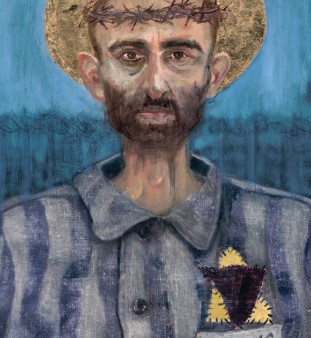
Our next piece of ‘Remarkable Holocaust Nonsense’ is one that I’ve had multiple requests to cover which is the story of how a jew pretended to be Jesus in order to ‘escape the Holocaust’ – in this case Einsatzgruppen A – in Lithuania.
This story is included in Eve Nussbaum Soumerai and Carol Schulz’s book ‘Daily Life During the Holocaust’ but comes from an earlier collection by one Yaffa Eliach titled ‘Hasidic Tales of the Holocaust’ from 1982.
We read that:
‘In her book Hasidic Tales of the Holocaust (1982), Yaffa Eliach tells a tale of a massacre that took place only days before the one at Babi Yar. By the first day of Rosh Hashana (the Jewish New Year), September 25, 1941, the Jews of Eisysky, a small town in Lithuania, had come to realize that they were doomed. Surrounded by Lithuanian guards, working for the Germans, 4,000 Jews and their rabbi, Shimon Rozowsky, dressed in his special Sabbath robes and yarmulke, were told to report to the horse market.
As they had done elsewhere, the authorities separated the men and women, and, in groups of 250, led the people to the Jewish cemetery where their open graves awaited them. The Jews were ordered to undress and line up at the edge of the ditches, and then they were shot in the back of the head.
Sixteen-year-old Zvi Michalowsky stood by his father, a teacher in the village, as they comforted each other and waited for death. But Zvi was also counting the intervals between each volley of shots, and just before he was fired upon he fell into the grave, feigning death. He felt the bodies piling up on top of him, the streams of blood surrounding him, and the trembling bodies below him.
He waited until the shooting had ended and proceeded to dig his way to the top of the grave. Naked, cold, frightened and covered with blood, he headed for the houses of Christians he had grown up with. At the first house, he knocked. The peasant who lived there came to the door and shined his lamp on Zvi.
“Jew, go back to the grave where you belong!” was Zvi’s greeting, as the door was slammed in his face (Eliach, 1982, 54). Next, he tried the home of a widow he knew; but she chased him off with the same words, brandishing a burning stick after him as if he were the devil himself.
Zvi stopped abruptly, faced her, and shouted “I am your Lord, Jesus Christ. I came down from the cross. Look at me – the blood, the pain, the suffering of the innocent. Let me in” (1982, 55). Awestruck, the widow believed him. For three days she cared for him and kept him hidden, in exchange for his promise to bless her and her children. Then dressed in borrowed clothing, with a small supply of food, he left, swearing her to secrecy. He survived the war by living with other partisans in the forest.’ (1)
Now obviously this tale is confabulated as it is a typical ‘Holocaust miracle’ tale in the sense that it has the plucky jew outfitting the ‘evil Nazis’ and then going to ‘Christians he’d grown up with’ for the shelter only for the Christians to be evil and then be reminded by the ‘miracle’ that ‘Jesus was a jew’ and therefore as a jew Zvi was Jesus.
The story of how Zvi was ‘knocking on doors and was driven away’ is clearly lifted from the common Christian nativity trope of Joseph and Mary asking various innkeepers ‘Do you have room in the inn?’ for them to stay and for Mary to give birth to Jesus.
This in turn based on Luke 2:7:
‘And she gave birth to her first-born son and wrapped him in swaddling cloths, and laid him in a manger, because there was no place for them in the inn.’ (2)
The idea that Zvi then turns around and declares ‘He is Jesus’ to his unjust persecutors is also obviously taken from Fyodor Dostoevsky’s ‘novel within a novel’ ‘The Grand Inquisitor’ which features just this kind of scenario where the persecutor realises that the persecuted and/or from Leo Tolstoy’s widely-read works and stories that also harped on the theme of the ‘persecuted stranger’ being God/Jesus/an Angel (for example ‘Papa Panov’s Special Christmas’ and ‘My Religion’).
So, what we have in truth here is not an actual account of how Zvi Michalowsky ‘survived the Holocaust’ but rather a confabulated pro-jewish morality tale filched the Gospel of Luke and the works of Fyodor Dostoevsky/Leo Tolstoy.
A jew making up stories?
How rare!
References
(1) Eve Nussbaum Soumerai, Carol Schulz, 2009, ‘Daily Life During the Holocaust’, 2nd Edition, Bloomsbury: London, pp. 122-123
(2) Lk. 2:7 (RSV)
Karl’s SubstackRead More






 T1
T1