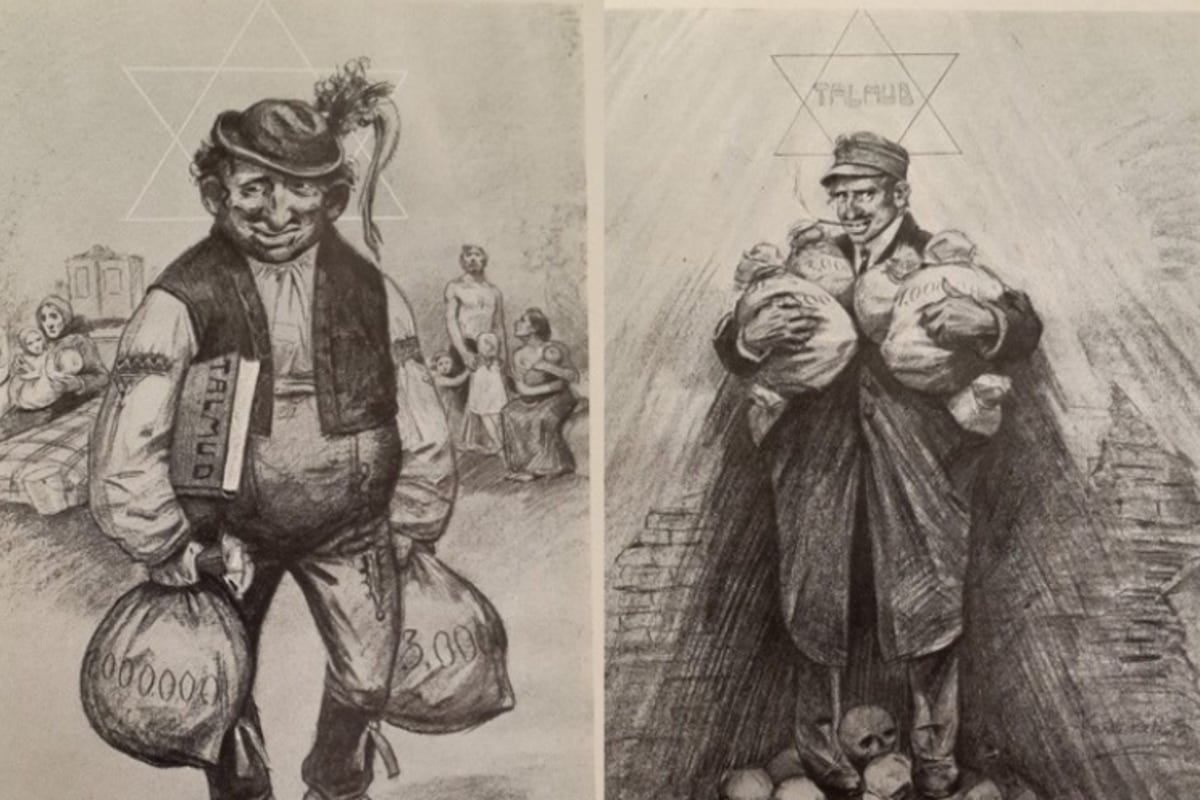
These examples may suffice to vividly bring to mind the strangeness of the jewish mind. How was it possible that products of such a nature that were inherited, discussed and jealously guarded for thousands of years could have been pointed to as a religious and moral book?
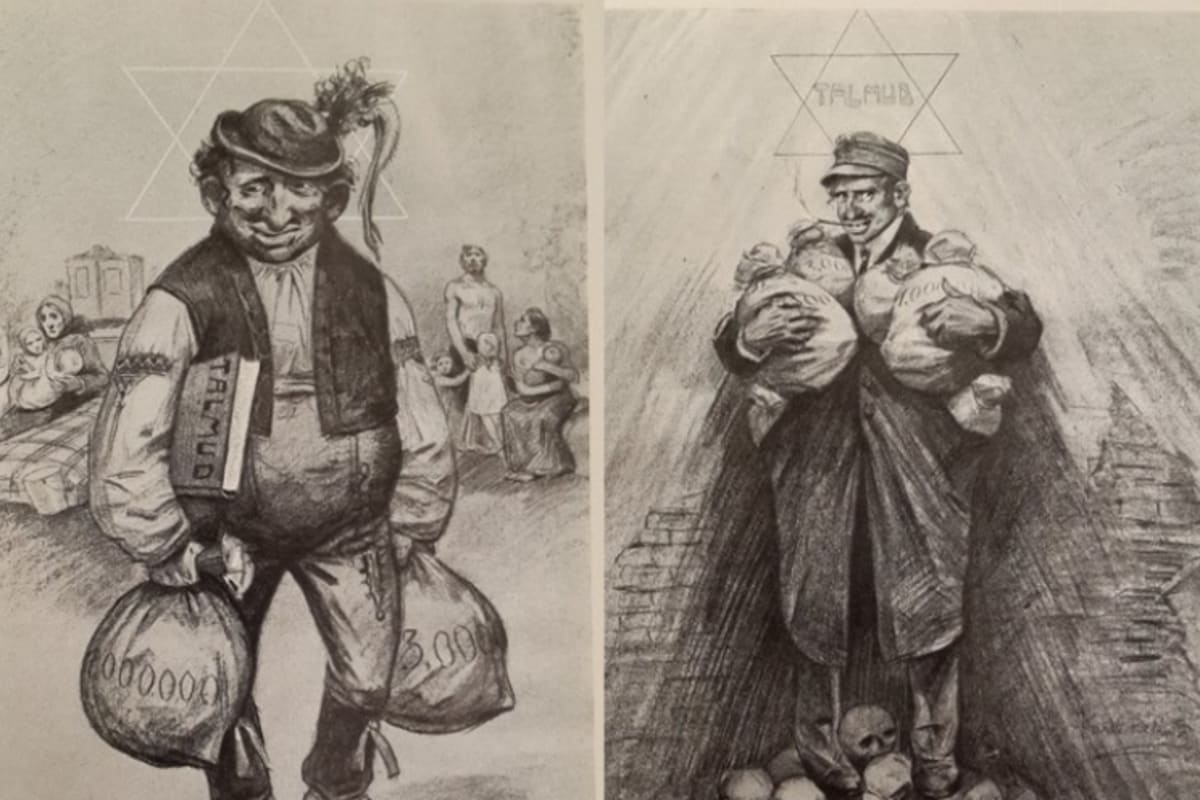
If we wish to form for ourselves a judgment on the character of the jewish mind we must necessarily go back to that work which is the monumental expression of it and which even today, as we said, is respected by two-thirds of the entire jewry as absolute and untouchable: the Talmud.
Something has already been said about it, that is, its moral laws were briefly mentioned. Now I would like to illuminate some other pages. And even if disgusting things must be set down in writing, that is unavoidable if one wishes to see all that can be found in a “religious book”.
It is indeed the strange thing about the judgement of our contemporaries that they consider the Talmud as a religious book fighting against which would be backwards and indicative of intolerance. But if one reads the innumerable tractates, one is astonished to find next to nothing of religion, or at least of religion as we understand it. There, no metaphysical thought emerges, no search for a solution of the riddle of life, no image that can illustrate our secrets to us, no insight, no mystery. Everything is self-evident and clear.
The world has been created out of nothing by the god of the jews, the people who should rule the world and to whom every created thing belongs by right. That is the “religious” foundation. Alongside moralising absurdities and crudities appear hair-splittings of a quasi-pathological madness that one would resist taking seriously if they did not come from the mouths of the rabbis revered by the jews.
Some examples of this:
“When Solomon was in his mother’s womb he started singing a song as it says in Ps. 103,1: ‘Let my soul praise the eternal and my entire inner being thy holy name.’”
“When he sucked at his mother’s breast and observed the breast, he started to sing a song, v.2329: ‘Let my soul praise the eternal and not forget all his good deeds.’
According to Rabbi Abahu, the words ‘good deeds’ mean that god has set her breasts in the place of reason or that he (Solomon), as Jehuda thinks, does not look at a place of shame, or, according to Rabbi Mathna, so that he may not suck at a place of shame.
Gen. 2:22: “And the eternal god formed the rib. Rab and Samuel are of differing opinions on that. According to one, it was a face (from which something was formed), according to the other, it was a penis.
But it is right according to one of them, since it says in Ps. 139:5:
‘Thou has formed me front and back’, but what will the citation mean according to the one who supposes that it was a penis?”
Rabbi Gamliel: “One day every woman will give birth daily, since it says in Jer 3 1 :8: ‘pregnant women and women in labour.’
One day the trees will bear fruit daily since it says in Eze 1 7:23 : ‘it will produce branches and bear fruit’.”
Rabbi Jeremiah: “The first man had two faces, Ps. 139:5: ‘You have formed me front and back.’
Rabbi Samuel: “Why were the words of the Torah compared to the gazelle?” “To tell you, ‘Just as the gazelle has a slender body and seems every hour to her man as dear as in the first hour, so also are the words of the Torah to its keepers as in the first hour.’”
Rabbi Eleazar: “When it says mDeut. 6:5: ‘You must love the Eternal, thy God, with thy whole soul’, why then does it say also ‘with all your possessions’? It means that there are many men to whom their body is dearer than their money, that is why it says: ‘with thy whole soul’, and again, that there are many men to whom their money is dearer than their body, that is why it says, ‘with all your wealth.’”
That the word ‘possessions’ is taken here in its literal sense as cash is significant, just as also nothing is said of the soul that one loves more than body and money.
Rabbi Papa: “If one has eaten or drunk out of a paired dish or beaker, how does one prevent the evil consequences? One grasps the thumb of one’s right hand with the left hand and the thumb of the left hand with the right hand and speaks thus: ‘You and I are three.’ But if one hears it said, ‘You and I are four’, then one says, ‘You and I are five’, etc.
“It is said in Jon 2:1: ‘Then the Eternal presented a great fish to swallow Jonah’. But it says in v.3: ‘And Jonah prayed to the Eternal to go out from the stomach of the fish and said: “I have called on the Lord from my confinement’”. There is no doubt; perhaps the great fish spat him out and the small fish swallowed him.”
Rabbi Meier: “Whence can it be proved that even the embryos in the mother’s womb began to sing a song? Because it says in Ps. 68:27: 339 ‘In the congregations praise the Lord God, from the womb of Israel.’”
“When a scratch blisters, one blows the trombone on Sabbath. But we have learnt: When other punishments are aroused and attack all, e.g., itches, grasshoppers, mosquitoes, one does not blow but cries (prays) to God? There is no question, it is only a matter of whether the itch is moist or dry.”
Rabbi Jehuda said: “One places in the synedrium (council) only such a man who is able to clean out (through conclusions) the worm from the Torah.”
Rabbi said: “I can pronounce it clean through conclusions. If even a snake, which kills or increases impurity thereby, is clean, then the determination is certainly valid in relation to a worm that does not kill and does not increase impurity!” That is not tenable since it (the snake) is only like a thorn (which can kill us and is nevertheless clean).
And it says in Ex. 8:2: “And the frog came up and covered Egypt.” According to Rabbi Eleazar it was just a frog but it multiplied and filled the entire land of Egypt. But the Tannaites are of an entirely different opinion on that.
Rabbi Akiba says: “It was only one frog and this filled the entire land of Egypt”. Then Rabbi Eleazar ben Azaria said to him: “Akiba, what do you have to do with the Haggadah?344 There was only one frog but it whistled to the others and they all approached.”
I break off these clever hair-splittings, they suffice to demonstrate palpably their intellectual emptiness. But one point must still be emphasised. A large space is taken up in all their utterances by sexual questions, we have seen some examples already. But how they are handled is characteristic. Not with a natural sensuality, and even not with the objective neutrality of a hygienist but with the repulsive lecherousness of bald old men who cannot do enough in the imagination of sexual activities. The pen hesitates to write down such citations but there remains nothing else to do in order to refute the complaint of having done an injustice.
BELOW: Unmoral im Talmud, München 1933

Rabbi Chama: “The one who sets up his bed between the north and the south gets children of the male sex,” as it says in Ps. 17:14: ‘And with thy ‘treasure’ thou fillest their wombs, they will have an abundance of children.’”
Three things are an illustration of the future world, the Sabbath, the sun and service. Of what sort? If they meant the service of the bed (sexual intercourse), this surely becomes weak? Only the service of the opening of the woman is meant.
Woman is a tube full of vituperation whose mouth is full of blood. Rabbi Jochanan: “Every woman who invites her husband to sexual intercourse gets children of a kind that was not existent even in the age of Moses.”
The wives of the uneducated are vermin and of their daughters it is said Deut. 27:21: “Cursed is one who lies with a cow.”
One who deals with the Torah in the presence of an uneducated person is considered as if he lies with his betrothed.
The rabbis have taught: “The one who has sexual intercourse in a bed where a child is sleeping gets epileptic children.”
To Ben Soma was posed the question: “Can the high priest take a virgin who has been made pregnant or is that not to consider what Samuel said: ‘I can lie with many virgins without blood’ or does what Samuel said not occur?”
He answered them: “Of course what Samuel said does not occur but it is to be feared that she may have become pregnant in a bath. But Samuel did indeed say: ‘Every one who has sexual intercourse whose seed does not shoot like an arrow does not impregnate’. Then he must have been ready like a shooting arrow.”
The elders said: “Those emitting sputum, lepers, and such persons as are close to menstruating women are permitted to read from the Pentateuch, the Prophets and the Hagiograph, only the emitting of seed is forbidden.”
Elia: “Why does the messiah not come? See, it is now the day of reconciliation, I can lie with such and such women.”
Then Rabbi Jehuda asked him:“What does the Holy then say?” He replied: “He says in Gen. 4:6: ‘Sin lies at the door.’” “And what does Satan say?” And he replied: “Satan has no power on the day of reconciliation.”
Rabbi Simeon: “A proselyte who is less than three years and a day old is suited for the priesthood (i.e. the priest may lie with her)” for it says Num 13:18: ‘And all female children who have not lain with a man, may they live for you.’” “One ‘beaker’ is beautiful for a woman, two ugly, with three she demands it (without castigating) with her mouth,with four she takes the donkey to the market (for her satisfaction).”
Rabbi Johanan: “Crippled children are born because their parents turn the tables (their position in coitus) upside down; dumb children are born because they kiss that place (the genitals); deafmute children are born because they chat during intercourse; finally, blind children are born because they look at that place.”
Rabbi Jochanan: “Rabbi Ishmael’s penis was as big as a tube of six kabs.
Rabbi Papa: “Rabbi Jochanan’s penis was as big as a tube of five kabs,” according to others three kabs. Rabbi Papa’s penis was as big as the baskets of the inhabitants of Harpania.
Every criminal (simri) lay on this day with the Medianite woman 424 times, and Pinchas waited for one so long that his power was weakened. Pinchas did not know that the strong king (God) was with him.
It is indicated in a Boraitha: “He lay with her 60 times until he became like a rotten egg and she like a bed full of water.”
These examples may suffice to vividly bring to mind the strangeness of the jewish mind. How was it possible that products of such a nature that were inherited, discussed and jealously guarded for thousands of years could have been pointed to as a religious and moral book?
Here it must be determined once and for all that all that is written down in the Talmud is derived from a spirit that is hostile to us. It is a specifically jewish characteristic.
“One thing is certainly clear,” says the jew Dr. Bernfeld, “that the oral teaching is most intimately connected to the jewish race, it is bone of its bone, flesh of its flesh.”
And the jewish historian, M. Kayserling, rises to a eulogy in calling the Talmud “the greatest work admired for thousands of years, and the likes of which is not to be found in any literature.” So think all Hebrews.
There has hardly been a more tolerant man, hardly one who was so inclined to blur and deny the individual differences in the character of peoples, than Tolstoy. With endless repetitions he preached (that is, in his letters) the similarity of thought in China, India, Judaea, Europe.
But after he left his airy castle built on the dogma of the equality of men, and observed more closely the works of man, the great man came however to other results. In the study of the New Testament, he reports, he felt like a pearl-fisher who throws his net for precious mussels but draws with them at the same time slime and dirt from which he had to first release the former. “And so 1 found next to a pure christian spirit an alien dirty jewish spirit.”
Schiller felt great reverence for many figures of the Old Testament, that is, for the personality of Moses, but he already differentiates with a sure instinct (without a closer knowledge of the actual contexts) between the “unworthiness and reprehensibility of the nation” and the “merit of their law-givers.” He calls the jew an “impure and base vessel” in which however something precious was preserved which could later ripen “in brighter minds”, an “impure canal” through which the most noble of our possessions, the truth, was conducted, which however broke once it had performed that which it had to.”
Goethe said that the contrast between the present-day jews and their “forebears annoys us.” Both the great men therefore have a markedly contradictory attitude towards the jewish past.
But this must be dispelled when, as we know today, the great men of the Hebrew past were not at all the forebears of the present-day jews, that judaism is a very late product. Even Moses (even the name is not Hebrew) is, according to Egyptian representations, an escaped Egyptian priest named Osarsiph.
No, the jew has not been “broken,” the canal was completed in its formation ever since the Exile and indeed already earlier, it has only become stronger and more pronounced.
This instinctive aversion of Tolstoy, Schiller and Goethe, to name only a few great men, every person must feel who has gone closer into the jewish intellectual products and has still preserved his natural feeling: the above examples from the Talmud should prompt one to do so. The jew will describe us as “total Philistines,” which we, according to Abraham Geiger, are completely, then we are further branded by the disciples of Graetz as the “most limited of all peoples,” but that cannot disturb us.
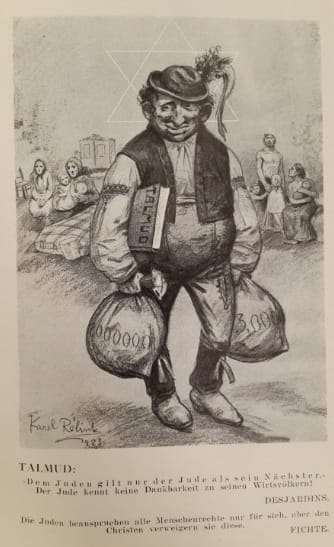
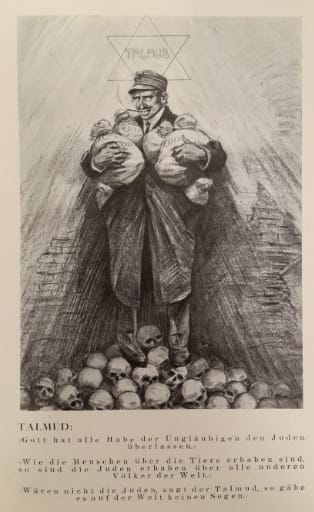
SOURCE: The Track Of The Jews Throughout The Ages
Found at https://www.renegadetribune.com/alfred-rosenberg-the-talmud/?doing_wp_cron=1768328045.9006099700927734375000
Ava’s SubstackRead More






 T1
T1