
Europe In Decline
By Teeuwe Mevissen of Rabobank
Not even a month ago, today’s author of the Global Daily walked through the main hall of the Musée d’Orsay, admiring its remarkable collection. Among the many sculptures, one large painting by Thomas Couture inevitably draws the eye: Romans in Their Decadence.
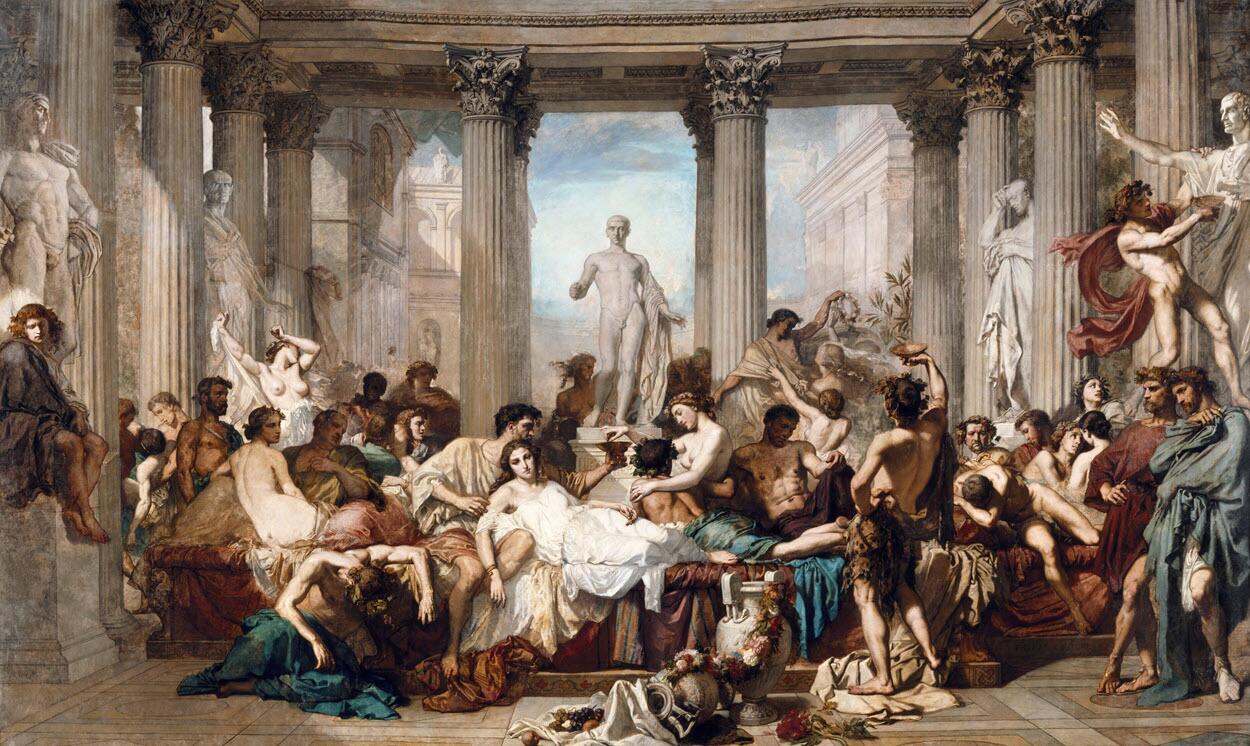
At first glance, it appears to depict Roman citizens engaged in an orgy, but a closer look reveals far more. Beyond the opulence on display, one sees a figure desecrating a statue resembling a former emperor or deity. Only three figures – the contemplative man on the far left and two men observing with evident disdain on the right – seem detached from the excess around them.
When the painting debuted at the Paris Salon, the exhibition catalogue included a quote from Juvenal:“Nunc patimur longae pacis mala; savior armis luxuria incubuit, victumque ulciscitur orbem.” – “Now do we suffer the evils of prolonged peace; luxury, more ruthless than the sword, broods over us and avenges a conquered world.”
A portrait of Rome in decline. And today, some argue, a portrait of Europe.
Political and economic commentators increasingly draw parallels between today’s Europe and the late Roman Empire. Those who subscribe to the decline narrative point to data showing that Europe’s share of global GDP has fallen from 25% in 1990 to roughly 14% today. Others highlight the innovation gap, demographic headwinds, and the erosion of industrial competitiveness. While these trends worry many, a Wall Street Journal report yesterday added a more urgent dimension: a recent wargame underscored Europe’s vulnerability to a potential Russian attack.
The Dutch Defence Minister noted that “Russia will be able to move large amounts of troops within one year” and that Moscow is already expanding its assets along NATO borders. This alone underscores the perceived urgency amongst European leaders to accelerate efforts to rebuild and modernize its military capabilities – and suggests that Europe’s geopolitical weight has indeed diminished.
Whether Europe is truly in decline remains subject to debate, but equity markets certainly are. And, in fact, particularly US markets this time – with the S&P500 now down 0.7% year-to-date but the European Stoxx 600 index still up 2.8%. Investor sentiment has deteriorated sharply. While the selloff had moderated at the time of writing, US tech stocks experienced steep declines, with Amazon losing 11% in extended trading. Bitcoin also continued its slide, touching lows not seen since October 2024 and barely holding above $60,000. Oil prices remain somewhat elevated, with traders watching closely to see whether the US will take action against Iran in the coming days.
In another Wall Street Journal article, China’s leadership appears to have concluded that the deterioration in U- China trade relations is irreversible and likely to lead to a messy decoupling. This raises important questions about how such a shift might affect China’s broader trade surplus. Here, we argue that China is likely to maintain significant trade surpluses for the foreseeable future. One important reason is that 2025 has demonstrated that it is not so easy to decouple from China; another is that countries like Canada and the UK reconsider their trade relationship with China because of ongoing trade tension with the US.
Turning to central banks: the ECB left rates unchanged yesterday, keeping the deposit rate at 2% for the fifth consecutive meeting. No forward guidance was provided, and the Governing Council judged that risks remain broadly balanced. The ECB struck a generally constructive tone, citing low unemployment, strong private sector balance sheets, and ongoing investment in defence and infrastructure.
However, it also warned of persistent geopolitical risks and uncertainties around global trade policy. Until the data clearly point in a particular direction, the ECB is likely to remain on hold. As expected, questions arose about the recent EUR/USD rally, which briefly pushed the pair to 1.2044 eight days ago , yet President Lagarde remained calm despite acknowledging that a stronger euro could contribute to lower inflation. A full summary of the meeting can be found here.
At the Bank of England, the meeting was more eventful. Rates were held at 3.75%, but the split vote – 5 in favour of holding, 4 pushing for a cut – was unexpectedly narrow, with Governor Bailey casting the deciding vote. This increases the likelihood of a March cut, a view we have held for some time. New guidance that “judgements around further policy easing will become a closer call” triggered a repricing in markets, with the probability of a March cut rising from 20% before the announcement to around 60% at the time of writing. Full coverage of the meeting is available here.
Tyler Durden
Fri, 02/06/2026 – 11:20ZeroHedge NewsRead More








 T1
T1